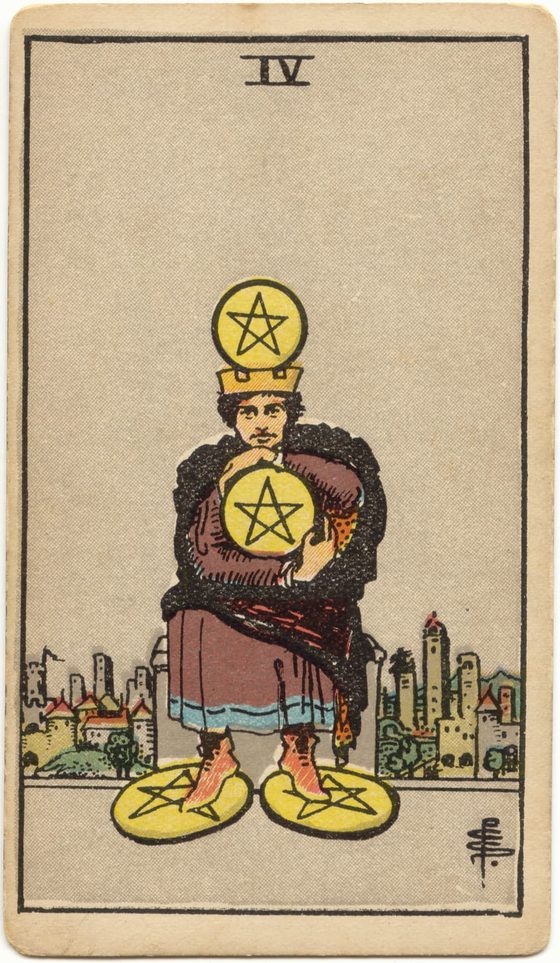
Search for this card and the miser arrives inside two sentences. He is hunched, he is clutching, he will not share, and the reading writes itself: hoarding, greed, a man who needs to open up. It is the most confident piece of character assassination in the suit, and it is repeated so uniformly that it reads like the card's definition rather than one interpretation of it.
It is not what the sources say. Waite's list for the Four of Pentacles contains no moral word anywhere, and it includes gift, legacy and inheritance. The moralising vocabulary is real and it does have a source, but it is a different source, attached to a different claim, and the two got welded together somewhere in the twentieth century. What follows is the lineage, and what the weld costs when the card actually lands in a spread.
What Waite actually printed
The Pictorial Key to the Tarot was published in 1910, the year after Pamela Colman Smith drew the deck. Waite's divinatory meanings for this card run, in full: the surety of possessions, cleaving to that which one has, gift, legacy, inheritance. Reversed: suspense, delay, opposition.
Read the upright list again with the miser in mind. Nothing in it names greed, meanness, or a defect of character. The surety of possessions describes a state of affairs, which is that things are secure. Cleaving to that which one has is the picture put into words, and Waite does it again in his description of the drawing, where the figure holds to that which he has. Then come three words most modern entries drop without mentioning that they have dropped them: gift, legacy, inheritance. Waite's card can perfectly well describe money arriving and being kept. It is not a card about a hoard. It is a card about possession being certain.
The reversed list is stranger, and it is where the modern reading diverges furthest. Suspense, delay, opposition. There is no generosity in it and no release. Waite reversed this card into things not moving, which is close to the opposite of what a reader trained on the miser will reach for.
The Golden Dawn did use the word
Here the honest version gets more interesting than the debunking version, because the moralising is not invented. It has a pedigree.
Book T is the tarot manuscript of the Hermetic Order of the Golden Dawn, dating from around 1888 and circulated privately among initiates rather than sold. It titles the Four of Pentacles the Lord of Earthly Power and assigns it the Sun in Capricorn. Its reading is assured material gain, success, rank, dominion, earthly power, completed but leading to nothing beyond, and then a second cluster: prejudicial, covetous, suspicious, careful and orderly, but discontented.
So covetous is in the record, roughly twenty years before Smith drew the card. But look closely at what those words are doing. Book T is not condemning the possession. It grants the material gain and calls it assured, then describes a temperament that tends to arrive with it, and the actual charge in the entry is the phrase in the middle: completed but leading to nothing beyond. That is a criticism of a position, not of a person. It says the gain is real and the road stops here.
One more fact belongs in this section. Waite was initiated into the Golden Dawn in 1891 and later led a branch of it. He had this material. He knew the attribution and the title and the keyword cluster, and when he wrote his own entry nineteen years later he carried across none of the personality words. That is a choice, not an oversight, and it is consistent with how he handled the rest of the suit.
How the two lists got fused
Book T stayed unpublished until Israel Regardie printed the order's papers between 1937 and 1940. From that point the English-language tarot writers of the middle and later twentieth century had both lists open in front of them, plus Smith's drawing, and the drawing is extremely persuasive: hunched shoulders, locked elbows, a crown above a plain stone block, two coins pinned under the shoes, a city he has his back to.
What survived the fusion was the half of each list that agreed with the picture. Book T's temperament words came over. Book T's assured material gain did not. Waite's grip came over. Waite's gift, legacy and inheritance did not. Strip both lists down to the parts that match a hunched man clutching a coin and you get the miser, and once he exists he is easier to teach than either source, because he needs no attribution and no qualification. That is how a card acquires a personality it was never given. It is worth reading alongside what actually happened in 1909, because the pattern is the same one: the version that circulates is the version that was easiest to repeat.
What the moralising costs upright
A description turned into a verdict, and the two are used differently. A description of a grip invites a question. A verdict answers it, and the answer is that the person holding on is at fault.
The trouble is that the picture withholds the single fact that would settle the matter: whether four coins is a fortune or the last of what he has. A person with four coins and no income is not being greedy by keeping them. Beside Five of Pentacles, the holding reads as a reasonable response to real scarcity. Beside Six of Pentacles, it reads as a refusal to let anything circulate. The card supplies the posture and the spread supplies the grading, and a reader who has already graded it has stopped reading.
The moralised version also has the quality that makes an interpretation hard to check: it fits almost everyone. Most people are holding something they could name, and most people can be talked into feeling slightly guilty about it. A reading that lands that way feels like insight and is not, for reasons set out in confirmation bias and the honest reading.
What it does to the reversal
The clearest damage is here. If upright means greed, then reversed auto-completes to generosity, and the reader stops looking.
Reversed, this card points two contradictory ways. The grip loosens: spending after a long freeze, information finally shared, a position given up. Or the grip tightens past the point of use: suspicion, opportunities refused because taking them would risk what is held, nothing moving. Waite's own reversed words, suspense and delay and opposition, point squarely at the second. The miser reading points only at the first, and it gets there without consulting the spread, which is the one thing qualified to decide. The general case is set out in reversed tarot cards, and how the spread decides, and this card is the sharpest example of it in the suit.
In a love reading
A moralised card hands the reader a motive, and motive is precisely what a card cannot supply.
What the Four of Pentacles describes in a relationship reading is a reserve being kept, and the withheld thing is usually access rather than affection: time, plans, money, the parts of a life that get shared when people commit. That is observable. Selfishness is not. The step from someone is keeping a reserve to they are keeping it because they are selfish is a claim about another person's private reasoning, and it is on the list of things a tarot reading cannot tell you.
The practical cost is specific. Told that the card means greed, a querent hears a verdict on their partner and stops asking the question that would actually help, which is what the reserve is protecting and whether the thing it protects against is still happening. Someone guarding what is left after a real loss is behaving sensibly, and no keyword can tell the difference between that and a habit that outlived its reason.
As someone's feelings
Read as feelings, the moralised card says they do not care about you. The card does not say that, and the difference matters because the two situations call for opposite responses.
What the picture supports is attachment that has gone rigid: they do not want to lose you, and they are not willing to open anything up in order to keep you. That is not coldness. It is closer to fear wearing a very steady face, and it is a common position rather than a rare one. Indifference and frightened attachment produce similar behaviour from the outside and need completely different handling, and the card is the outside. Compare Nine of Pentacles, where someone has enough and is not braced against losing it, which is what this card looks like when the fear is gone.
A test before you call it greed
One question, answered before the keyword: is four coins a lot, here, in this situation, for this person? If you cannot answer it from the querent's circumstances rather than from the drawing, you do not yet know whether you are looking at prudence or a grip, and saying either one is a guess wearing a keyword.
The second thing the moral reading costs is the non-financial version, which it hides completely. Because the card is filed under money, the other grips get missed: a grudge held for years, a story about what happened that has been sanded smooth by retelling, a role in a family that everyone including the person holding it has outgrown. Those are harder to see than a coin and they cost more, and they are what the card is describing at least as often.
What to keep from each source
Keep Waite's neutrality, and keep the three words nearly everyone drops. Gift, legacy and inheritance mean this card can describe something received and kept, which rules out reading the grip as automatically shameful.
Keep the Golden Dawn's real criticism, which is not covetousness but completed but leading to nothing beyond. That one is checkable against a situation. It asks whether the arrangement has anywhere left to go, and a querent can usually answer it.
Discard the miser as the card's identity. Not because the card is never about meanness, but because deciding that in advance removes the only interesting work the card offers, which is finding out which of the two it is this time. The full breakdown, section by section, is on the Four of Pentacles card page, and if you want to see it land in a real position rather than in the abstract, draw a spread and read it against the cards either side of it.