- Card number
- 5
- Arcana
- Minor Arcana
- Suit
- Pentacles
- Element
- Earth
- Rank
- Five
- Yes or no reading
- No
Five of Pentacles
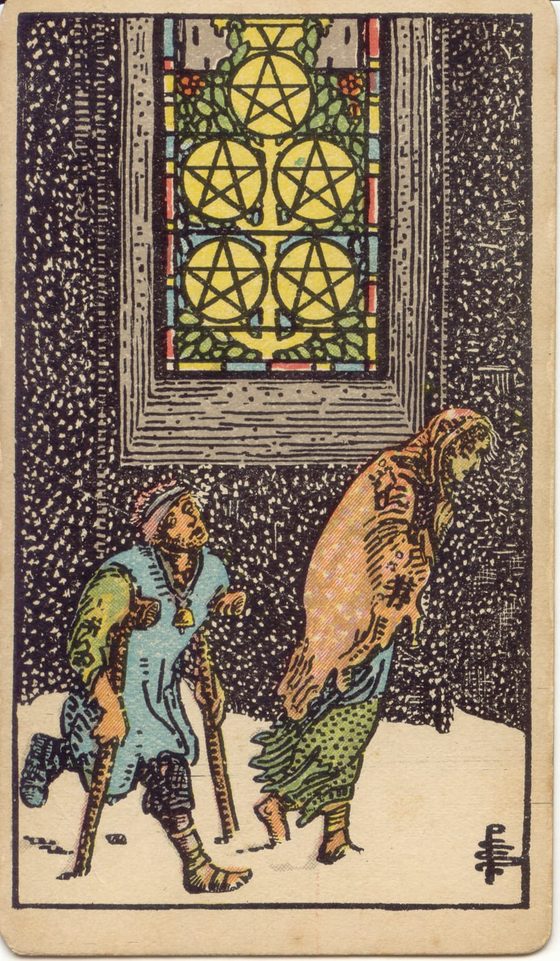
Two people pass a lit window in the snow without looking up. The Five of Pentacles describes hardship and exclusion at once, and the exclusion in the picture is not obviously anyone's doing.
- hardship
- exclusion
- shortfall
- insecurity
- isolation
- recovery
- help accepted
- entrenchment
- return
- resignation
What the card shows
Snow falls as a dense scatter of white flecks against a dark ground. Two figures move through it toward the left along a wall. In front is a man on two crutches, both legs bound in wrappings, barefoot, a cloth tied round his head and a small bell hanging at his throat. His clothes are patched blue and green.
Behind him a woman follows with a blanket pulled over her head and gathered at the chest, her head down, barefoot, a green skirt showing beneath. Above and behind them is a tall stained-glass window, lit from within, with five pentacles set into the glass, one at the top and two rows of two below, framed by a design of leaves and small flowers. Neither figure looks at the window. Neither looks at the other. No door is drawn anywhere in the wall.
Upright meaning
The Five of Pentacles is the hardship card of the suit, and Waite's own gloss is blunt: material trouble, above all. Money short, work gone, a body that is not working, a place to sleep that is not secure. The card describes the condition rather than its cause.
What makes it more than a card about poverty is the window. There is warmth and light a few feet away, and the two figures walk past it. Nothing in the drawing says they are barred. Nothing says they are welcome either. The card holds both possibilities: help that exists and is being withheld, and help that exists and is not being asked for. Pride, shame, exhaustion and genuine exclusion produce the same picture.
The other thing it names is company. Two people, not one. Whatever is happening, it is being gone through alongside somebody, and neither is looking at the other. Beside Six of Pentacles the reading turns toward help arriving on someone else's terms. Beside The Tower the hardship reads as recent and sudden. Beside Four of Pentacles it becomes a picture of resources that exist and are not moving.
Upright in love
In a relationship reading this card describes two people in difficulty together. That is different from two people in difficulty with each other. The strain is coming from outside, money, illness, housing, a family emergency, and it is landing on both of them.
The warning the card carries is about isolation. Couples under sustained pressure stop telling anyone, and the telling is usually the thing that would help. It can also describe a relationship where one person has stopped asking for support because asking has been expensive before. Neither figure in the drawing is looking at the other, and that detail is worth more attention than the snow. Compare Ten of Cups, which shows a household with none of this pressure on it.
Upright in work
Work lost, work that does not cover the bills, or a workplace where you are visibly outside the group that gets things. The Five of Pentacles at work is often less about money than about standing: being present, doing the job, and not being counted.
It also appears for people who are unwell and working anyway, and for people whose circumstances have made the ordinary machinery of employment hard to use. In those situations the card is not describing a failing. It is describing a mismatch between what a person needs and what the structure provides. What it does not do is name a remedy. If the spread contains cards about other people, the useful question is which of them already knows, and which of them has been told.
Upright in money
The card of the shortfall. Not a market fluctuation and not a bad quarter: the specific condition of not having enough for what is due. Waite's phrase, material trouble above all, is the plainest reading and usually the right one.
Two things are worth saying and neither is advice. The first is that the card describes a state, not a duration; nothing in the picture indicates how long the snow lasts. The second is that the window is drawn deliberately. Where money is short, there is often help that is nominally available and practically difficult to reach, and the difficulty is rarely only pride. If you are in this position, the useful step is a person, not a card.
Upright as feelings
As someone's feelings, this is the sense of being on the outside of something. Not resented, not excluded by anyone in particular; simply not part of it. It often comes with a reluctance to say so, because saying so is an admission. The card describes loneliness with a practical cause rather than a mood.
Upright as advice
Ask one specific person for one specific thing, this week, and make the thing small enough that saying yes is easy. The card's failure mode is not the cold. It is walking past the lit window for the eleventh time because the tenth was humiliating.
Reversed meaning
Reversed, this card runs two ways and they are close to opposites. The first is recovery: the worst of the hardship passing, the job found, the treatment starting, the help finally accepted. Read this way the reversal is the end of the walk rather than the middle of it.
The second is the hardship becoming settled. Not worse in any dramatic way, but no longer temporary. This is the reading where the person has reorganised their life around the shortage, learnt to manage it, and stopped expecting it to change. Waite's own reversed line goes further and darker, disorder and ruin and discord, which is a third possibility rather than a synonym for the first two.
Choosing is the reader's job. If the spread is full of movement, read recovery. If it is full of static and repeated cards, read entrenchment. And be careful with the cheerful version: telling someone that their difficulty is nearly over because a card is upside down is a prediction, and this card is a description.
Reversed in love
Either a couple coming out of a hard stretch and starting to look at each other again, or a hard stretch that has become the normal temperature of the relationship. The second is the one worth watching, because it does not announce itself. Nobody has a row. The two people simply keep walking in parallel and stop mentioning it. Reversed, this card often marks the point where shared difficulty has quietly turned into separate difficulty.
Reversed in work
Work found, or a long unemployment settling into something the person no longer describes as temporary. The reversal also covers a return after illness, which is its own kind of difficulty and rarely as clean as the phrase suggests. Look at whether the surrounding cards describe arrival or repetition. And note what the card cannot do: it cannot tell you whether a particular application will succeed, and any reading that claims otherwise is inventing.
Reversed in money
The shortfall easing, or the shortfall becoming the baseline. Both are real and they feel different from inside: one has an end date and the other has stopped having one. Reversed, the card sometimes also marks money arriving that comes attached to conditions, which is help and is not free. This page cannot advise you on debt, benefits or borrowing. What the card offers is a clear description of a position, which is occasionally the thing that makes it possible to describe the position to someone who can help.
Reversed as feelings
Either someone is starting to feel included again, or they have given up expecting to be and have made peace with the outside. The second is quieter and easier to miss. It sounds like acceptance and functions like withdrawal, and the difference shows in what they stop asking for.
Reversed as advice
Find out what you are actually entitled to, from an organisation rather than from a friend, and write the answer down. Reversed, this card rewards specific information over general resolve. The lit window in the picture is not a metaphor for optimism; it is a building with people in it who have a job.
Symbolism in the 1909 image
The lit window. Tall, stained, glowing from inside, with the five pentacles set into the glass. It is the only warm thing in the frame. Read as the church, as institutional charity, as help that exists. What the drawing does not include is a door, which is either an accident of composition or the most pointed thing in the card.
The bell. Hung at the man's throat. In medieval practice a bell of this kind marked a leper, required to announce himself so others could avoid him. Smith's audience would have read it faster than a modern one does. It makes the exclusion in the card formal rather than accidental.
The crutches. Wooden, plain, and the reason he is moving at the speed he is. The card includes disability as a cause of hardship, not as a symbol of something else, and readings that spiritualise it are dodging.
The snow. Drawn as a dense scatter of white flecks across the dark ground, settling. Weather in this deck is usually mood; here it is a material fact.
The bare feet. Both figures are drawn barefoot in the snow, hers plainly and his below the leg wrappings. It is the detail that fixes the card's register: this is not metaphorical poverty, and a reading that makes it so has changed the subject.
Where this meaning came from
The five of coins was a pip card in the fifteenth-century Italian decks: five discs, no scene, no meaning. It became a divinatory object only in eighteenth-century France, through Court de Gebelin and Etteilla, whose Egyptian genealogy for the tarot was fabricated and has since been thoroughly dismantled.
Smith's 1909 drawing gives the card the scene modern readers know. Waite's entry in The Pictorial Key to the Tarot (1910) is short: two mendicants in a snow-storm pass a lighted casement. His divinatory meanings are destitution and material trouble above all, and reversed, disorder, chaos, ruin, discord, profligacy.
The medieval detail Smith supplies, the leper's bell, the crutches, the church window, is hers rather than Waite's, and it is what gives the card its specific weight. She was drawing on a visual vocabulary of English religious art she knew well; she had trained at Pratt and worked extensively in theatre design.
The Golden Dawn title is Lord of Material Trouble, Mercury in Taurus. Smith was paid a flat fee for the whole deck and signed the cards only with her monogram. She died in 1951 with no royalties from the most reproduced tarot images in the language.
The common misreading
The commonest misreading of this card is the consoling one: help is right there, you just have to ask. It is said kindly and it puts the whole burden on the person in the snow. The drawing gives no door. Whether the light is reachable is exactly what the picture withholds, and a reader who supplies the answer is inventing the most important detail.
The second is spiritualising the hardship. The card gets read as poverty consciousness, a mindset problem, a failure of belief in abundance. Smith drew two people barefoot in the snow, one of them on crutches. Reading that as an attitude is not insight, it is a way of not looking.
The third: because the card is grim, readers soften it into loneliness in general. It is more specific than that. This is exclusion with a material cause, and the useful reading names the cause. If the question was about a friendship and this card appears, ask what has changed in the person's circumstances rather than in their feelings. Compare Nine of Swords, which is distress without a material cause attached.
Questions to sit with
- What specifically is short right now, and by how much?
- Who already knows, and who have you decided not to tell?
- What help exists on paper that you have not tested?
- Is the person walking beside you in this having the same conversation with themselves?
Pull this card in a real spread.