- Card number
- 9
- Arcana
- Minor Arcana
- Suit
- Swords
- Element
- Air
- Rank
- Nine
- Yes or no reading
- No
Nine of Swords
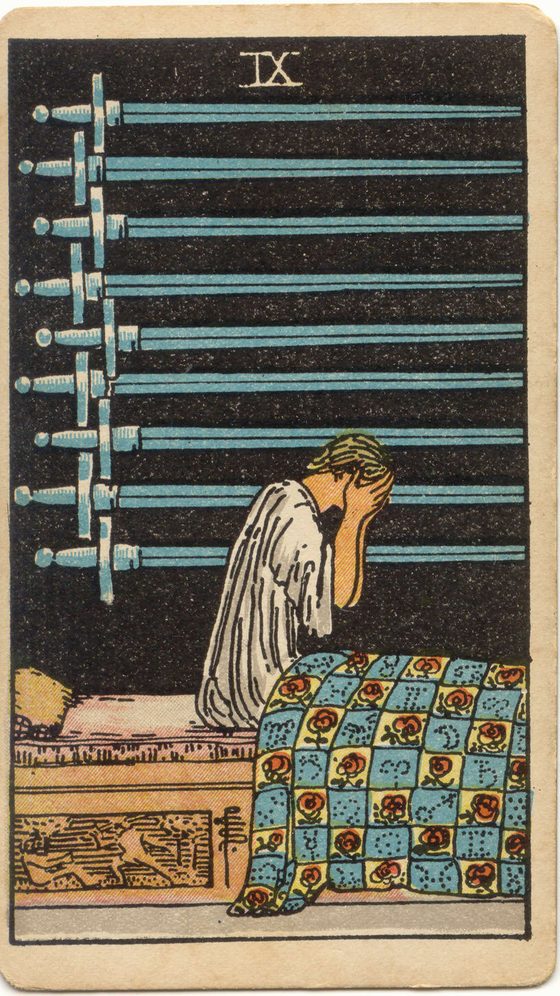
A figure sitting up in bed with their face in their hands, nine swords hanging on the dark behind them. The card describes the mind at night, and none of the swords in it are touching anyone.
- anxiety
- sleeplessness
- dread
- guilt
- isolation
- relief
- speaking up
- recovery
- buried fear
- numbness
What the card shows
A figure sits upright in bed with both hands covering the face. The bed is set against a black ground, and the head and shoulders are the brightest thing in the picture. The nightgown is plain and pale.
Nine swords hang horizontally on the darkness behind, stacked one above another and receding slightly, none of them pointing at the figure. The quilt is divided into squares alternating red roses and astrological signs. The side panel of the bed is carved in relief with two figures, one standing over the other with a weapon raised. The base of the bed is solid wood. There is no window and no light source anywhere in the frame.
Upright meaning
The Nine of Swords is the card of the mind at night. It describes the particular quality of distress that arrives when there is nothing to be done about it: the replaying, the rehearsed conversation, the catastrophe assembled in detail out of very little material.
What the picture is careful about is where the swords are. They are on the wall, not in the figure. Nothing in the frame is happening. This is suffering that is entirely real and entirely internal, and the card does not treat those as opposites. Anyone who has lain awake at four in the morning knows the difference between a problem and thinking about a problem, and knows that the second one still hurts.
The card says nothing about whether the fear is justified. That is its honest limit. Read the neighbours for that: with Eight of Swords the dread has a real situation attached to it; with Ten of Swords the thing has already happened and this is the aftermath; beside The Moon the querent cannot yet tell which of their fears are which.
Upright in love
In a relationship reading this is usually anxiety about the relationship rather than a description of it. Sleepless nights, unsent messages, a conversation replayed until it means something it did not mean at the time.
Occasionally it points at something concrete: real grief, a betrayal, a decision that has to be made and is being made at three in the morning instead of at ten. More often the card is describing the hours between the worry and the evidence.
It is not a report on the other person. Anyone reading this card as proof that a partner is lying or leaving is reading their own fear back to themselves and calling it a message.
Upright in work
Work stress carried home. The Nine of Swords at work is the dread before the review, the email reread at midnight, the certainty that a mistake will be found and will cost everything. It describes the anticipation, which is almost always more elaborate than whatever actually arrives.
There are workplaces where the fear is proportionate, and the card does not pretend otherwise. What it does say is that the querent is currently doing the job twice, once in the day and once at night, and is only being paid for one of them.
Look at whether any neighbouring card describes an actual event or only a mood.
Upright in money
Money anxiety in its purest form: the unopened statement, the sum recalculated at night, the arithmetic that always comes out the same.
Financial fear is often accurate and out of proportion at the same time, and this card does not distinguish between the two. What it does is mark the point where worry has stopped producing information. If the same figures have been turned over for a week without a decision, the turning over has become the problem.
That is a comment on the state of mind, not on the balance, and nothing here is advice about the money itself.
Upright as feelings
As feelings, this is anguish carried privately. Guilt, dread or grief that the person has decided not to burden anyone else with. From the outside it usually reads as reserve, or as ordinary tiredness. There is a great deal more feeling here than is being shown, and the silence around it is not indifference or a lack of care.
Upright as advice
Get the fear out of your head and onto paper tonight, in specific sentences. Vague dread survives daylight; a written list rarely does. Then pick one item from that list you could check tomorrow with a single question to a real person, and go and check it.
Reversed meaning
Reversed, the Nine of Swords reads two ways and they are not compatible.
The first is the night ending. The worst of it has passed, the fear has been said out loud to someone, or the feared thing arrived and turned out to be survivable. This reading treats the reversal as the swords coming down off the wall.
The second is worse than the upright. The distress has gone underground. It is no longer felt as panic, only as a low constant assumption that things are bad, held so long it has stopped registering as a mood at all. Reversed, this card can describe someone who has stopped noticing they are frightened.
The spread decides. Movement, daylight or other people nearby point to the first. Repetition, isolation and more of this suit point to the second. If the second reading fits and the person is describing something that sounds like an illness rather than a hard week, the responsible move is to stop reading cards. A spread is not a diagnostic tool and should not be used as one.
Reversed in love
Either the worry finally gets said out loud and turns out to be smaller than the silence around it, or it hardens into a settled expectation of being let down. The second version is quieter and does more damage. A person who has stopped voicing a fear has not stopped having it. Look at whether the surrounding cards describe a conversation or another closed door.
Reversed in work
The dread lifts, or it stops being noticed. Reversed, this can mark the review that went fine and the mistake that was never the disaster it looked like. It can equally mark someone who has normalised working in fear and would now describe it as simply how the industry is. Four of Swords nearby argues for genuine rest rather than numbness.
Reversed in money
The statement gets opened, or the worrying gets folded into the background where it does no work at all. Reversed, this card sometimes marks relief that came from information rather than from more money. It can equally mark chronic low-level financial dread that no longer prompts any action. The card describes the state of the worry, not the state of the account.
Reversed as feelings
Feelings that have either been confided or buried. If confided, expect relief mixed with a certain amount of embarrassment at the length of the silence. If buried, what remains looks like flatness rather than distress, and it is easy for other people to mistake that for having got over it.
Reversed as advice
Tell one person. Not the whole thing, and not in order to get advice. Say the fear out loud to somebody who is awake, in daylight, and let it be heard rather than solved. If this has been running for months rather than nights, tell somebody qualified to help instead.
Symbolism in the 1909 image
The nine swords. Mounted flat on the wall behind the bed, receding into the dark, none of them touching the figure. They are the only swords in the suit that threaten nobody. The picture puts all the danger out of reach and leaves the distress entirely unaffected, which is the whole argument of the card.
The hands over the face. The figure is not looking at the swords. Whether this is despair or simply the act of waking is left undecided in the drawing, and the second reading is the more interesting one: the moment of surfacing, before the day has organised itself.
The quilt. Squares alternating red roses and astrological signs. Roses are usually read as life or passion, the signs as the ordered turning of time. Both are things the figure is lying under and currently unable to see.
The carved bed panel. Two figures in relief, one standing over the other with a weapon. Commonly read as a duel or a defeat. It is worth noticing that it is a carving rather than a scene: a fixed image of violence that the sleeper keeps beside the bed.
The black ground. Not a room. No window, no wall, no furniture but the bed. Smith drew the surroundings out of existence altogether, which is a fair picture of what three in the morning is actually like.
Where this meaning came from
Like every numbered card in the suit, the Nine of Swords began without a meaning. Fifteenth-century Italian decks used the pips for play, and nine swords on a card meant nine swords. There was no scene, no sleeper and no interpretation attached to it.
Divinatory meanings for the pips were supplied in eighteenth- and nineteenth-century France, notably by Etteilla, who issued keyword lists for the entire deck. The nine of this suit was given readings around illness, loss and unfounded suspicion, which is close to, but not the same as, what the card is used for now.
The image everyone actually pictures is Pamela Colman Smith's, drawn in 1909 to Arthur Edward Waite's direction. Smith gave the Minor Arcana narrative pictures, and this is one of her most inventive: a domestic interior for a card that had previously been an arrangement of blades.
Waite's gloss in The Pictorial Key to the Tarot (1910) mentions death, failure, misery and deception, and notes the figure's posture of lamentation. The modern reading of the card as anxiety, insomnia and the mind at night is a twentieth-century refinement. It is a good one, but it is not what Waite wrote. It came from readers looking harder at Smith's picture than at his text.
The common misreading
The Nine of Swords attracts prediction more than almost any card in the deck. A reader sees the blades and the hidden face and tells the querent that something terrible is coming. Nothing in the card describes an event. Every sword in it is on the wall.
The second misreading runs the other way, dismissing the distress because it is internal. Telling someone their suffering is only in their head is not a reading and it is not kind. The card is explicit that the pain is real. What it locates is where the pain is, not how much it counts.
The third is diagnosis. This card comes up constantly in questions about depression, insomnia and panic, and readers routinely oblige with an interpretation. A tarot spread cannot tell anyone whether they have a health condition, and should never be used to try. When that is the real question, the cards are the wrong tool and saying so is the only honest reading available.
A smaller one: the card is often read as the querent's own night when the question was about somebody else. It cannot tell you what another person lies awake about.
Questions to sit with
- What exactly are you afraid of, in one sentence, without using the word everything?
- Is this a problem, or is this thinking about a problem, and what would tell the difference?
- What time of day does this fear feel true, and what time of day does it not?
- Who could you say this to out loud, and what has stopped you so far?
Pull this card in a real spread.