- Card number
- 10
- Arcana
- Minor Arcana
- Suit
- Swords
- Element
- Air
- Rank
- Ten
- Yes or no reading
- No
Ten of Swords
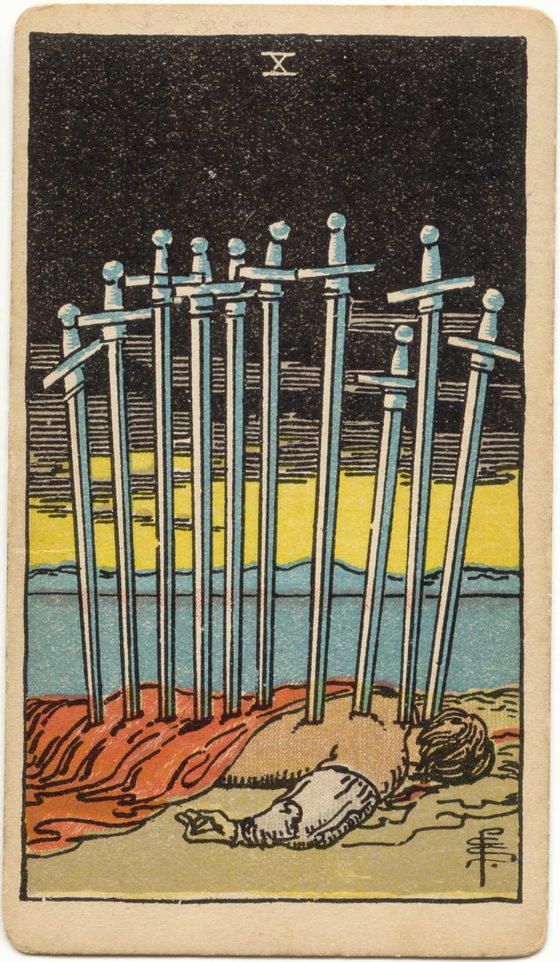
A figure face-down under ten swords, with a yellow band of light along the horizon. The card marks a thing that is finished rather than a thing that is coming, and the overkill is part of the point.
- endings
- ruin
- betrayal
- rock bottom
- aftermath
- recovery
- getting up
- resistance
- prolonged grief
- melodrama
What the card shows
A figure lies face-down on bare ground at the edge of still water. Ten swords are driven into the back and legs, spaced evenly from the neck to the thigh. A red cloth covers the body from the waist down. The right hand is raised slightly, thumb and first two fingers extended in the gesture used for blessing.
The upper half of the sky is solid black, drawn as a flat mass rather than as cloud. Below it a broad band of yellow light runs along the horizon, with low dark hills between the light and the water. The water itself is unbroken and calm. Nothing else is in the frame. There is no attacker, no weapon left over, and no sign of struggle in the ground.
Upright meaning
The Ten of Swords marks an ending that has already happened. Unlike most cards in the deck it is not describing a posture or a tendency; it is describing an aftermath. Whatever the situation was, it is over, and the querent is on the ground.
The ten swords are excessive and Smith knew it. One would have done. The overkill is the most useful thing in the picture, because it describes how endings of this kind are actually experienced: not as a single clean blow but as a sequence, each one arriving after the outcome was already decided. The last four swords change nothing and hurt anyway.
Read the neighbours to learn what kind of ending it is. Beside Death the card describes a transition the querent did not choose and cannot reverse; beside Nine of Swords the dread ran ahead of the event and the event has now caught up; beside Ace of Swords something is already being rebuilt out of the same material. The light on the horizon is drawn in, but the card promises nothing about it.
Upright in love
In a relationship reading this is usually a finished relationship rather than a struggling one. The betrayal has happened, the decision has been made, the last conversation has been had. It is not a card about whether to stay.
Where it gets harder is when the querent already knows this and is asking anyway. The Ten of Swords comes up often for people looking for permission to stop hoping, and a reading that hedges is not doing them a service.
It says nothing about blame and nothing about the other person's state of mind. Ten swords in a back look like an assault, but the picture shows no attacker. That absence is deliberate.
Upright in work
The end of a job, a project or a professional relationship, usually not on the querent's terms. Redundancy, a collapsed venture, a role made impossible until leaving became the only move left.
The card is specific about timing: this is after, not before. If the question was whether something will fail, the Ten of Swords is a poor instrument for answering it. If the question is what to do now that it has, the card is at least honest about the state of things.
It also describes the particular indignity of an ending drawn out longer than it needed to be, which is what the extra swords are for.
Upright in money
A financial position that has already come apart: a debt called in, a business closed, a loss taken. The card describes the aftermath and the flatness that follows it, not the events that caused it.
What it cannot do is tell you the size of the damage. People draw this card over a bad month and over genuine ruin, and the picture looks identical either way. That is a limitation of the card rather than a hidden message inside it.
Nothing here is advice about what to do with money, and no card in the deck can tell you whether a loss is recoverable.
Upright as feelings
As feelings, this is finality. Someone who has stopped fighting for the outcome, not out of calm but out of exhaustion. There may still be affection underneath, and it usually cannot be mobilised for anything. It reads as absence rather than as anger, which is often harder to be on the receiving end of.
Upright as advice
Stop trying to reverse it. The energy currently going into arguing with what has already happened is the only resource you have that could go somewhere else. Write down in one line what is actually over, then leave it alone for a week before deciding anything about what comes next.
Reversed meaning
Reversed, the Ten of Swords splits three ways, and they are not variations on one another.
The first is recovery. Getting up. The swords come out, the worst of it is behind, and what the card describes is the slow unglamorous business of the aftermath rather than the fall itself. Many readers take the reversal as the light on the horizon finally arriving.
The second is resistance to the ending. The situation is over and the querent will not have it. The relationship is being restarted, the decision is being appealed, the case is being made again to someone who stopped listening a while ago. Reversed, this card can describe a person lying on the ground and refusing to acknowledge the ground.
The third is less common and still worth naming: melodrama, where an ordinary setback has been cast as a catastrophe because the catastrophe is doing something useful for the person telling it.
The spread decides which. Look at whether the surrounding cards describe time passing or the same scene repeating.
Reversed in love
Either recovery from a finished relationship has genuinely started, or the finished relationship is being restarted for the third time. The reversal describes the querent's relationship to the ending rather than the ending itself. Nothing here says whether reconciliation is possible. What it can flag is the difference between grief that is moving and grief that has settled into a position.
Reversed in work
Picking up after a professional collapse, or refusing to accept that it happened. Reversed, this card sometimes marks the point where somebody stops rehearsing the injustice of it and starts looking for the next thing, which is rarely dramatic and rarely feels like progress at the time. It just as often marks a grievance kept warm for years. Six of Swords nearby favours the first reading.
Reversed in money
Slow recovery from a loss, or a refusal to accept the numbers. Reversed, this card can describe someone rebuilding quietly from a low base, which is unspectacular and rarely looks like anything in a spread. It can equally describe money still being spent to defend a position that has already failed. The card is about the response to the loss, not the loss.
Reversed as feelings
Feeling starting to return, or grief that has hardened into an identity. If the first, expect something tentative rather than resolved. If the second, what shows is a person for whom the ending has become the main fact about them, which is a difficult thing to be in a relationship with.
Reversed as advice
Get up before you feel ready. Not because the feeling is wrong, but because waiting for it to lift is a plan with no end point in it. Do one ordinary thing on the far side of this: a meal, a walk, a message to somebody who does not know about it yet.
Symbolism in the 1909 image
The ten swords. Far more than the job required, driven in along the length of the body. Ten is the last number of the suit, and this is what the suit's logic looks like when it runs all the way out. The excess is the meaning: an ending that kept going after it had been decided.
The blessing hand. The right hand shows thumb and two fingers raised, the standard gesture of benediction in Western religious painting. Waite says nothing about it. Readers have variously called it a final blessing, a sign of life, or a hand caught mid-fall. The drawing does not settle the question, and the card is better for that.
The black sky. Flat black across the top half, not stormy and not cloudy, simply absent. It reads as a curtain more than as weather.
The yellow horizon. A band of light beneath the darkness. Almost every modern reading treats this as dawn and therefore as hope. It could as easily be dusk. Smith gives the light no direction and no sun.
The still water. Flat and unbroken. Water in this deck usually carries feeling, and here it has no movement at all, which is the most accurate detail on the card about how the hours after a bad ending actually pass.
Where this meaning came from
The Ten of Swords started life as a pip card. In the fifteenth-century Italian decks it was ten swords arranged on a card for the purposes of trick-taking, with no figure, no scene and no meaning beyond its rank in play.
Interpretive systems for the pips were built in France across the eighteenth and nineteenth centuries. Etteilla's lists gave the ten of this suit associations with grief, affliction and tears. Those associations were assigned by a bookseller working in the 1780s, not inherited from anywhere older, whatever later writers claimed about Egypt.
The scene everybody now pictures was drawn by Pamela Colman Smith in 1909, working to Arthur Edward Waite's direction. The prone body, the ten blades and the light on the horizon are hers. Nothing resembling it exists in the earlier decks.
Waite's entry in The Pictorial Key to the Tarot (1910) is unusually blunt for him: pain, affliction, tears, desolation, and a specific note that the card does not signify violent death. That clause is worth remembering, because it is the reading Waite himself ruled out and the one modern readers still reach for first.
The common misreading
The most damaging misreading of the Ten of Swords is treating it as a prediction of disaster. It is an aftermath card. Read as a forecast it does two harmful things at once: it frightens the querent about an event the card is not describing, and it distracts from the ending that has already happened and is the actual subject.
The second is the rescue reflex. Readers see how bleak the picture is and rush to the yellow band on the horizon, telling the querent that dawn is coming. The light is there, and it is the least specific thing in the frame. Turning a card about a real loss into a reassurance is a way of avoiding sitting with someone while it is still bad.
The third is death. Waite wrote explicitly that this card does not signify violent death, and readers have been ignoring him for over a century. Nobody should be told anything about mortality on the strength of a picture.
And one more: the swords look like an assault, so the card gets read as betrayal by a named person. There is no attacker in the image. Sometimes an ending has no author.
Questions to sit with
- What is actually over, stated in one sentence with no qualifiers attached?
- Which of the swords arrived after the outcome had already been decided?
- What are you still doing that only makes sense if this could be reversed?
- Who knows about this, and who are you still performing for?
Pull this card in a real spread.