- Card number
- 6
- Arcana
- Minor Arcana
- Suit
- Swords
- Element
- Air
- Rank
- Six
- Yes or no reading
- Yes
Six of Swords
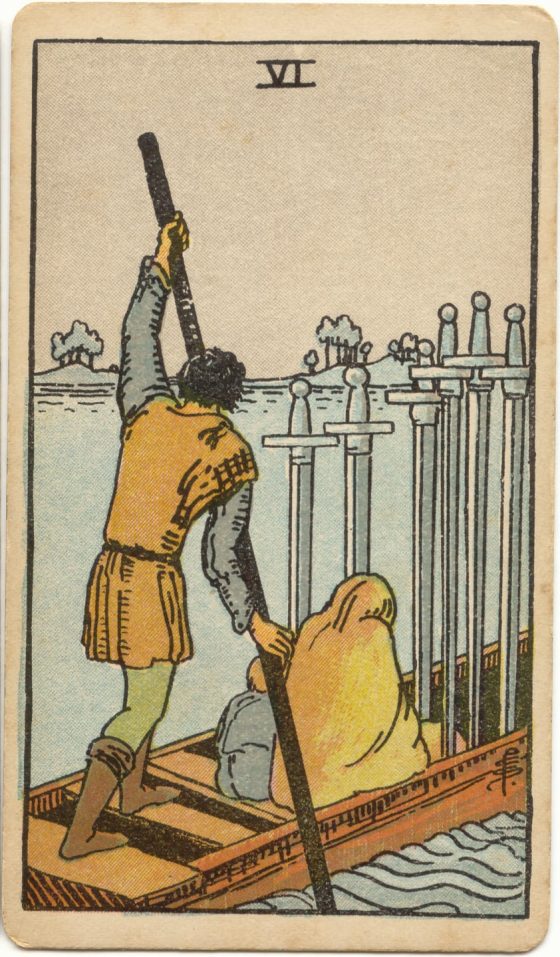
A ferryman poles a boat across water, carrying two passengers and six swords. The Six of Swords is a passage away from something difficult, and the swords are travelling with them rather than being left behind.
- transition
- passage
- leaving
- assistance
- gradual relief
- stuck
- delayed move
- return
- unresolved baggage
- no change
What the card shows
A flat punt moves across shallow water. A man stands in the stern in a yellow tunic and grey sleeves, both hands on a long pole that he is driving down into the riverbed. His back is to the viewer and his face is not visible.
Two passengers sit low in the bow. One is wrapped head to foot in a pale cloak and hunched forward; a smaller covered figure sits beside them. Six swords stand upright in the front of the boat, planted point-down through the hull in two ranks. On the near side of the punt the water is drawn in short broken ripples; ahead of it the surface is smooth and unmarked. A line of trees stands on the far bank.
Upright meaning
The Six of Swords is a crossing. Someone is being taken from one place to another over water that is rough on one side of the boat and calm on the other, and the whole card is organised around that difference. It is the suit's first real relief after the five, and it is a modest one.
Upright it usually describes a transition away from difficulty: leaving a situation, a house, a job, a period. What makes it honest rather than consoling is the cargo. The six swords are standing in the boat, planted in the hull, coming along. Whatever the trouble was, it has not been resolved and it has not been left on the bank. It has been relocated.
The card also declines to show the destination. The far bank is a line of trees and nothing else. Beside Five of Swords it reads as the departure of the people who lost. Beside Eight of Cups the leaving looks chosen rather than necessary. Beside Death the same movement reads as something final, which this card is not: it is a passage, not a transformation.
Upright in love
A relationship moving out of a hard stretch, or a person moving out of a relationship. The card covers both, because both are the same picture seen from a different seat. It often describes leaving that is quiet and administrative rather than dramatic: the logistics phase, after the decision and before the feeling has caught up with it.
It says nothing about whether the destination is better. That is the honest limit of the card and it is worth stating plainly in a reading. What it does say is that the difficulty is coming too. People who leave without addressing what happened tend to find the same six swords standing in the next boat.
Upright in work
Leaving a job, a team or an industry, usually for something calmer rather than something better paid. It also fits a project being moved elsewhere, or a role relocated rather than fixed. The swords in the boat are the part worth attending to: the unresolved thing usually travels with the person.
As advice it favours the move, with one condition. Name what you are carrying before you arrive. If the reason for leaving is a person, a pattern of overwork, or a way of handling conflict that you brought in with you, the crossing gives you time to look at it, and the card is unusually generous about that time.
Upright in money
Money in transit rather than money resolved: a move, a transfer, the costs of relocating, a period of reduced circumstances during a change. It often appears where a financial situation is being managed down to something survivable rather than actually repaired.
Nothing here is advice about a financial decision. The observation the card supports is narrow and useful: transitions cost more than people plan for, and the passenger in this picture is not the one steering. If somebody else is arranging the practicalities, it is worth knowing exactly what they are arranging.
Upright as feelings
Numb rather than unhappy. As someone's feelings, this is a person in the middle of something, past the worst of it and not yet arrived anywhere. Smith hides both passengers' faces, which is a fair description of the state: very little is legible from the outside, including to them. The card does not say what they will feel on the far bank.
Upright as advice
Go, and take an inventory before you do. Write down the one thing about this situation you would be carrying into the next one, and say it out loud to someone. The card supports the move. What it asks is that you stop describing it to yourself as an escape while the swords are in the boat.
Reversed meaning
Reversed, the Six of Swords divides, and the readings ask opposite things of the querent.
The first is the crossing refused or stalled. Somebody is staying: unable to leave, unable to afford it, unable to decide, or returning to a situation they had already left once. The boat is still on the near bank. This is the reading most books lead with and it is often accurate, particularly where the obstacle is money rather than resolve.
The second is a crossing that has happened without anything changing. The person moved, the job changed, the city changed, and the same difficulty reassembled itself at the destination. Here the reversal is not about being stuck in place but about carrying the trouble so completely that the journey made no difference to it.
Some readers also take the reversal literally, as a delayed or cancelled journey, following Waite's very literal entry. That is available and worth checking before reaching for anything psychological. The spread decides among the three, and a reader who never allows the literal one has decided in advance what tarot is for.
Reversed in love
Either a departure that is not happening, with somebody staying in a situation they have already decided about, or a separation that has technically occurred while nothing between the two people has actually moved. The second is the more common and the more painful. If the spread shows repetition, read the trouble arriving intact at the new address rather than reading a reunion.
Reversed in work
A move that falls through, or a move that changes nothing. The second is the reading worth spending time on: a new job with the same problem in it, which is a familiar experience and rarely the fault of the person having it. As advice, before the next application, name the specific thing you are leaving. If you cannot name it, the card suggests you will meet it again and not recognise it.
Reversed in money
A relocation or transition blocked by money, or one that has happened and left the same position in a different currency. This is the reversal where somebody cannot afford to leave, which is a constraint rather than a failure of will and should be read as one. The card offers nothing about what to do with the money, only the observation that being unable to move is itself a cost, and that it compounds.
Reversed as feelings
Stuck, or unchanged. As someone's feelings, this can be a person who cannot bring themselves to move on, or one who has moved on in every visible respect and privately has not. The card marks the gap between the position and the feeling. It does not say how wide that gap is.
Reversed as advice
Find out what is actually stopping the move, and be specific: money, a person, a fear, or the absence of anywhere to go. Each of those has a different answer and only one of them is about willpower. If the move has already happened, the task is not to move again but to unpack.
Symbolism in the 1909 image
The six swords. Standing upright in the bow, planted point-down through the hull. They are the difficulty, and they are aboard. Smith could have left them on the shore, and there is no card in the deck where the choice of what to include is more pointed.
The water. Broken into short ripples on the near side of the punt and drawn smooth ahead of it. This is the card's central claim and the one thing in it that is unambiguous: conditions are improving in the direction of travel.
The ferryman. Standing, doing all the work, face turned away. Read as help, or as the practical business of getting somebody out. Note that the passengers are not steering, and that someone else knows where this boat is going.
The covered passengers. Cloaked, hunched, faces hidden. Most books call the smaller one a child, and the drawing supports that without confirming it. Their expressions are exactly the information the card withholds.
The far bank. A line of trees and nothing else. There is no house, no figure, no landing stage. The destination is drawn as an absence of detail.
Where this meaning came from
The Six of Swords began as six swords on a pip card in the fifteenth-century Italian packs, played as a game with no divinatory meaning anywhere in it.
Meanings arrived in eighteenth-century France, through Antoine Court de Gebelin and then Etteilla, whose card lists supplied vocabulary that later writers inherited wholesale. The Egyptian ancestry claimed for tarot at that time was fabricated, which is worth keeping in mind whenever a modern book calls a meaning ancient.
Waite's entry in The Pictorial Key to the Tarot (1910) is among the most literal in the book: journey by water, route, way, envoy, expedient. He is describing travel, not a psychological process. The modern reading of this card as emotional transition is a twentieth-century layer added on top, and it works, but it is not what Waite wrote.
The scene is Pamela Colman Smith's. She drew the boat, the ferryman, the covered passengers and the divided water, none of which existed on any earlier six of swords. She was paid a flat fee for the work, and the deck went out under two other names.
The common misreading
The commonest misreading is turning the card into a promise. Because the water ahead is calm, it gets delivered as things are about to get better. The picture shows a direction of travel and nothing whatever about the destination, which Smith drew as an empty line of trees. Movement away from difficulty is not the same as arrival somewhere good, and a reading that runs them together is inventing the far bank.
The second is forgetting the swords. The card is regularly described as leaving your troubles behind, which is precisely what is not happening: six of them are standing in the boat. That detail is the whole reason this card is more interesting than a picture of a ferry.
The third is the casting. The querent is assumed to be a passenger, when in a great many spreads they are the ferryman: the person doing the work of moving somebody else out of a bad situation, at their own expense, with no face and no seat. That reading is there in the drawing and it is almost never offered.
Questions to sit with
- What are you carrying into the next situation that you have not named?
- Are you the one being moved here, or the one doing the moving?
- What would have to be different at the destination for this to count as an improvement?
- Who is steering, and how much do you actually know about where you are going?
Pull this card in a real spread.