- Card number
- 5
- Arcana
- Minor Arcana
- Suit
- Swords
- Element
- Air
- Rank
- Five
- Yes or no reading
- No
Five of Swords
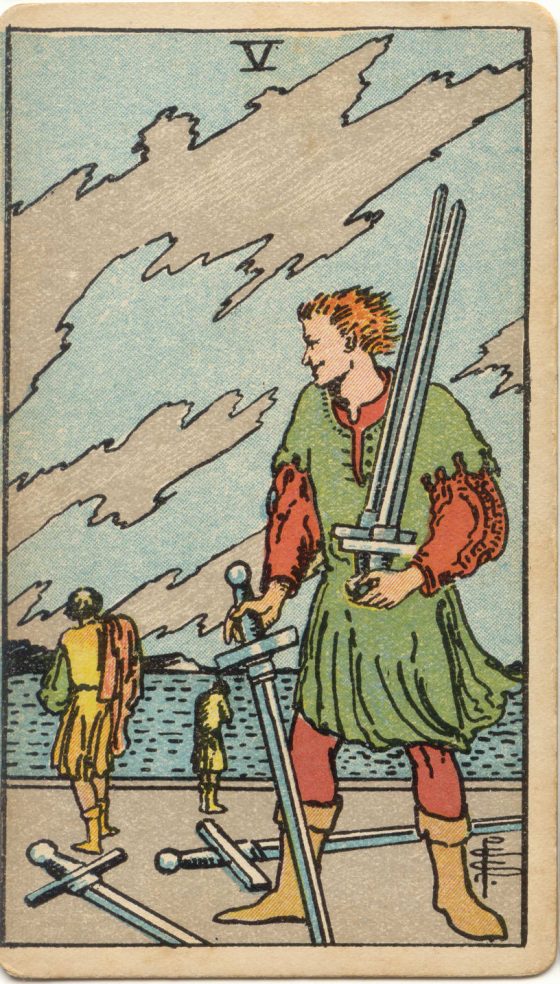
A man gathers swords while two figures walk away from him. The Five of Swords describes a conflict that has ended in someone's favour, and it refuses to tell you which of the three people you are.
- hollow victory
- conflict
- self-interest
- defeat
- cost
- amends
- lingering resentment
- truce
- consequences
- hidden conflict
What the card shows
A young man in a green tunic and red sleeves stands in the foreground, turned to the left with his face in profile. He carries two swords over his shoulder and rests the point of a third on the ground. His expression is faintly amused. Two more swords lie on the ground near his feet, and he is not reaching for them.
Behind him, two figures walk away toward the water's edge. One has both hands raised to the face; the other stands further off with the head lowered. Neither is looking back. Beyond them is a flat grey sea and a low headland. The sky is filled with long jagged streaks of cloud, drawn as torn shapes rather than rounded ones. The ground is bare.
Upright meaning
The Five of Swords is a fight that is over and a card that will not tell you who you are in it. Three people are drawn: one holding the swords, two walking away. Smith gives the victor the only visible face. Everyone else is turned from us, which is roughly what happens after this kind of argument.
Read upright it usually describes a conflict decided by force of some sort, where winning cost more than it returned. Not always. Some fights need winning, and the card is not a moral verdict. What it consistently marks is that the relationships in the situation have changed, and that the change is not symmetrical: one person is counting what they gained and two people are leaving. The card is describing the aftermath, not the argument, and the aftermath is where the actual information is.
Beside Justice the same conflict reads as something settled properly rather than won. Beside Seven of Swords the gains look taken rather than earned. Beside Six of Swords the reading moves on to what the departing figures do next, which this card does not show.
Upright in love
An argument that somebody won. In a relationship reading this is the row where a point was proved and something else was spent proving it, and the card is more interested in the second part. It can also describe a pattern rather than an incident: a household where being right has become the currency.
The card does not name who is at fault, and it is a mistake to use it that way. Both people in a spread like this usually recognise themselves in the figure with the swords at some point. Where the question is about someone else's behaviour, what the card offers is the shape of the situation, not a judgement on their character.
Upright in work
A workplace conflict that has been decided rather than resolved. A meeting somebody dominated, a decision pushed through, a colleague who got what they wanted and lost the room doing it. It equally covers being on the other side of that, which is the reading people apply to themselves far less often.
As advice, the card asks what the win is worth in the specific terms of the situation. If the fight was necessary, count what it cost and notice who left. If it was not, this is the point at which people usually decide the relationship did not matter, and that decision tends to look different a year later.
Upright in money
Money inside a dispute: a settlement, a claim, a negotiation where one side gave up. It can describe a gain that came at somebody's expense in a way that is going to be remembered.
Nothing here is advice about a financial decision, and the card has no opinion on whether the sum was worth it. What it observes is that money extracted from a relationship usually costs the relationship, and that this is a real cost even though it appears nowhere in the numbers.
Upright as feelings
Cold satisfaction, or defeat, depending on who is being asked about. As someone's feelings, this can be a person who believes they came off best and is untroubled by it, or one who has been humiliated and is walking away. The card does not say which, and reaching for the unflattering reading about someone else is a habit worth breaking.
Upright as advice
Count the cost of the last thing you won, out loud and specifically: who is not speaking to you, what you are no longer told. Then decide whether the next disagreement is worth the same price. The card asks for the accounting, not for an apology you do not mean.
Reversed meaning
Reversed, the Five of Swords splits, and the readings put the querent in different positions.
The first is the conflict easing. Amends, a truce, somebody deciding the fight is not worth continuing. Most books lead with this and it is genuinely common; the reversal often marks the point where a person puts the swords down without being made to.
The second is the conflict going underground. The argument stops being had out loud and continues in every other register: the withheld email, the pointed silence, the story told about someone to everybody except them. This is the harder reading, it lasts considerably longer, and nobody involved will call it a fight.
Some readers also take the reversal as the losses landing rather than the win, with the consequences of the upright card arriving. All three of these are supportable readings of the same reversed card. The spread decides, and a reader who always picks reconciliation because it is the pleasant option is not reading anything at all.
Reversed in love
Either a couple genuinely stepping back from a fight, or a fight that has moved into the walls. The second is harder to see and much harder to repair, because there is nothing to point at. If the spread is otherwise warm, read repair. If it is full of avoidance and silence, read a conflict that has changed form rather than ended, and expect the same argument in different words.
Reversed in work
A workplace dispute defused, or one that has gone quiet and political. The second version is where information stops being shared and nobody can say exactly when that started. As advice, if you were the one holding the swords, the reversal is an opening to give something back, and it closes faster than people expect. The card cannot tell you whether the offer will be taken.
Reversed in money
A financial dispute settling, or one that has stalled into resentment without being resolved. The reversal often marks the point where the amount stops being the issue and the principle takes over, which is usually the most expensive phase of any disagreement about money. Nothing here is advice about a claim or a settlement; the card only notes that the cost has moved somewhere the numbers do not show.
Reversed as feelings
Regret, or hardening. As someone's feelings, this can be a person who has cooled off and would like to repair something, or one who has stopped arguing because they have finished with the relationship. Both look like quiet from the outside, and the card does not distinguish between them.
Reversed as advice
Say the specific thing you got wrong, without the clause explaining why it was reasonable. If you were on the receiving end, decide what you actually want back before you talk: an apology, a change, or distance. Those need different conversations, and the card will not choose for you.
Symbolism in the 1909 image
The swords held. Two over the shoulder, a third resting point-down. He has three of the five, and the other two lie on the ground where he is not picking them up. Whatever this victory is, it is partial, and Smith drew it that way.
The two on the ground. Discarded, unclaimed, still there. They are the loose ends of the argument. Nobody in the picture has finished with this.
The face. The only visible expression on the card, somewhere between a smirk and plain satisfaction. Readers project a great deal onto it. The drawing itself is more neutral than the card's reputation.
The two departing figures. Both turned away, one with hands raised to the face. They are not being pursued and they are not in danger. What has happened to them is social rather than physical.
The torn sky. Long jagged streaks rather than rounded cloud, the most agitated sky in the suit. Read as the weather after a row: not a storm, but nothing settled either.
The water. Flat and grey behind everyone, and the direction the losers are walking. This suit keeps putting water at the back of its cards, unlooked at.
Where this meaning came from
The card began as five swords on a pip, in the fifteenth-century Italian packs where tarot was a trick-taking game with no divinatory content whatsoever.
Interpretation arrived in eighteenth-century France with Antoine Court de Gebelin and Etteilla, who supplied meanings for every card. Etteilla's entry for this one is loss, and the modern sense of a costly or shameful victory grows out of it. The Egyptian ancestry claimed for tarot in the same period was invented, and a good deal of the early interpretive apparatus with it.
Waite is unusually harsh here. In The Pictorial Key to the Tarot (1910) he gives degradation, destruction, reversal, infamy and dishonour, and describes the figure as looking after two retreating men with a smile of derision. That word, derision, is Waite's rather than Smith's, and much of the card's modern reputation as a portrait of a bully comes from it.
The scene itself is Smith's invention, drawn in 1909 for a flat fee. It is worth noticing how much of what readers think they see in the victor's face was supplied by a sentence Waite wrote about it a year afterwards.
The common misreading
The first and largest misreading is the casting. The card gets read as though the querent is obviously the person holding the swords, or obviously one of the figures walking away, depending on the reader's sympathies. Nothing in the image assigns roles. Three positions are drawn, and working out which one the querent occupies is the reading, not a preliminary to it.
The second is the hollow-victory formula applied automatically. Sometimes a fight had to be won, and the person who won it did the right thing and paid for it anyway. Telling someone their necessary win was empty is a judgement dressed up as a reading.
The third is using the card to identify an enemy. It turns up in a spread and gets delivered as somebody is working against you, occasionally with a description attached. The card cannot see a person it was not dealt about, and a reading that names an antagonist has invented one. What the image shows is a relationship after a conflict, not a culprit.
Questions to sit with
- In the last argument that mattered, which of the three figures were you?
- What did winning it cost, in things you can name rather than in feelings?
- Who has stopped telling you things since then?
- Would you still want this disagreement if nobody ever found out who was right?
Pull this card in a real spread.