- Card number
- 7
- Arcana
- Minor Arcana
- Suit
- Swords
- Element
- Air
- Rank
- Seven
- Yes or no reading
- No
Seven of Swords
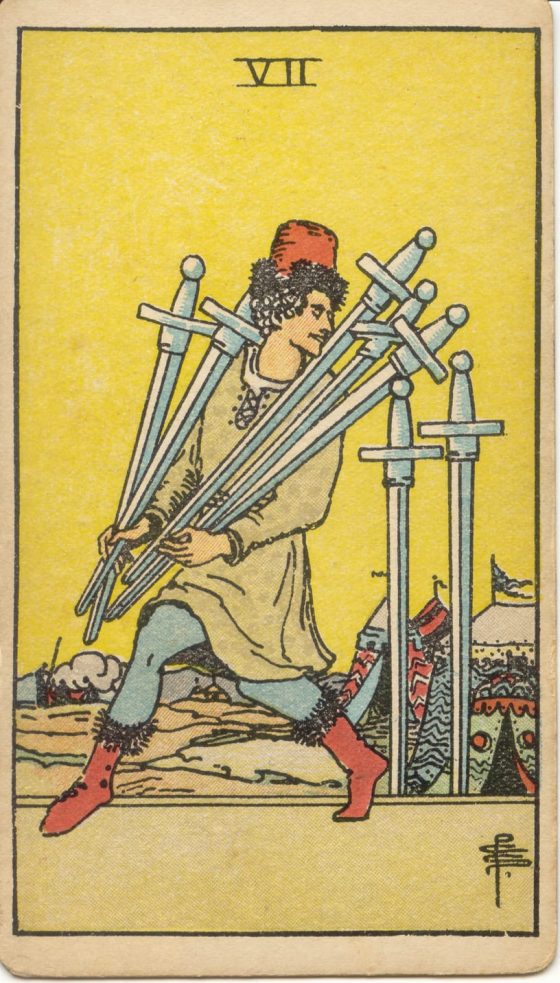
A man walks away from a camp carrying five swords by their blades, looking back over his shoulder. The Seven of Swords is a card about taking what you can carry, and it does not say whether he is right to.
- concealment
- strategy
- acting alone
- taking
- evasion
- exposure
- confession
- abandoned plan
- return
- second thoughts
What the card shows
A man in a red cap and soft boots moves across the foreground on tiptoe, his body turned away from the camp behind him and his head twisted back over his shoulder to look at it. He carries five swords gathered against his chest, gripping them by the blades rather than the hilts, with the points trailing behind him.
Two more swords stand upright in the ground where he has left them, hilts uppermost. Behind him, to the right of the card, are the striped tops of tents and a row of pennants. A small group of figures stands some distance off, near what appears to be a fire. The background is flat yellow. His mouth is open slightly and he is smiling.
Upright meaning
The Seven of Swords is a person leaving with what they can carry. Five swords out of seven, held badly, taken from a camp that is still occupied. Whether he is a thief, a defector, or somebody making a sensible exit is not stated, and every serious reading of this card starts by admitting that.
Upright it usually describes acting alone and acting quietly: a plan not shared, a resource taken, a departure arranged without announcement. Sometimes that is deception. Sometimes it is what a person has to do to get out of a situation they were never going to be released from. The card is far more interested in the method than in the morality.
Two details keep it honest. He is holding the blades, which cuts, and he left two swords behind, which means this did not work completely. Beside The Magician the same dexterity reads as skill rather than theft. Beside The Moon it reads as a situation where nobody has the full picture, including him. Beside Five of Swords it becomes the sequel to a fight that somebody lost.
Upright in love
Something is being kept back. In a relationship reading this can be a secret, a plan made privately, a person preparing to go before saying so, or simply a part of someone's life they have decided not to share. The card marks the concealment without describing what is concealed.
It is not proof of an affair, and using it that way is the single most damaging thing done with this card. What it will support is the observation that one person is operating with information the other does not have. That is worth naming, it is not the same as an accusation, and a reading that turns it into one has gone well past what the picture shows.
Upright in work
Working around a system rather than through it. Taking a client, a method, a piece of work or an idea and leaving with it; interviewing quietly; routing around a manager. It also covers the ordinary version, which is doing something unilaterally because asking would have produced a no.
As advice the card is pragmatic rather than approving. If you are going to act alone, be honest with yourself about what carrying it this way costs. Notice that he left two swords behind: solo plans usually collect less than they hoped and leave a trace anyway. Whether the situation justifies it is a question for you, not for the tarot.
Upright in money
Money moved quietly, or money that is not where it is supposed to be. It can describe careful private planning, an arrangement not disclosed, or a sense that something in a shared financial picture is not being shown.
Nothing here is financial advice, and the card cannot tell you that anybody has taken anything. What it supports is a much smaller claim: somebody is operating on information that others do not have. If that is you, count what carrying it costs. If you suspect it is someone else, the reasonable step is a question, not a conclusion drawn from a picture.
Upright as feelings
Guarded. As someone's feelings, this is a person keeping their own counsel, either because the feeling is not settled or because sharing it would commit them to something. It can be evasion and it can be self-protection. The card describes the withholding and refuses, deliberately, to describe the motive behind it.
Upright as advice
Decide whether you are being strategic or evasive, and use a test rather than a feeling: would you be comfortable if the person affected knew exactly what you are doing? If yes, proceed and stop calling it sneaking. If no, that discomfort is the information, and the card is asking you to look at it rather than move faster.
Reversed meaning
Reversed, the Seven of Swords has two readings that run in opposite directions, and both are common.
The first is exposure. The plan comes out, the thing is returned, the person confesses or is caught. Most books lead with this and it covers a real situation: the moment a private arrangement stops being private. Whether that is a disaster or a relief depends on cards this one cannot see, and on whether anyone was actually harmed.
The second is the plan abandoned before it happens. Somebody thinks better of it, or loses their nerve, or realises the swords are too heavy to carry. This reading is quieter and it does not always come with a moral: plenty of good decisions look like a failure of nerve from the outside.
Waite's own reversed list for this card is largely about advice and instruction being given, which is a third possibility and bears no relation to either of the above. It is a reminder that the received meaning of this card and its printed source have drifted a long way apart, and that the drift happened without anyone announcing it.
Reversed in love
Either something hidden coming into the open, or a person deciding not to do the thing they were preparing to do. Both change the situation and only one of them is visible. If the spread is full of conflict, read the disclosure. If it is quiet, consider that somebody has stepped back from a plan and never mentioned it, which happens more often than readings tend to allow.
Reversed in work
Something coming to light at work, or a private plan that gets dropped. The first is the resignation already written, the arrangement that surfaces, the shortcut somebody notices. The second is the person who was going to leave and has decided to stay, usually without telling anyone that either decision was made. The card does not say which, and it does not predict the consequences of the first.
Reversed in money
A financial arrangement becoming visible, or one abandoned before it started. This is the reversal where an undisclosed account, debt or commitment comes into the open, and equally where somebody decides against a scheme they had half-built. Nothing here is advice about money, or a claim that anyone has done anything wrong. It marks a change in what is known, not a change in what is true.
Reversed as feelings
Something being admitted, or something quietly dropped. As someone's feelings, this can be a person ready to say what they have been holding back, or one who has given up on a hope without announcing it. Both read as a change in temperature from the outside, and the card does not say which has occurred.
Reversed as advice
Say the thing before it is found. If you have been holding something back, choose the moment and the person rather than waiting to be asked, because the version you volunteer is a different conversation from the version that gets discovered. If the plan is already dropped, tell whoever was counting on it.
Symbolism in the 1909 image
The five swords. Held against the chest by the blades rather than the hilts, points dragging behind. It is the worst possible way to carry them. Whatever he has taken is cutting him while he leaves with it, and Smith drew that deliberately.
The two left behind. Standing upright in the ground, hilts uppermost, exactly where they were. He could not manage all seven. The card is a partial success at best, and readings that treat it as a clean getaway are ignoring two sevenths of the picture.
The backward look. His body goes one way and his head goes the other. He is not away yet, and the thing he is most concerned with is behind him.
The tents. Striped, with pennants, drawn as a camp rather than a house. What he is leaving is temporary and shared, which changes the reading: this is not burglary, it is something taken from a group he belonged to.
The distant figures. A small group standing off to the right, near a fire. They are not chasing him and they may not have noticed anything. The card leaves the question of whether he was seen entirely open.
Where this meaning came from
The card began as seven swords on a pip, in the fifteenth-century Italian packs where tarot was a game and none of the cards carried a meaning.
Divinatory readings arrived through eighteenth-century France, with Antoine Court de Gebelin and then Etteilla assigning interpretations across the deck. The Egyptian ancestry attached to tarot in that period was invented, and the readings produced alongside it were frequently arbitrary.
What makes this card unusual is the gap between its picture and its text. Waite's entry in The Pictorial Key to the Tarot (1910) reads: design, attempt, wish, hope, confidence, also quarrelling, and a plan that may fail. There is no theft in it anywhere. The modern reading of the Seven of Swords as the deception card is built almost entirely on Smith's drawing, against the accompanying commentary rather than from it.
That is worth stating plainly. Smith was given a written brief and produced an image so specific that it overwrote the meaning it was meant to illustrate. She was paid a flat fee, signed the card with her initials, and the deck went out under Waite's name and the publisher's.
The common misreading
The first misreading is the accusation. This card lands in a spread and gets delivered as somebody is lying to you, sometimes with a guess at who. It cannot see a person it was not dealt about. What it can support is that something in the situation is not being shared, which is a description rather than a name, and the distance between those two is the distance between a reading and a rumour.
The second is reading it as a successful escape. He is holding blades, he is looking backwards, and he left two swords in the ground. Nothing in the picture says he got away with it. The card describes an attempt in progress, which is very close to what Waite's own word for it was.
The third is the moral certainty. The figure is assumed to be in the wrong, and the querent is either warned about him or quietly accused of being him. People take what they can carry and leave for a great many reasons, including good ones, and a reader who cannot hold that open is not reading the card so much as judging it.
Questions to sit with
- What are you not telling the people this affects, and what would change if you did?
- Would you still be doing it this way if asking directly were an option?
- What is this costing you to carry, specifically?
- Which two swords did you leave behind, and did you choose to leave them?
Pull this card in a real spread.