- Card number
- 18
- Arcana
- Major Arcana
- Suit
- Major Arcana
- Element
- Water
- Rank
- Trump
- Roman numeral
- XVIII
- Zodiac attribution
- Pisces
- Yes or no reading
- It depends
The Moon
A card about not being able to tell what you are looking at. The Moon describes a stretch where perception is unreliable, and it declines to say whether the thing frightening you is real.
- illusion
- uncertainty
- anxiety
- intuition
- concealment
- clarity
- disclosure
- confusion
- release
- self-deception
What the card shows
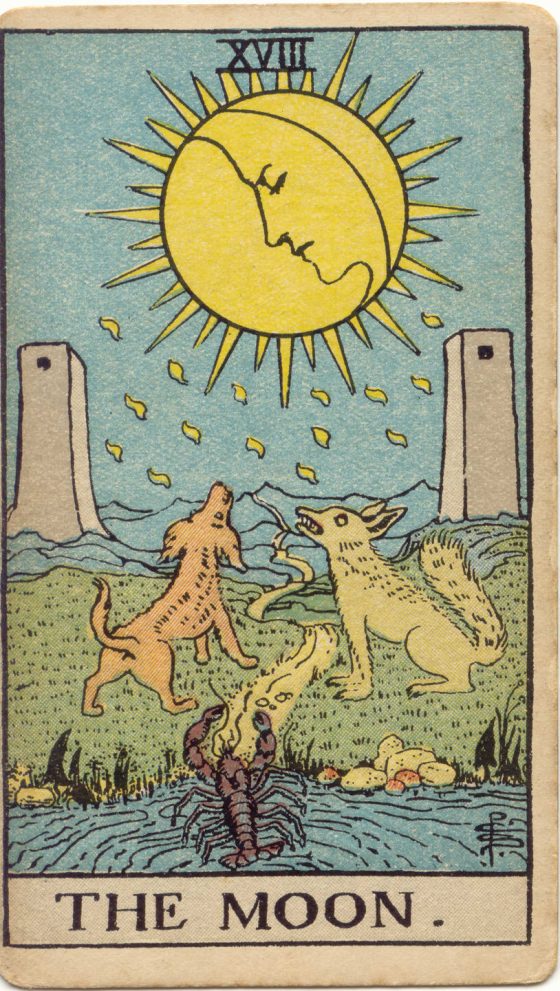
A large moon fills the upper third of the card. It is drawn as a full disc with a crescent face in profile inside it, ringed by straight yellow rays. Beneath it, fifteen small yellow shapes hang in the air, curled like flames or drops. Two grey towers stand at either side, each with a single dark window near the top.
On the ground below, a dog and a wolf face each other with their heads raised and mouths open. Between and behind them a pale track runs back toward low hills. In the foreground a crayfish is emerging from a pool of water at the bottom edge of the card, front claws clear of the surface. Reeds and stones line the bank.
Upright meaning
The Moon is the deck's card for unreliable information. Not lies told by other people, though it can be that. More often it describes a situation the querent cannot see clearly because of where they are standing in it: fear, tiredness, longing, or a story they have been telling themselves long enough that it now looks like evidence.
Drawn upright, it usually marks a period rather than an event. Something is unresolved and the querent is filling the gap with interpretation. The card is not saying the interpretation is wrong. It is saying it has not been checked, and that the conditions for checking it are poor. This is why The Moon so often accompanies questions the querent has already asked three times.
There is a route through it. The track between the towers goes somewhere, and the card does not say the journey fails. What it withholds is reassurance about what is waiting. Beside The Star, which precedes it, the calm of that card starts to look premature; beside The Sun, which follows, The Moon reads as the last stretch before something becomes plain.
Upright in love
In relationship readings The Moon is about the gap between what is happening and what is being imagined about it. Silence read as rejection. A change in tone read as a decision. The card appears constantly in questions about someone who has gone quiet, and it is describing the querent's night rather than the other person's intention.
It can also mark genuine concealment, and the honest position is that the card does not distinguish the two. Anxiety and accurate suspicion look identical from inside. What The Moon rules out is settling the question by thinking harder about it. If there is something to know here, it will be established by asking, not by reading.
Upright in work
At work The Moon describes incomplete information presented as a complete picture. A restructure nobody will confirm, a manager whose mood is being parsed for meaning, a role whose boundaries were never written down. The querent is usually spending real effort on interpretation that a single direct question would settle.
It also appears for work that is genuinely obscure to outsiders: research, creative work in its unformed stage, anything where you cannot yet show what you are doing. That version of the card is not a warning. Compare The High Priestess nearby, which describes knowledge deliberately withheld rather than fog.
Upright in money
In money questions The Moon points at figures nobody has actually looked at. An arrangement whose terms were skimmed, a subscription still running, a shared cost that was agreed verbally and remembered differently by each person.
It is not a card of loss. It is a card of not knowing, which is a different and more fixable problem. Where a decision is pending, the card is describing the quality of the information rather than the merits of the choice. The reasonable response to The Moon in a money position is to go and read the document.
Upright as feelings
Feelings that have not been named, or have been named wrongly. As someone's feelings, The Moon usually means something is present and unspoken, and that the person may not have a clear account of it themselves. It is a poor card for concluding that someone is hiding something deliberately. Confusion and concealment are drawn the same way here.
Upright as advice
Write down the thing you believe is happening, then write down the evidence for it in a separate column. Do it on paper. The Moon's characteristic failure is not being wrong; it is not noticing how little of the belief rests on anything you could show someone else.
Reversed meaning
Reversed, The Moon divides, and the two readings pull in opposite directions.
The first is the fog lifting. Something that has been unclear for a while resolves, often undramatically: a question gets asked, a document gets read, a person says the thing plainly. This is the reading most books lead with, and it is genuinely common. The relief is real and usually earned.
The second is the fog thickening while the querent stops noticing. Reversed, the card can describe someone who has adjusted to unclear conditions and now treats them as normal. The anxiety is gone, which feels like progress, but nothing was ever established. This version is harder to spot precisely because it is comfortable.
Neither is the default. Look at what surrounds it. Cards of action and clarity nearby support the first; cards of stasis or avoidance support the second. If the querent has been asking the same question for months and reports feeling fine about it now, that is the second reading, whatever they say.
Reversed in love
Either something that was murky is finally being said out loud, or the querent has stopped asking and called that peace. The reversal is often drawn after a conversation that clarified less than it seemed to. Where the question is about trust, the card reversed does not deliver a verdict; it asks whether the reassurance you received actually addressed the thing you were worried about, or simply changed the subject warmly.
Reversed in work
Information arriving, or the querent giving up on it arriving. The first looks like a decision finally being announced. The second looks like someone who has stopped chasing an answer and reorganised around its absence. Both produce calmer people. Only one produces better decisions. Ask whether anything was actually confirmed in the last month, or only accepted. The distinction is checkable, which is what makes this reversal useful.
Reversed in money
Either the numbers are becoming visible after a period of not looking, or the avoidance has become settled enough to feel like a system. Reversed, this card frequently marks the point where someone knows roughly what they will find and is managing the timing of finding it. Nothing here says the position is bad. It says it is unmeasured, and that measuring it is available.
Reversed as feelings
Something surfacing, or something submerged so long it no longer registers as a feeling at all. Reversed, the card often describes a person who would answer honestly if asked and has simply never been asked. That is a more ordinary situation than the card's atmosphere suggests. Ask the plain question before assuming the complicated answer.
Reversed as advice
Ask the one question you have been circling, in plain words, of the person who can actually answer it. Not a hint, not a test, not a message designed to produce a reaction you can interpret. The reversal of The Moon rewards exactly one thing, and it is directness.
Symbolism in the 1909 image
The dog and the wolf. Two canines, one domesticated and one not, both with their heads raised toward the moon. Usually read as the tamed and untamed parts of the mind. Smith drew them almost identically in posture, which undercuts the tidy division the reading depends on.
The crayfish. Climbing out of the pool at the bottom of the card, front claws already on land. Waite associated it with the deep mind surfacing. It is also the only figure in the picture that is making progress, and it is the least attractive thing in the frame.
The two towers. Grey, identical, each with one dark window, standing on either side of the track. Commonly read as a gate. Nothing in the drawing shows what they are for, whether they are occupied, or whether the path between them is guarded.
The falling shapes. Fifteen curled yellow forms below the moon, usually called yods after the Hebrew letter. Waite treated them as a kind of dew. They fall in the same shape on other cards in the deck, so their meaning here is inherited rather than local.
The moon's face. A crescent profile drawn inside a full disc, eyes closed or lowered. The card is called The Moon and shows two moons at once, full and crescent, occupying the same space. Most commentary passes over the contradiction.
Where this meaning came from
The moon card is one of the oldest and least stable in the deck. Fifteenth-century Italian versions vary widely: some show two astronomers measuring, some a woman holding a crescent, some a spinner. The dogs, the towers and the crayfish are not a medieval inheritance. They arrive later, in the Marseille pattern, and Smith worked from that lineage rather than from anything Italian.
The occult reading is eighteenth-century French. Court de Gebelin's essays of 1781 declared the tarot an Egyptian survival, and Etteilla turned that into a working divination system within a few years. The Moon's association with deception and error dates from this period. There is no evidence for the Egyptian claim and there never was.
Waite's 1910 The Pictorial Key to the Tarot gives the card an unusually gloomy gloss for him, describing a place of unrest and imagination lit by a light that deceives. That phrase has propagated further than almost anything else he wrote. Smith's drawing is less committed than the text: the animals are not menacing, the path is open, and the crayfish is simply climbing out. She was paid a flat fee for the whole deck and signed the cards only with her monogram.
The common misreading
The Moon is routinely read as proof that someone is lying to you. It is not evidence of anything. The card describes conditions in which a person cannot see clearly, and those conditions are produced as often by the querent's own fear as by another person's conduct. Using this card to confirm a suspicion is using it to license a conclusion you brought with you.
The second misreading is treating it as a warning to do nothing. Fog is not a stop signal. There is a track drawn through the middle of the card, and the crayfish, the least dignified thing in the picture, is the one making progress. Compare Eight of Cups, which shows someone leaving in poor light rather than waiting for better. The card counsels checking, not freezing, and the difference matters because freezing feels responsible.
The third is subtler. Because The Moon is atmospheric and slightly frightening, it gets used to make ordinary situations feel significant. A colleague being short with you, a friend replying slowly, a partner having a bad week. Most of what this card is drawn for has a mundane explanation that a direct question would produce in under a minute.
Questions to sit with
- What do you believe is happening that nobody has actually told you?
- Who could answer this question directly, and what has stopped you from asking them?
- Which parts of your account of this would survive being said out loud to the other person?
- Are you more afraid of the answer or of continuing not to have one?
Pull this card in a real spread.