- Card number
- 19
- Arcana
- Major Arcana
- Suit
- Major Arcana
- Element
- Fire
- Rank
- Trump
- Roman numeral
- XIX
- Planetary attribution
- Sun
- Yes or no reading
- Yes
The Sun
The clearest card in the deck, and the least complicated. The Sun describes conditions where things can be seen plainly and said plainly, which is a smaller claim than happiness and a more useful one.
- clarity
- vitality
- success
- openness
- warmth
- delay
- pretence
- dimming
- overconfidence
- deflation
What the card shows
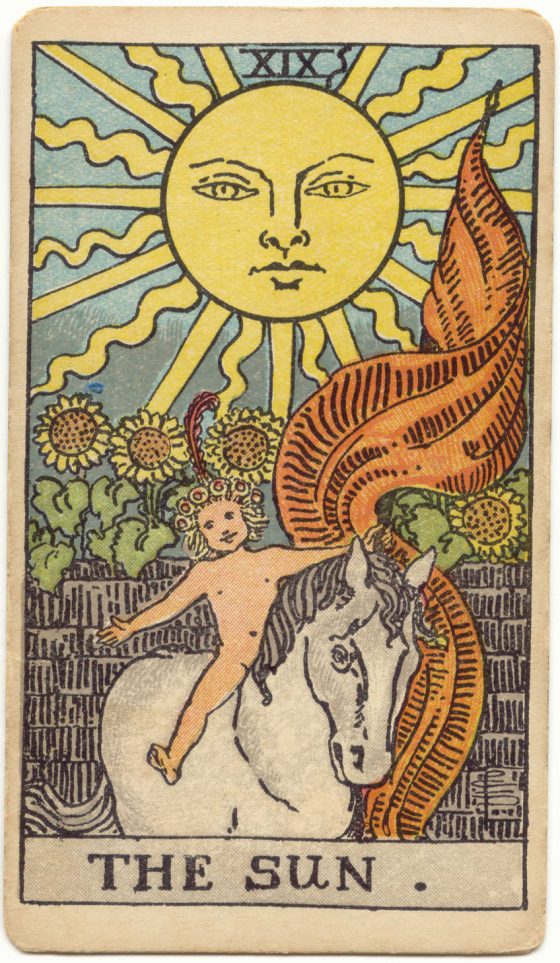
A large sun with a human face occupies the top half of the card. Its rays alternate between straight and wavy. Below it, a naked child sits astride a white horse, facing forward with both arms open. The child wears a wreath of flowers with a single red feather standing up from it, and holds nothing.
A long orange banner streams behind the child on a staff, filling the right side of the frame. The horse has no saddle, bridle or reins. Behind them runs a grey brick wall, and above the wall four sunflowers turn toward the front of the card rather than toward the sun. Green foliage shows above the wall between the flowers. The ground is not visible.
Upright meaning
The Sun is the least ambiguous card in the deck, and that is its actual content. Where most cards describe a situation that could be read two ways, this one describes conditions in which things are visible: the facts are known, the position is stated, nobody is guessing at anybody's meaning. That is rarer than happiness and more consequential.
Drawn upright it usually marks a stretch in which effort produces a recognisable result, and in which the querent can say what they want without strategy. Books call it joy and success, and it is often both. But the card's mechanism is clarity rather than reward. Things go well here because nothing is hidden, not because the situation was fortunate.
It is also a card without caution in it. The child rides with no reins, no saddle and nothing held. That is either confidence or an absence of any means of stopping, and the drawing does not say which. Beside The Moon, which precedes it, The Sun reads as genuine resolution; beside a card of overreach it reads as someone who has stopped checking because things are going well.
Upright in love
In relationship readings The Sun describes a connection where both people know where they stand. Not necessarily a new one, and not necessarily an easy one. What marks it is that the terms have been said out loud and nobody is managing anybody's impressions.
It reads well for questions about whether something is real, and badly for questions about whether something is safe. The card shows a child on an unbridled horse, which is not a picture of caution. Where the querent is asking about someone else's feelings, The Sun is one of the few cards that supports a plain answer, because the situation it describes is one where feelings are not being concealed. That still says nothing about what happens next.
Upright in work
At work The Sun usually means the thing you have been doing is now visible to the people who decide. Credit landing where it belongs, a project that can finally be shown, a role whose expectations are written down and agreed.
It is a strong card for anything public: presenting, teaching, launching, being the named person on something. It is a weaker card for detailed or defensive work, because it carries no caution at all. Compare Six of Wands, which is the same recognition seen from the outside and is more concerned with the audience than with the work. The Sun does not care who is watching.
Upright in money
In money questions The Sun usually means the position is what it appears to be. No hidden terms, no surprise, nothing waiting in a drawer. That is worth more than it sounds, and it is most of what this card offers here.
It is not a card of quantity. Nothing in the image indicates scale, and reading it as a windfall is reading in something that is not drawn. If a decision is pending, The Sun says the information is sound. Whether the decision is sound is a separate question, and the card does not answer it.
Upright as feelings
Warmth that is not being rationed. As someone's feelings, The Sun is the most straightforward card in the deck: what they feel is roughly what they have shown, and there is no second layer to work out. Querents often find this harder to accept than a difficult card, because it removes the puzzle they came with. Compare Ten of Cups, which shows the same warmth at rest rather than in motion.
Upright as advice
Say the plain version out loud to the person who needs to hear it, this week, without softening it into a hint. The Sun's advantage is visibility, and visibility is not a mood you wait for. It is a thing you do by stating your position in words someone else could repeat back.
Reversed meaning
Reversed, The Sun does not go dark. It goes two different kinds of dimmer, and they need separating.
The first is delay. The clarity described upright is coming but has not arrived: an announcement held back, a result not yet confirmed, a conversation everyone knows is due. Nothing is wrong. The card reversed here is simply describing a gap in time, and it is the milder of the two readings.
The second is harder. Brightness maintained on the surface while the substance has gone: enthusiasm that is being performed, a success being talked about more than it is being had, cheerfulness used to prevent a difficult conversation rather than to survive one. This reading is common and rarely welcome, because from inside it feels like keeping a good attitude.
The spread decides. If the surrounding cards describe waiting, read delay. If they describe effort spent on appearances, read the second. And if the querent's account of the situation is noticeably sunnier than the cards around it, the reversal is probably describing that gap.
Reversed in love
Either the clarity is late and everyone is still waiting for someone to say the obvious thing, or the good humour has become a way of not saying it. The second is the one worth watching for. A relationship can be perfectly pleasant and still have a question in it that neither person has been willing to put into a sentence. Reversed, The Sun often marks precisely that arrangement.
Reversed in work
Recognition delayed, or recognition for something that did not happen the way it is being described. The first is ordinary and passes. The second is a reputational position that has to be maintained, and maintaining it costs more each month. Reversed, this card is worth taking seriously when the story about a project has become smoother than the project. Ask what was actually delivered.
Reversed in money
Either good news that has not been confirmed yet, or a position being described more comfortably than it is. Reversed, the card does not indicate loss. It indicates a gap between the account and the arithmetic. That gap is easy to close and uncomfortable to open, which is why it stays open. The card offers no view on the figures themselves, only on whether anyone has looked at them recently.
Reversed as feelings
Warmth that has not been expressed yet, or warmth being performed past the point where it is felt. Both look friendly. The difference shows in what happens when something goes wrong, which is information the querent may already have and may not have counted. It is worth counting.
Reversed as advice
Stop performing the good version for one conversation. Pick the person you have been giving the cheerful account to, and give them the accurate one instead, including the part you have been leaving out. Reversed, this card is fixed by subtraction rather than effort. There is nothing to build here, only something to say.
Symbolism in the 1909 image
The child. Naked, unarmed, holding nothing, riding without reins. Read as innocence and as the self before self-consciousness. The posture is worth noticing: the arms are open, which is trusting, and also means both hands are off the horse.
The white horse. No saddle, no bridle, no bit. Books read it as controlled power. The drawing shows the opposite of control, or at least the absence of any apparatus for it, and the horse's expression is entirely placid.
The banner. Large, orange, and streaming behind. Waite associated the colour with vitality. It is the biggest object in the lower half of the card and the child is not looking at it, which is a reasonable picture of how reputation works.
The wall. Grey brick, running across the middle of the card, separating the garden from whatever the child is riding into. It is the one piece of structure in an otherwise open image, and the card gives no indication of what is on the far side.
The sunflowers. Four of them, above the wall. Sunflowers track the sun, which is presumably why they are here, and Smith drew them facing the viewer instead. Whether that is a mistake, a compositional choice, or a joke about who the light is actually for has never been settled.
Where this meaning came from
The sun trump is one of the few cards whose imagery stayed comparatively stable. Fifteenth-century Italian versions show a figure beneath a sun, sometimes a woman with a distaff, sometimes a child. Early Italian decks did not agree on the subject at all. The Marseille pattern settled on two children behind a wall, and that wall is the detail Smith kept while removing the second child.
The card acquired its divinatory meanings in eighteenth-century France, through Court de Gebelin's claim that the tarot preserved Egyptian priestly doctrine and Etteilla's commercial system built on top of it. The claim was false. The meanings stuck anyway, and The Sun has been glossed as happiness and material success continuously since.
Smith drew the 1909 version to Waite's brief, and Waite's The Pictorial Key to the Tarot of 1910 gives it one of his least hedged entries: the light of the world, and attainment. He was normally more careful than that. The single child on horseback is the deck's own invention rather than an inheritance, and it is the version nearly every English-language book now describes. Smith received a flat fee, no royalties, and initials in the corner.
The common misreading
The Sun is the card most often used to overrule the rest of a spread. It turns up alongside three difficult cards and the reading becomes about The Sun, because it is the one everybody wants. This is the single most common failure in reading it. The card describes clarity, not immunity, and it does not cancel what is drawn next to it.
The second misreading is treating it as a forecast of happiness. It shows a set of conditions, not an outcome. People are perfectly capable of being miserable in clear conditions, and the card has no view on whether the querent will enjoy what becomes visible. Occasionally what The Sun brings into the open is something the querent preferred not seeing.
The third is the missing apparatus. The horse has no reins and the child holds nothing. Read as a picture of trust that is charming; read as a practical arrangement it means there is no way to stop or steer. Where a spread already suggests overcommitment, that detail is the card's actual warning, and it is the part almost nobody mentions. Compare The Fool, which has the same problem drawn more honestly.
Questions to sit with
- What is currently true about this that you have not said out loud to anyone?
- If things are going well, what specifically is producing that, and is it repeatable?
- Who would give a noticeably different account of this situation than you would?
- What would you need to stop doing to keep this going?
Pull this card in a real spread.