The two methods
Coins and yarrow stalks give different odds
Both methods produce a hexagram and both are traditional, but they do not weight the changing lines the same way. Each page gives the procedure and its probabilities.
Six lines, built from the bottom up, by either of the two classical methods. The result links straight through to the hexagram it produced and to the text of every line that moved.
The Yi answers what you ask, so the wording matters more than the casting. Questions of the form is now the moment work; questions of the form what will happen do not.
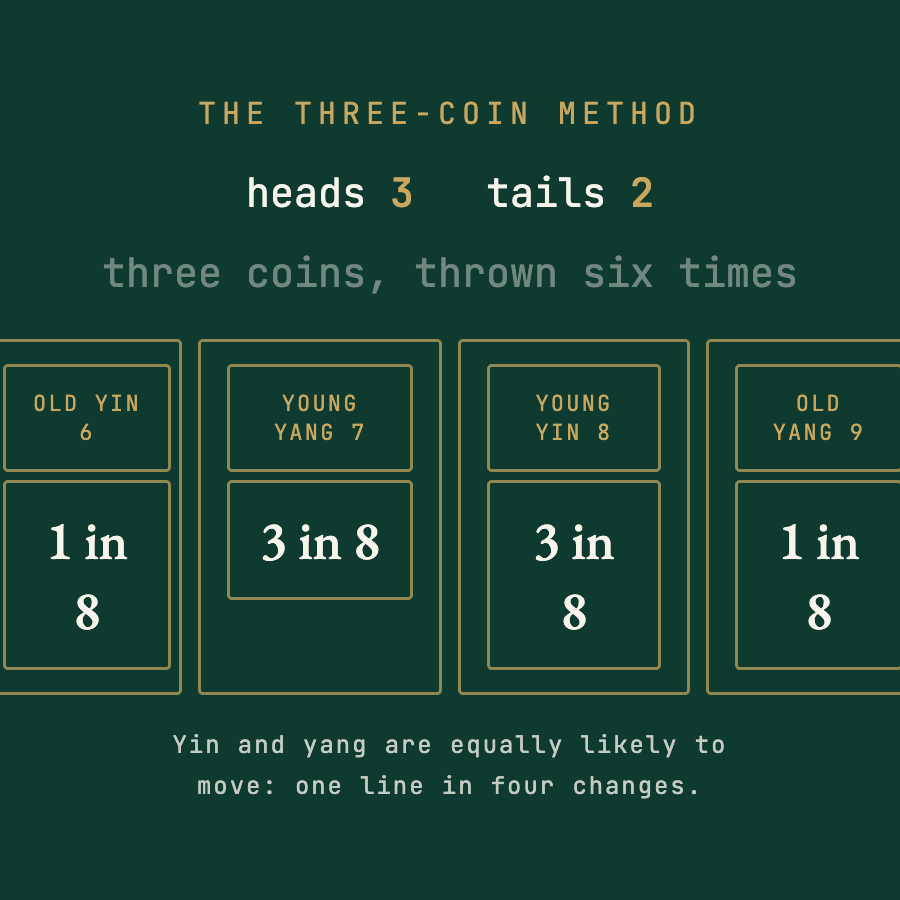
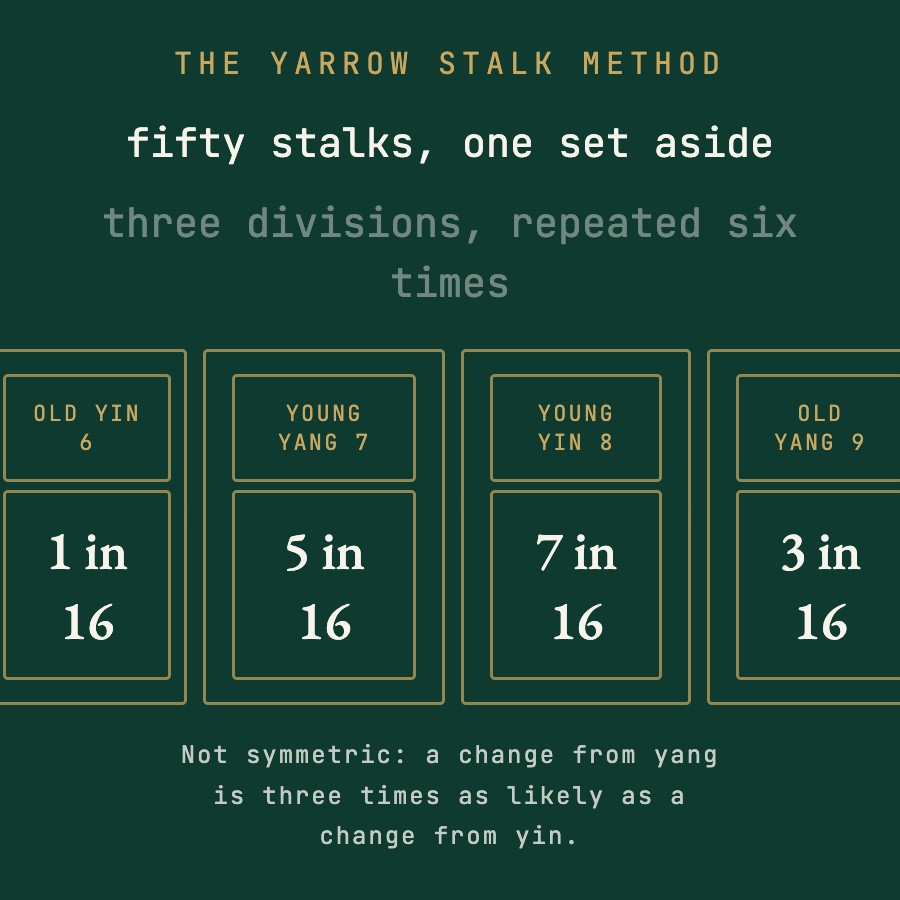
Both methods move a quarter of all lines. What differs is which way a moving line goes, and that is the whole of the argument between them.
Six throws, built from the bottom up. Build downwards and you have not made a small error, you have read somebody else's hexagram.
Three classical readings of the same six lines, computed from the figure rather than looked up, and checked against all sixty-four pages on this site.
Both methods move a quarter of lines, so this distribution is the same for coins and stalks. A casting with no moving line at all is the second most common result there is.
Castings are kept in this browser, on this device, and nowhere else.
This tool generates six numbers and looks up a table. It does not predict, and it knows nothing about you or your question. The link you can copy reproduces the same casting rather than a new one, which is the only sense in which any of it is fixed.
The I Ching is unusually good at describing timing and position, which is why people bring it questions of the form is now the moment rather than what will happen. It is not an answer machine, and a hexagram that reads badly is describing a situation, not issuing a verdict.
They are not the same oracle. Three coins give every line the same chance of moving: one in eight either way. The yarrow stalks do not, and their asymmetry is the older behaviour, which is why some readers hold that a change from yang is meant to be three times as likely as a change from yin. Neither is wrong. This tool shows you the odds for whichever you pick.
The casting is generated from a number that travels in the URL. Sharing the link shares that number, so whoever opens it sees the casting you saw. Press Cast again for a new one.
Then you read the Judgement and the Image of the hexagram you got, and no line text at all. A still hexagram is a complete answer, and reading line texts into it is the commonest mistake beginners make.
That is the one case with a genuine special rule, and it applies only to hexagrams 1 and 2, which have a seventh line text for exactly this situation. For every other hexagram, read the Judgement of the second hexagram.
No. The Wilhelm and Baynes text is still in copyright and is not reproduced here. The hexagram pages are written against James Legge's 1882 translation, which is in the public domain, rendered into plain English rather than pasted.
You can, and the tradition is fairly blunt about it: asking again usually means you did not like the first answer. If the second casting is meant to be useful, change the question rather than repeat it.
Both methods produce a hexagram and both are traditional, but they do not weight the changing lines the same way. Each page gives the procedure and its probabilities.