- Method
- Yarrow stalks
- Difficulty
- Advanced
The yarrow stalk method
Fifty stalks, divided and counted by fours, produce one line at a time through three separate divisions. It takes about a quarter of an hour per casting, and unlike the coins it does not treat yin and yang alike.
- yarrow stalks
- fifty stalks
- three divisions
- asymmetry
- classical method
How the method works
Begin with fifty stalks. Set one aside at the start; it takes no further part and is not counted again. Forty-nine remain, and those forty-nine produce a single line through three divisions.
First division. Split the forty-nine into two heaps without counting. Take one stalk from the right heap and hold it between the little finger and the ring finger. Count off the left heap in fours until between one and four stalks remain, and hold those. Do the same with the right heap. What you are holding is the residue, and it will be either five or nine.
Second division. Set the residue aside, gather what is left, and repeat the whole operation on it. This time the residue is either four or eight. Third division. Repeat once more; the residue is again four or eight.
Now score the three residues. Five and four count as three. Nine and eight count as two. Add the three scores and you get six, seven, eight or nine, the same four line values the coins produce. Six is old yin and moves, seven is young yang at rest, eight is young yin at rest, nine is old yang and moves.
Repeat all of that six times, building from the bottom line upward. Each line costs three divisions, so a full casting is eighteen divisions and a good deal of counting. The slowness is not incidental to the method; several traditions treat the interval as part of the consultation rather than as overhead.
What the odds actually are
The asymmetry comes out of the counting, and it is worth following once because it is the whole difference between this method and the coins.
The first division cannot produce a residue of four or eight; it produces five or nine, and not evenly. Nine requires both heaps to leave a remainder of four, which happens one time in four. Five happens the other three. So the first division favours the score of three, at three to one.
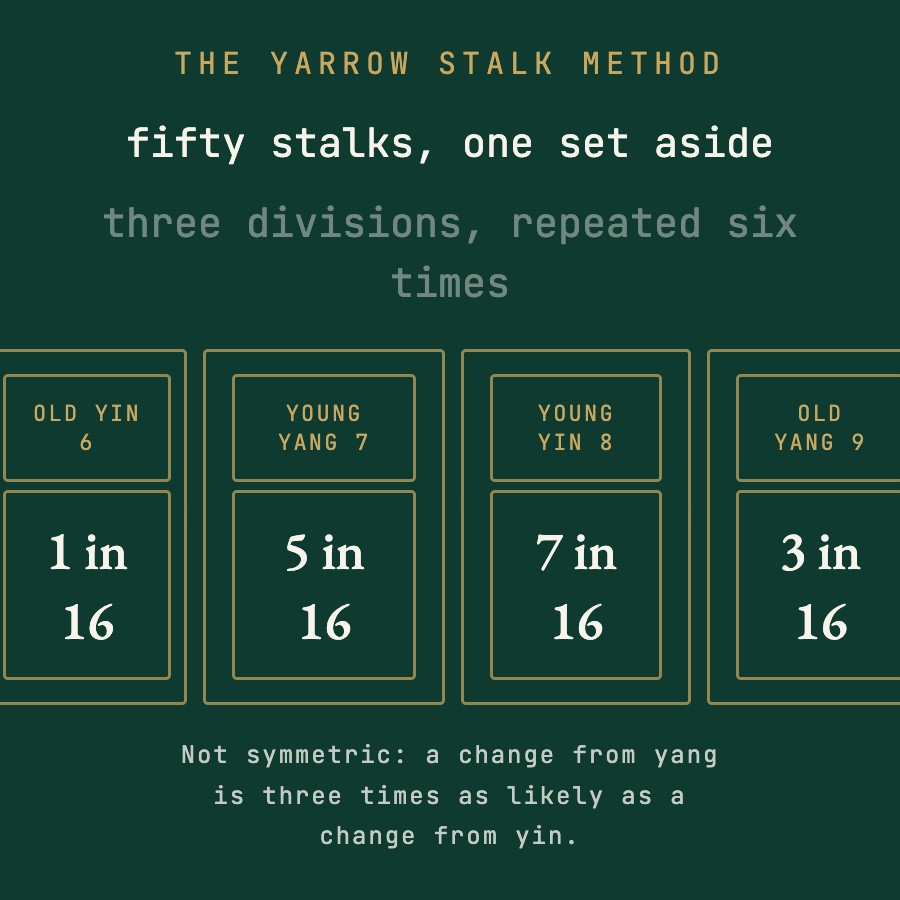
The second and third divisions produce four or eight, and those are close to even. Multiply the three together and the four line values fall out unevenly: old yin one in sixteen, young yang five in sixteen, young yin seven in sixteen, old yang three in sixteen. Those are the figures this tool uses.
The consequence is the one that matters at the table. A yang line has a three in eight chance of being a moving line; a yin line has one in eight. A change out of yang is three times as likely as a change out of yin. The coins make both one in four and treat the two as interchangeable.
What is easy to miss is how much the two methods still share. Overall, yang and yin are equally likely under both, at one half each. Both move a quarter of all lines and average one and a half moving lines per casting. The odds of a still hexagram are identical, 729 in 4,096, and so are the odds of all six lines moving, one in 4,096. The number of lines that move has exactly the same distribution. What the stalks change is which of them moves, and therefore which hexagram you end up travelling towards.
How to read the result
Nothing about reading changes between the methods. The primary hexagram, its Judgement and its Image are the answer; the moving lines qualify it; the second hexagram shows the same situation from the other side of that movement.
What does change, subtly, is the texture of what you get over time. Because yin lines rarely move under the stalks, a hexagram heavy with broken lines tends to arrive still, or nearly so, and the reading rests on the Judgement rather than on line texts. A hexagram heavy with solid lines moves more, and produces busier castings with more to weigh.
Readers who use the stalks regularly often say the oracle feels less talkative in some moods and more in others. That is not mysticism. It is the arithmetic, showing up as texture. Take Hexagram 2, The Receptive, six broken lines: under the stalks a casting that lands there has close to even odds of arriving with nothing moving at all, where six solid lines would move something more than nine times in ten.
The trigram reading is unaffected. Kan, the abysmal, reads the same whichever way you arrived at it.
What to do with changing lines
The conventions for reading by the number of moving lines are the same whichever way you cast; the stalks only change how often you meet each case. This tool prints the applicable rule on screen.
None. The Judgement and the Image of the primary hexagram, and no line text. This is the single most likely outcome, at roughly one casting in six, and a still hexagram is a finished answer rather than a partial one.
One. The moving line carries the reading; the second hexagram indicates the direction.
Two. The upper of the two is generally governing, though practice varies and many readers weigh both.
Three. The middle of the three is commonly taken as governing, and the second hexagram carries more weight than the individual texts.
Four. Read the two unchanged lines of the second hexagram rather than the four that moved.
Five. Read the single unchanged line of the second hexagram.
Six. Read the Judgement of the second hexagram, except for Hexagram 1, The Creative and Hexagram 2, which carry a seventh line text for this case alone. At one in 4,096 you may cast for years without meeting it.
One stalk-specific point: because yin lines seldom move, castings that land on broken-line-heavy hexagrams reach the none and one cases more often than the coins would send them there. The rules do not change, but the mix of cases you actually encounter does.
Where this method came from
This is the older method, and the one the classical text presupposes. The procedure is described in the Great Treatise, the Xici, which forms part of the Ten Wings, the commentary layer that accreted around the core text of the Zhou yi and was largely in place by the Han dynasty.
The passage that describes it is famously terse, and it has been reconstructed rather than simply read. The received procedure, fifty stalks with one set aside, three divisions per line, counting by fours, is a reconstruction that most modern practitioners agree on, but the text does not spell out every step, and there are variant reconstructions that produce slightly different odds. Anyone who tells you the ritual has been performed identically for three thousand years is overstating what survives.
Yarrow, Achillea millefolium, was used because the stalks are straight, light and strong enough to handle repeatedly, and because the plant carried its own associations. Practitioners today often use bamboo or wooden equivalents, which changes nothing arithmetically.
The method's authority rests on age rather than on results, and it has never been shown to produce better readings than the coins. What it does produce is the older set of frequencies, which is a real difference and a defensible reason to prefer it.
The common misreading
The first misreading is that the stalks are more accurate. There is no sense in which that can be true, and no test that could establish it. What they are is older, and older is a claim about provenance rather than about correctness. If you prefer the stalks, prefer them for the frequencies or for the pace, both of which are real.
The second is the opposite, and just as common: that the difference is a technicality with no reading consequence. It is not. Over many castings the stalks push yin lines towards stillness and yang lines towards movement, which systematically changes which second hexagram you arrive at. That is not a rounding error. It is a different oracle wearing the same numbers.
The third is treating the fifteen minutes as dead time to be endured. The tradition does not, and the practical case for the stalks is often made on exactly this ground: the interval between forming a question and receiving an answer is long enough that the question usually changes. Whether that counts as an advantage is a matter of taste, but it is the one difference that is definitely not arithmetic. Hexagram 29, The Abysmal, on repetition and depth, is a fair emblem for it.
Questions to sit with
- Do you have fifteen minutes, and is the question worth fifteen minutes?
- Which residues did you get on the first division of each line, five or nine?
- If you are choosing the stalks over the coins, is it for the frequencies or for the pace?
- Did the question you started with survive to the end of the casting?
Put a real question to the lines.