Ten bodies, the lunar node, the angles and the major aspects, computed in your browser from a real ephemeris. Three house systems, and a plain statement of what each one cannot do.
The positions are astronomy and they are checkable. They come from a standard open-source ephemeris, and against the published equinox and solstice instants the Sun lands within a thousandth of a degree. What those positions are taken to mean about a person is not astronomy, and no mechanism for it has ever been demonstrated.
Three things this page deliberately does not do. It does not guess your time zone, because there is no server here to look one up, so the time you enter is read as UTC. It does not include Chiron or the asteroids. And it does not offer Placidus above the polar circles, because there the system genuinely has no answer.
Because there is no server here to resolve a time zone from a place and a date, and getting it wrong by an hour moves the ascendant by about fifteen degrees. Asking you to convert is honest; guessing silently would not be. If you were born in London in July, subtract an hour for summer time before entering it.
Tick the box. The planets are still worth having: over twelve hours the Sun moves half a degree and the outer planets barely move at all. The Moon can shift six or seven degrees, so it may be near a sign boundary. The ascendant, the midheaven and the houses are simply not computable, and the tool leaves them out rather than showing you something invented.
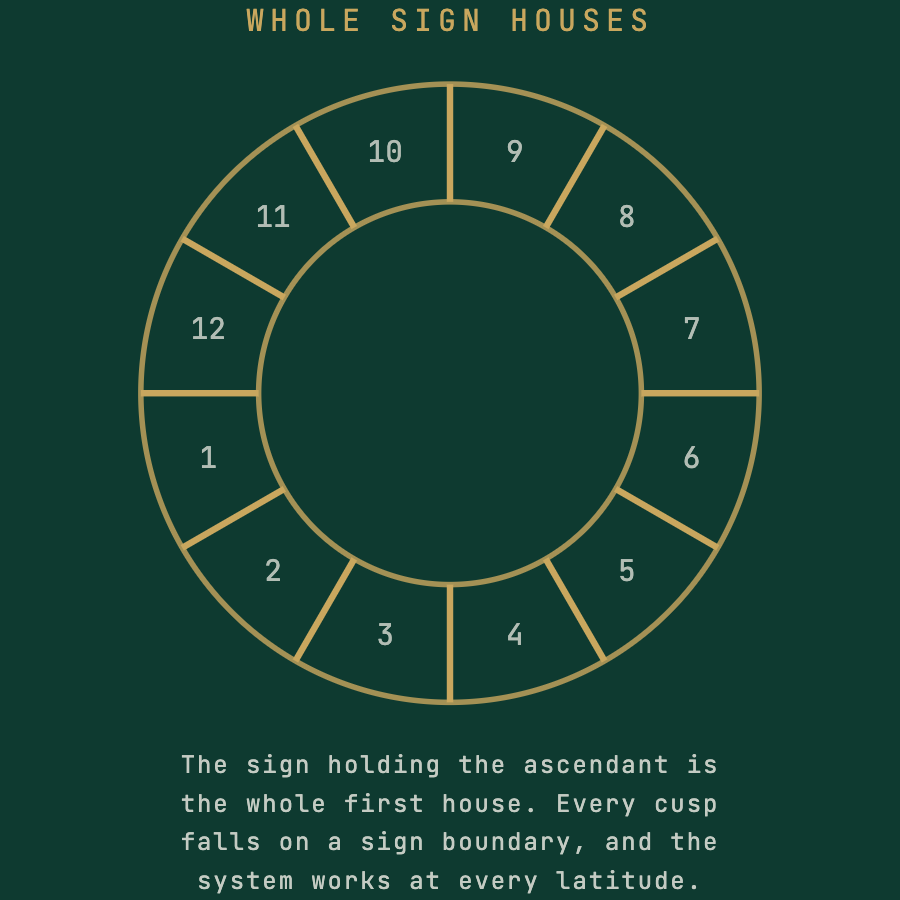
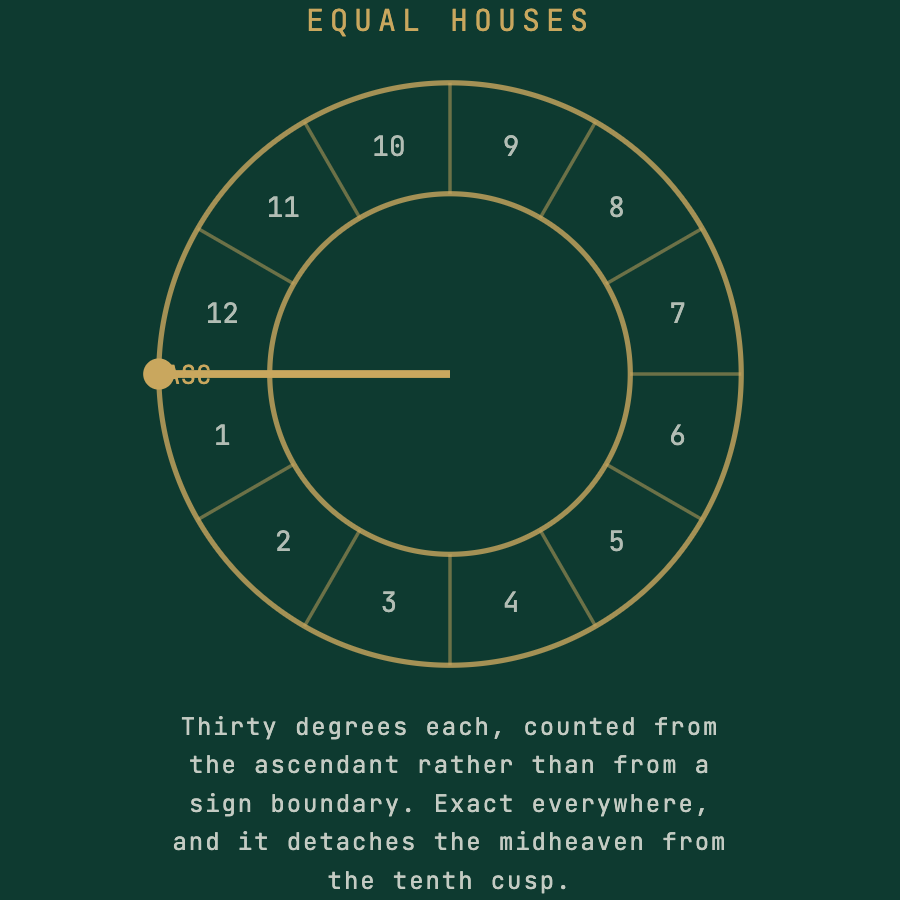
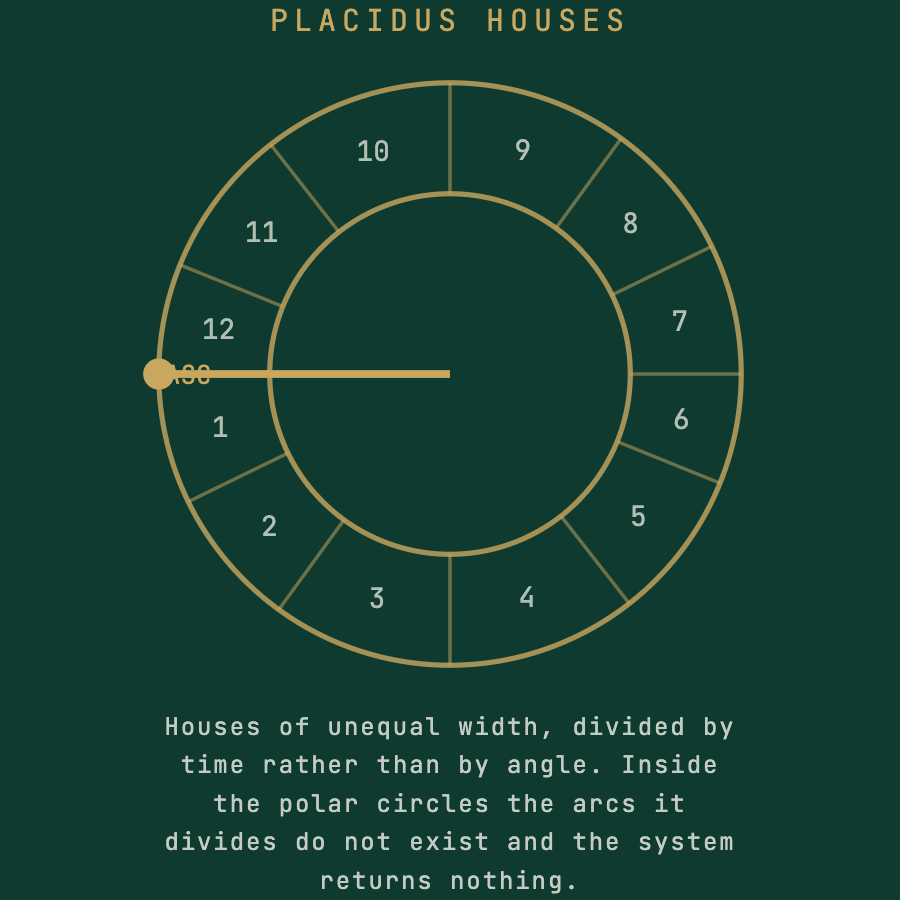
Whole sign is the oldest and the simplest: the sign containing the ascendant is the whole first house. Placidus is the modern default in the English-speaking world and divides the day into time arcs, which is why it fails near the poles. Equal houses are thirty degrees each from the ascendant. They genuinely disagree, and no evidence settles it, so the tool offers all three rather than picking one for you.
Because inside the polar circles the arcs it divides do not exist. A body that never rises has no semi-diurnal arc to take a third of. Software that returns a number anyway is returning an artefact. This one says so and falls back to whole sign.
The astronomy-engine library, which is open source under the MIT licence. Against the published equinox and solstice instants the Sun lands within about a thousandth of a degree. The Swiss Ephemeris is more precise still, but every JavaScript port of it is licensed AGPL, which would require this whole site to be open sourced, and the extra precision is meaningless when an aspect orb is six degrees wide.
Chiron is not in the ephemeris this tool uses, so it is left out rather than approximated. The node shown is the mean node, which is the smoothed average; the true node oscillates around it by up to about a degree and a half. The table marks it as mean so you know which you are reading.
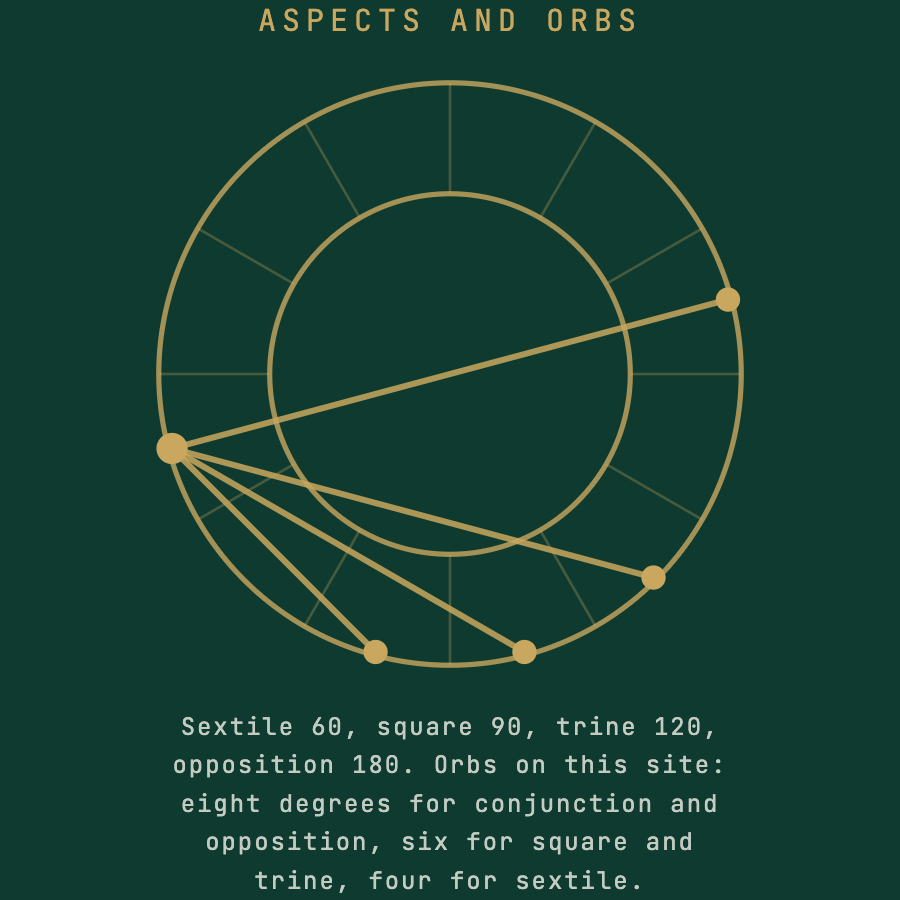
An aspect counts when the separation falls within these windows: conjunction and opposition eight degrees, square and trine six, sextile four. Those are the values the page actually computes with, and they do not overlap, so no pair of bodies can register as two aspects at once. Orb conventions are not standardised and a tighter set would report fewer aspects, which is why the numbers are printed here rather than left implicit.
Because this page measures aspects by angular separation alone. A body at twenty-nine degrees of Aries and one at two degrees of Taurus are three degrees apart, so they fall inside the conjunction orb. Traditional practice would say the two are in different signs and therefore form no aspect at all. Both positions are defensible and this tool takes the first; the aspects page sets out the disagreement so the output does not imply there is none.
No. That distinction needs the relative motion of both bodies at the moment of the chart, and this page does not compute it. Every aspect in the table is reported as a separation and an orb, with no claim about which direction it is heading.