- Kind of topic
- House system
Whole sign houses
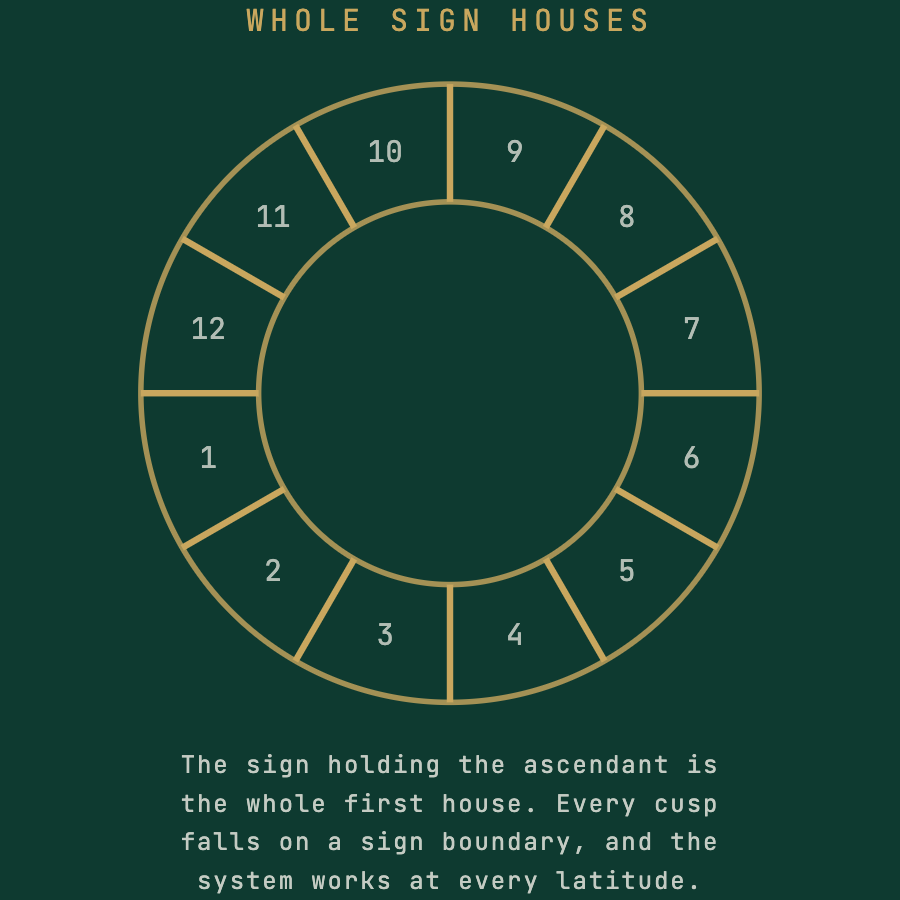
The sign containing the ascendant is the entire first house, and the eleven signs after it are the other eleven. It is the oldest system, it needs no solving, and it works at every latitude including the poles.
- whole sign
- house system
- hellenistic
- rising sign
- cusps
What it is
Whole sign houses make each house exactly one sign. Find the ascendant, take the sign it falls in, and that whole sign is the first house from its zeroth degree to its thirtieth. The next sign is the second house, and so on around the zodiac.
The consequence is that houses and signs are the same objects. If your ascendant is at nineteen degrees of Libra, your first house is Libra entire, your second is Scorpio entire, and the nineteen degrees does no further work. Two people born four hours apart on the same day in the same city can share a house layout exactly, provided the ascendant stayed inside one sign.
The midheaven is not a cusp in this system. It is still calculated and still shown, and it falls wherever the geometry puts it, most often in the ninth, tenth or eleventh house. Practitioners who use whole sign generally treat it as a separate significant degree rather than as a boundary.
How it is computed
There is nothing to solve. Given the ascendant's ecliptic longitude, the first cusp is that longitude rounded down to the nearest multiple of thirty degrees, and each following cusp is thirty degrees further on. The calculator on this site marks the result as exact, because it is: no iteration, no convergence criterion, no failure case.
All the astronomy lives upstream, in the ascendant. That calculation needs the local sidereal time, the obliquity and the latitude. Once it has returned a longitude, whole sign discards everything except which of twelve thirty-degree segments that longitude fell into.
That is worth stating plainly because it is the system's main structural property. The whole of the local information in a whole sign chart, all the latitude and longitude and clock time, is compressed into a single choice among twelve options. Everything else in the house layout follows by counting. It is the reason the system never fails and the reason its critics say it throws information away.
Because the only latitude-dependent step is the ascendant itself, whole sign houses are defined wherever the ascendant is, which is everywhere short of the geographic pole. There is no polar failure mode, and no latitude at which the twelve houses stop being twelve equal signs.
How to read it
Because house and sign coincide, whole sign makes rulership straightforward. The first house is a sign, that sign has a traditional ruler, and that planet is the chart ruler without any argument about which side of a cusp it sits on. The same holds for every house, so the chain of rulerships that traditional technique runs on stays clean.
It also removes a whole class of borderline cases. A planet at twenty-eight degrees of a sign is unambiguously in that house; there is no question of whether it is close enough to the next cusp to be read there instead. Practitioners who have moved from quadrant systems to whole sign often say this is the practical difference they notice first.
What it costs is the sense that houses have different sizes and weights. Every house is thirty degrees, so no house is emphasised by being unusually large, and the midheaven no longer marks the top of the chart. Whether that is a loss or the removal of an artefact is precisely what the argument between the systems is about, and it is not settled by anything either side can show the other.
How much the birth time matters
Whole sign is the most forgiving system for an uncertain birth time, and the reason is structural. Only the rising sign matters, so an error in the birth time changes nothing at all unless it moves the ascendant across a sign boundary.
Some numbers. The ascendant moves about fifteen degrees an hour, so ten minutes of error moves it roughly two and a half degrees. In an equal or quadrant chart that shifts every cusp by two and a half degrees and can reassign planets near a boundary. In a whole sign chart it does nothing whatever, unless you happened to be born within two and a half degrees of the start or end of a sign.
The failure mode is therefore all or nothing. Either the rising sign is right and the entire house layout is right, or the rising sign is wrong and every house is wrong by one. Since a sign rises in roughly two hours on average, an uncertainty of half an hour usually leaves the layout intact and an uncertainty of two hours makes it a guess. That is a cleaner risk profile than the gradual degradation quadrant systems suffer, though it is not obviously a safer one.
Where practitioners disagree
House systems are the sharpest live dispute in Western astrology and whole sign is one of the two poles of it. The case for it is historical and practical: it is what the earliest surviving Hellenistic texts describe, it keeps houses and signs aligned so that rulership works without exceptions, and it produces a defined answer at every latitude.
The case against is that it is not really a division of the sky. Quadrant practitioners argue that a house system ought to reflect where things actually are relative to the horizon and the meridian, and that a scheme which reduces all of that to one sign choice has stopped doing astronomy. They also point out that whole sign leaves the midheaven adrift, which they regard as discarding a real feature of the geometry.
Whole sign is standard in Indian astrology, was standard in the Hellenistic and early medieval West, and returned to Western use through the translation projects of the late twentieth century, which put the Greek sources in front of practitioners who had only ever seen quadrant charts. Quadrant systems dominate the modern English-speaking mainstream, mostly through Placidus. No evidence settles it, no experiment has been designed that could, and this site offers all three rather than choosing.
What the astronomy says
A house in any system is a division of the local sky rather than a region of space. Nothing is out there at a house boundary; the boundary exists because an observer at a particular place and moment drew it. That holds for whole sign as much as for the quadrant systems, but whole sign draws only one line and infers the rest.
The honest astronomical description of whole sign is that it is a zodiacal scheme with one local input. Which sign is rising depends on latitude, longitude and the exact instant. Everything after that is arithmetic on the zodiac and involves the sky no further. A whole sign seventh house is not the western horizon; it is the sign opposite the rising sign, which is a different claim and usually a different piece of sky.
That detachment is exactly why the system has no polar problem. Quadrant houses divide arcs that bodies trace between horizon and meridian, and inside the polar circles those arcs stop existing. Whole sign never asked about arcs. As long as the ascendant returns a longitude, and it does at any latitude short of the pole itself, the twelve houses follow by counting. Robustness here is a consequence of using less of the sky, not of modelling it better.
Where it came from
Whole sign is the oldest house system for which we have direct evidence. It is what the surviving Hellenistic Greek technical texts of the first centuries BCE and CE describe, and it remained standard through the Roman period, in the Persian and Arabic astrology that inherited from it, and in the early medieval Latin West.
It never stopped being standard in India, where houses counted as whole signs from the rising sign remain the normal practice. The Western abandonment is therefore the anomaly rather than the Indian retention, and it happened gradually through the later medieval and Renaissance period as quadrant systems spread.
By the twentieth century whole sign had effectively vanished from English-language practice, to the point where popular manuals did not mention it. Its return began in the 1980s and 1990s with organised efforts to translate the Greek and Latin sources directly, which made it obvious that the earliest practitioners had used something the modern textbooks had dropped. It is now in wide use again, particularly among practitioners working in traditional technique, and that recovery is about forty years old rather than continuous.
The common misreading
The commonest misreading is that whole sign is a simplified or beginner's version of a real house system. It is not a simplification of anything. It is older than the systems it is supposedly a simplification of, and the quadrant systems are the later development. Calling it basic gets the history exactly backwards.
The second is treating the fact that it always returns an answer as evidence that it is right. It always returns an answer because it asks less of the sky, not because it has solved a problem the other systems failed at. Robustness and accuracy are different properties, and a system that cannot fail is not thereby correct. This is worth saying on a page that has just spent several paragraphs praising the system's reliability.
The third is expecting a whole sign chart to agree with the quadrant chart you already had. It usually will not. Planets move house, the midheaven stops being the tenth cusp, and readings built on the old layout may not survive. That is not a bug in either system; it is what it looks like when two incompatible conventions are applied to the same sky. If switching systems changes your chart's meaning substantially, the honest conclusion is something about how much the meaning depended on the convention.
Questions to sit with
- Was your ascendant near the beginning or the end of its sign?
- If you have read your chart in another system, which planets change house here?
- Which of your house readings would survive every planet moving one house along?
- Does it matter to you which system is older, and if so, why?
Cast your own chart and see it in place.