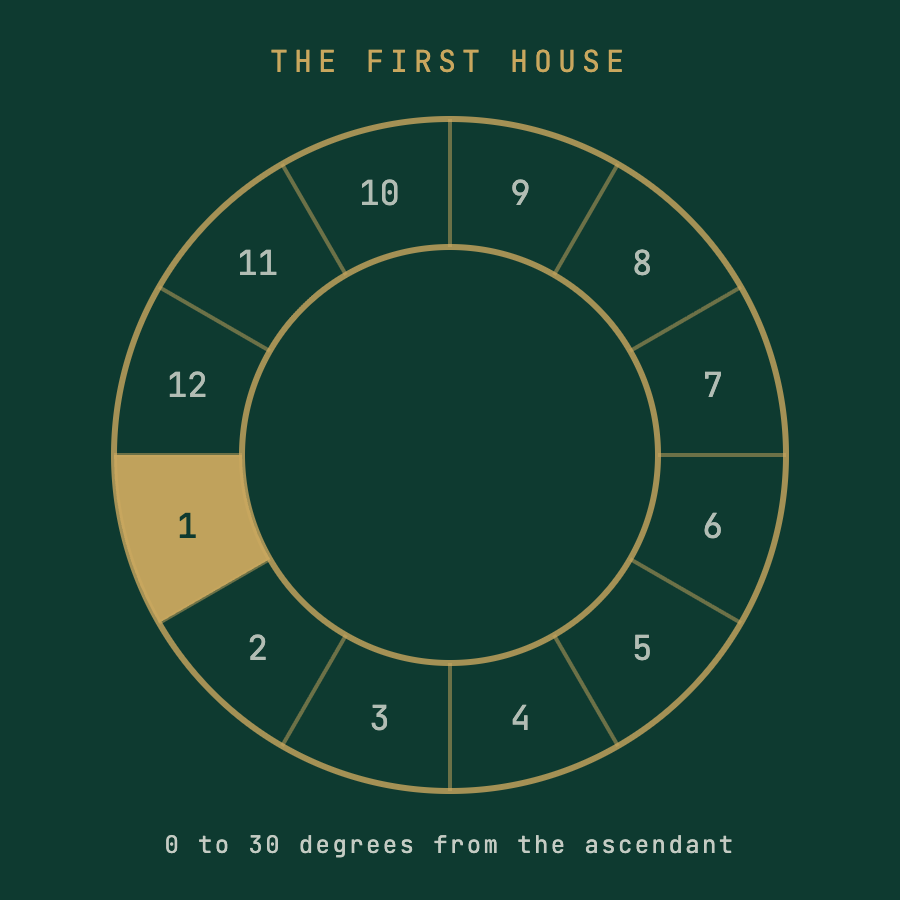
- Entry type
- House
- Number
- 1
- Element
- Fire
- Modality
- Cardinal
- Modern ruler
- Mars
The First House
The house that begins at the Ascendant, the degree rising on the eastern horizon at birth. It is read as manner and body: how a person arrives in a room, rather than what they are like once they have.
- self
- body
- appearance
- arrival
- manner
What this describes
The First House starts at the Ascendant, the point of the ecliptic that was rising over the eastern horizon at the moment and place somebody was born. Everything else in a chart is measured from there, which makes this the most birth-time-dependent thing in astrology and the part most often computed from a guess.
What it is read as describing is manner rather than character: the way a person enters a situation, the impression they make before anybody knows anything about them, physical bearing, and the reflexes they reach for when they do not yet know what is required. The tradition also gives it the body, which is why the older texts consulted it about physical constitution.
The most useful thing to understand is what it is not. The First House is not the self. Popular astrology often calls the rising sign a mask, implying something false over something true, and that framing is misleading in both directions. A manner is not a disguise, and it is not the whole person either. It is the part that arrives first and the part other people meet, and describing it as either superficial or definitive misses what the placement is actually good for. Compare the Seventh House directly opposite, which covers what a person meets in others.
What it does well
This house describes the capacity to make a beginning. Whatever sign is on the Ascendant and whatever planets sit here, the material is about initiation, the first move, and the willingness to be visible before you are certain of your ground.
Its practical value in a reading is diagnostic rather than flattering. Most people have some idea of what they are like inside and very little accurate information about how they land, and this is the one part of a chart explicitly about the gap between those two. Where a person's manner and their intentions are badly matched, this is where it shows, and knowing that is more useful than most of what a chart can offer. The tradition's association with vitality and physical presence holds up reasonably well in practice.
Where it goes wrong
The characteristic difficulty is a manner that has outlived its usefulness. Most people's first-impression reflexes were formed early, in a situation that required them, and they persist long after the situation has changed. Somebody whose bearing was protective at fifteen may still be deploying it at forty in rooms where it is doing nothing but creating distance.
The second difficulty is over-identification. Because this house is where a person is seen, it is easy to start managing the impression rather than living, and the effort of that is invisible to everyone else. The tradition also warns against reading this house as the whole person, which is less a personal failing than a failing of interpretation, though the two feed each other.
In relationships
In relationship readings this is the house of first impressions, in the literal sense: what somebody notices about you before anything has been said. Attraction to a rising sign is a real and shallow phenomenon, and the tradition is comfortable saying so.
The more interesting use is longer term. A mismatch between somebody's Ascendant and their Sun or Moon corresponds to the familiar experience of a person being quite different once you know them, and it explains a class of relationship difficulty where one partner feels they were sold something else. Nobody was lying. The manner and the interior were simply not the same thing, and neither party had a way to say so. This house cannot tell you how another person feels, only how they arrive.
In work
At work the First House covers presence: how somebody comes across in an interview, a first meeting, or any situation where a judgement gets made quickly on incomplete information. Those judgements are made constantly and this is the part of a chart that speaks to them.
Its practical content is about fit between manner and role. A forceful Ascendant in work requiring patience, or a reserved one in work requiring visible confidence, describes a friction people often experience as being bad at their job when it is more precisely a mismatch of register. None of that predicts a career. It describes an interface, and interfaces can be adjusted more easily than temperaments.
In money
The First House has little direct money content in the tradition, which allocates that to the Second House next door. What it contributes indirectly is the way a person presents in situations where money is decided: negotiations, rates, asking.
Nothing here is financial advice and none of it forecasts anything. The examinable question the symbolism raises is whether somebody's manner in those conversations is helping them, since presence and preparation are different things and only one of them is what this house describes. Somebody can be entirely competent and consistently underpaid because of how they arrive at the discussion.
How to read it in a chart
Read the sign on the cusp first, since that is the Ascendant and sets the manner. Then read any planets in the house, which are conventionally taken as strongly expressed and visible in the person. Then read the ruler of the Ascendant sign and where it sits, which is the traditional method and considerably more informative than the rising sign alone.
The First House is routinely confused with the Sun sign, and the distinction is worth keeping: the Sun is what somebody is oriented toward, the Ascendant is how they arrive. It is also confused with Mars, since both can produce a forceful first impression, but Mars is what happens when a person meets resistance and this is what happens before there is any. Everything in this house depends on an accurate birth time, and a chart built on an approximate one has an unreliable Ascendant and therefore unreliable houses throughout.
How it meets other placements
Between two charts, contact to the Ascendant is read as the immediate, physical, unaccountable part of attraction. A planet from one chart falling on another's Ascendant is one of the more reliably reported synastry effects in the sense that people describe recognising it.
What it describes is recognition rather than compatibility. Two people can register each other strongly and want entirely different lives, and this house has no access to that question at all. The comparison worth making is with the Seventh House opposite, since the axis runs between how somebody arrives and what they look for in another person, and those two are frequently in tension within the same chart.
The part people leave out
What popular astrology leaves out is that the rising sign has become the most flattering part of the chart. A great deal of writing about it is essentially a description of how attractive somebody is, and the language of first impressions makes that easy to disguise as analysis.
The harder material is available and rarely used. This house describes a manner that other people have to deal with, and the honest question is not what impression somebody makes but what it is like to be on the receiving end of it. A commanding Ascendant is also a manner that can make other people small; a gentle one can be a way of never being challenged. The tradition, which read this house for the body, was blunter about it being a real thing with consequences.
Where the symbol comes from
The Ascendant is not a symbol in the way a planet or a sign is. It is a geometrical fact: the intersection of the ecliptic with the eastern horizon at a given moment and place. The symbolism attached to it is derived from that geometry rather than from a myth.
The reasoning is straightforward and quite old. The horizon divides what can be seen from what cannot, so the point where the sky is emerging over it was taken as the point of emergence in general: birth, appearance, the moment something becomes visible. The Hellenistic term was the horoskopos, the hour-marker, and it is the origin of the English word horoscope, which originally meant this single point rather than a whole chart.
The association with the body follows from the same logic. What appears first and is seen by everyone is the physical person, so the house of emergence became the house of the body. It is a chain of reasoning by analogy rather than an observation, and knowing that makes it easier to use sensibly.
Where this meaning came from
Houses are a Hellenistic development rather than a Babylonian one. Babylonian astrology worked with signs, planets and omens, and had nothing corresponding to a twelvefold division of the local sky. The house system appears in the Greek-speaking Mediterranean around the first century BCE, and it is what turns astrology from an interpretation of the sky into an interpretation of an individual life.
The earliest method was whole sign houses: the sign containing the Ascendant is the entire First House, the next sign the Second, and so on. That system was standard through late antiquity, was largely forgotten in the West, and has been widely revived since the 1980s through the work of translators recovering Hellenistic material.
The quadrant systems that dominated the intervening centuries, Placidus above all, divide the space between the angles by time or by other geometric schemes. Placidus became the default in English-language astrology largely because those were the tables that got printed cheaply and widely from the nineteenth century, not because anybody demonstrated it worked better. The psychological reading of the First House as identity and self-image is a twentieth-century layer on top of all of this.
What the astronomy actually says
A house is not a region of space or a constellation. It is a division of the local sky seen from one spot on Earth at one moment, and exists only relative to a horizon. Two people born at the same instant in different cities have identical planetary positions and completely different houses.
The Ascendant moves about one degree every four minutes, crossing a whole sign in roughly two hours. A birth time wrong by twenty minutes moves it about five degrees; wrong by two hours and the rising sign changes. Many people have only an approximate time, so a great many charts have an Ascendant that cannot be relied on.
House systems genuinely disagree, and this is not a technical footnote. Placidus, Koch, Campanus, Equal and Whole Sign place the cusps differently for the same birth data, and a planet can sit in the First House under one and the Twelfth under another. Time-based systems also fail at high latitudes, above roughly 66 degrees, where some degrees of the ecliptic never rise. No mechanism has been demonstrated by which any of this would act on a person.
The common misreading
The commonest misreading is that the rising sign is a mask concealing the real person underneath. That framing is popular because it flatters everybody twice, offering a public self and a secret truer one. A manner is not a deception. It is a genuine part of how somebody operates, and treating it as a costume encourages the useless habit of dismissing how you actually affect people as not the real you.
The second is confidence about an unreliable Ascendant. Because the rising sign changes roughly every two hours, it is the single most fragile element in a chart, and it is regularly read with total assurance from a birth time somebody's relative half-remembers. If the time is approximate, the honest response is to say the houses are provisional, not to interpret them anyway.
The third is ignoring the house system problem. Almost every site presents its house placements as facts, and a reader moving between two sites using different systems will be told two different things without either explaining why. The systems disagree by construction. Saying so costs nothing and is the difference between a page that respects the reader and one that hopes they do not check.
Questions to sit with
- What do people consistently assume about you on first meeting, and how far is it from accurate?
- Which of your first-impression habits were formed for a situation you are no longer in?
- Do you actually know your birth time, or is the chart you have been reading built on an estimate?
- What is it like to be on the other side of the way you arrive?
See where this sits in your own chart.