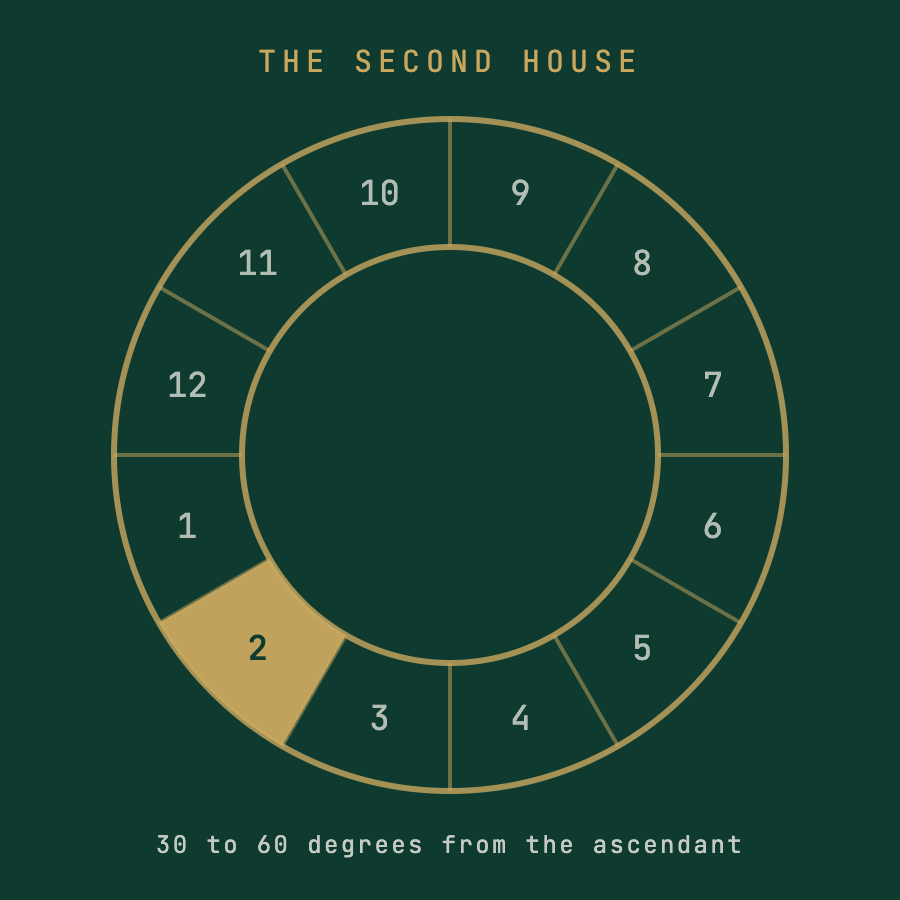
- Entry type
- House
- Number
- 2
- Element
- Earth
- Modality
- Fixed
- Modern ruler
- Venus
The Second House
The house of what a person holds: income, possessions, and what they treat as theirs. The older tradition read it as movable goods, and the modern reading of it as self-worth is a twentieth-century addition.
- resources
- money
- values
- security
- possession
What this describes
The Second House is the house of holdings. In the older tradition it covers substance, movable property, income and the resources a person can actually dispose of, and it was read alongside the questions a client in antiquity would have asked about their livelihood. It is the concrete part of a chart.
The modern reading extends it to self-worth, on the argument that what somebody values and what they think they are worth are versions of the same question. That extension is genuinely useful and it is also recent, dating from the psychological turn of the twentieth century. Both readings are in circulation and most sources present the newer one as though it were ancient, which is worth knowing when you meet it.
What the house does describe, on either reading, is a relationship rather than an amount. It is about how somebody holds things, what they count as security, and what they would find difficult to be without. That is why it can read the same for a person with a great deal and a person with very little, and why any interpretation that turns this house into a prediction about income has left the territory the symbolism can cover. Compare the Eighth House opposite, which covers resources that are not solely yours.
What it does well
This is the house associated with holding onto something, which is less glamorous than acquiring and considerably rarer. Whatever occupies it describes a capacity for steady accumulation, for maintaining what already exists, and for knowing the difference between what is wanted and what is merely available.
Its more interesting competence is discrimination about value. The house asks what a person actually treasures, and someone with a clear answer is unusual: most people's stated values and their spending diverge sharply. Where this house is working, the two match, and the practical result is that decisions get simpler because the criteria are known. The traditional link to the physical senses and to enjoyment of tangible things belongs here too, and it is not a trivial capacity.
Where it goes wrong
The characteristic failure is holding on past the point of use. This house describes attachment to what is already possessed, and the same steadiness that accumulates will keep hold of a possession, a habit or an arrangement long after it has stopped returning anything.
The second failure is substitution. Where security is the subject, it is easy for the accumulation of resources to stand in for whatever the security was originally about, and the substitution is invisible from inside because the activity looks productive. A person can be genuinely diligent and entirely unable to say what the diligence is for. The tradition also warns about identifying with holdings, which is the oldest observation about this house and still the most accurate.
In relationships
In relationship readings the Second House is more relevant than its reputation suggests, because a great deal of what couples argue about is here: money, possessions, and the unspoken differences in what each person considers worth spending on.
Those differences are rarely about arithmetic. Two people can have identical incomes and entirely incompatible ideas of what money is for, and this house is where that mismatch lives. It is also where the awkward question of financial dependence sits, in either direction, and that is worth naming plainly rather than romanticising. What the house cannot tell you is how somebody feels about you. It describes what they value, which overlaps with the question and is not the same as it.
In work
At work this house covers earnings rather than vocation, which belongs to the Tenth. It is about what the work pays and what the person does with it, and the two are treated as connected.
Its practical content is about pricing yourself. The house describes how somebody assesses the value of what they produce, and the modern self-worth reading is at its most useful here: a person who systematically undervalues their work usually does so consistently, across jobs and years, which is a pattern rather than a series of unlucky negotiations. That is an examinable claim about somebody's own history, and it is more useful than anything a chart could say about future income.
In money
This is the money house, and the honest thing to say is what that does and does not mean. It is read for the querent's own resources, income and possessions, as distinct from shared or borrowed money, which the tradition assigns to the Eighth.
None of this is financial advice and none of it forecasts anything about anybody's finances. What the symbolism supports is a question about relationship rather than quantity: what a person treats as security, whether that thing actually provides it, and whether their spending matches what they say they value. Those are answerable from a bank statement rather than from a chart, and any page claiming this house predicts wealth is selling something.
How to read it in a chart
Read the sign on the cusp for the manner of holding, planets in the house for what dominates the area, and the ruler of the cusp sign for where the person's resources are actually engaged. The traditional method leans on that last step and most popular writing skips it.
Because house cusps depend on birth time and on the house system used, the Second House is one of the placements most likely to differ between two charts of the same person calculated by different sites. Whole Sign and Placidus frequently disagree about whether a planet sits at the end of the First or the start of the Second. The house is also commonly confused with Taurus and with Venus, both of which share its territory through the natural rulership scheme, and the distinction matters: the house is an area of life, the sign is a manner, and the planet is a function.
How it meets other placements
Between two charts, contact into the Second House is read as one person materially affecting the other's resources or sense of security. In practice it describes the relationships where money becomes a live issue, whether through generosity, dependence or friction.
The pairing worth examining is against the Eighth House, since that axis is the whole question of what is mine and what is ours. Most long relationships eventually have to answer it explicitly, and a good many avoid doing so until circumstances force the conversation. The tradition's comparison language here is thinner than for the relationship houses, which is a fair reflection of how rarely this material gets discussed openly rather than of how much it matters.
The part people leave out
What popular astrology leaves out is that the self-worth reading, however useful, has become a way of avoiding the subject the house is actually about. Writing about the Second House now tends to be about believing in your own value, and much less about money, which is the thing most people would like help thinking about.
The avoidance is telling. Money is the least comfortable topic in most people's lives and the one where the gap between stated values and actual behaviour is widest, and turning the money house into a metaphor is a way of not looking. The uncomfortable version is a question rather than a description: what a person spends on is a better account of their values than anything they would say aloud, and the record already exists.
Where the symbol comes from
The Second House has no myth behind it, and that is worth stating because most of this material does. Houses are positional rather than mythological: their meanings come from where they sit relative to the Ascendant, not from a story about a god.
The reasoning that produced this one is visible in the Hellenistic sources. The Second is the place just below the eastern horizon, in the region that has not yet risen, and it was associated with what supports the emerging life rather than with the life itself. From there it becomes livelihood, substance, and the resources a person draws on. The ancient sources are not fully consistent about it, and some attach distinctly gloomier names to the same place.
The association with Taurus and with Venus comes from the natural wheel, in which the houses are matched to signs in order from Aries. That scheme is a later convenience rather than part of the original system, and it is the source of a good deal of blurring between house meanings and sign meanings in modern writing.
Where this meaning came from
The twelve houses appear in Hellenistic astrology around the first century BCE, and the Second is described from the beginning in material terms. The early Greek sources use language about livelihood and substance, and the questions the house answered were practical ones about property and income rather than about psychology.
Medieval and Renaissance astrologers kept it concrete. In seventeenth-century English practice, William Lilly's Christian Astrology of 1647 treats the Second as the house of a querent's estate, movable goods and profit, and uses it to answer specific questions about whether something lost would be recovered or a sum received.
The self-worth reading is twentieth-century. It arrives with the psychological reframing of the whole system, running through Alan Leo and then more fully through Dane Rudhyar and the humanistic astrologers of the middle of the century, who recast every house as an area of inner development. That reading is now so standard that many sources present it as the traditional meaning, which is precisely backwards: the material meaning is the old one, and the psychological gloss is about a hundred years old.
What the astronomy actually says
A house is a division of the local sky rather than a thing in space. It is defined relative to the horizon at one place and one moment, so it depends on latitude, longitude and an accurate birth time. Two people born at the same instant in different cities have identical planets and different houses.
House systems disagree with each other by construction, and this house is one of the more affected. Whole Sign, the oldest method, makes the sign after the rising sign the entire Second House. Placidus and the other quadrant systems divide the space between the angles, giving cusps at other degrees and houses of unequal size. The same planet can fall in the First under one system and the Second under another, and neither is a calculation error.
The distortion grows with latitude. Time-based systems break down above roughly 66 degrees, where some degrees of the ecliptic never rise, so far northern births can be undefined in Placidus. No mechanism has been demonstrated by which a division of the local sky would affect a person's finances.
The common misreading
The commonest misreading is that this house predicts how much money somebody will have. It does not, and it never claimed to in any of its layers. The traditional sources read it for the querent's resources in a specific question, not as a lifetime forecast, and the modern reading is about attitude rather than amount. Anybody offering a wealth prediction from a Second House placement has invented that.
The second is treating the self-worth reading as ancient. It is roughly a century old and it sits on top of a much older material meaning, and the difference matters because the two give different advice. The old reading asks what you have and what you are doing with it. The new one asks how you feel about yourself. Those are not interchangeable, and collapsing them lets a page avoid the concrete question entirely.
The third is a technical error with real consequences. Because house cusps depend on birth time and house system, a Second House placement is frequently not stable across two different calculations of the same chart. Readers routinely receive confident interpretations of a placement that would move if the site used Whole Sign instead of Placidus, and almost no source tells them so.
Questions to sit with
- What did you spend money on last month, and does it match what you say you value?
- What are you holding onto that has stopped returning anything?
- What would you need to have before you would call yourself secure, and have you ever tested that figure?
- Where does your sense of your own worth track your income, and would you defend that if somebody said it out loud?
See where this sits in your own chart.