- Entry type
- Sign
- Number
- 2
- Abbreviation
- TAU
- Element
- Earth
- Modality
- Fixed
- Polarity
- Receptive
- Modern ruler
- Venus
- Traditional ruler
- Venus
- Dates
- April 20 - May 20
- Symbol
- The Bull
- Traditional body rulership
- Neck and throat
- Matching tarot card
- The Hierophant
Taurus
The sign of what is worth keeping. Taurus describes the appetite for solidity, comfort and things that last, and the tradition treats it as a posture toward value rather than a verdict on anybody's ambition.
- steadiness
- patience
- comfort
- possessiveness
- persistence
What this describes
Taurus is the second sign and the first fixed one. Fixed signs sit in the middle of a season, when the weather has settled and nothing is changing, and that placement does most of the interpretive work. Where Aries starts, Taurus consolidates. The sign is earth, which the tradition associates with the physical and the practical rather than the abstract.
What it describes is the relationship between a person and what they have. Not acquisition for its own sake, the tradition is more specific than that. Taurus is read as the capacity to want a thing steadily over time, to build slowly, and to enjoy what has been built without immediately needing the next thing. That is a real and slightly unfashionable ability. It is also the sign least likely to be impressed by novelty.
The other half of the sign is resistance to change, and the tradition does not pretend this is a separate quality. It is the same one seen from the other side: what makes somebody able to hold a position for years also makes them slow to leave a position that has stopped working. Read next to Scorpio, its opposite, the pair describe what a person keeps and what a person destroys to make room.
What it does well
Taurus is good at staying. Most things that work require somebody to keep doing them after the interesting part is over, and this is the placement the tradition assigns to that. A garden, a business, a marriage, a skill: all of them are mostly maintenance, and maintenance is not a consolation prize.
It is also good at knowing what it likes. That sounds trivial and it is not. A great deal of unhappiness comes from people who cannot tell the difference between what they enjoy and what they think they should enjoy, and Taurus is described as unusually free of that confusion.
The third is reliability under pressure. Fixed earth does not panic. In a crisis the tradition puts this sign among the people who are still doing the practical next thing while everyone else is deciding how to feel.
Where it goes wrong
The failure is not laziness, which is the lazy reading. It is inertia with a justification attached. Taurus is very good at explaining why the current arrangement is fine, and the explanations are usually accurate, which is what makes them hard to argue with. The situation can be genuinely tolerable and still be a place somebody has been stuck for four years.
The second is possessiveness, and the tradition is direct about it. Applied to objects this is harmless. Applied to people it is the sign's worst habit: treating a relationship as something owned rather than something continuously agreed to.
Third, comfort is an effective anaesthetic. The specific Taurus trap is a life arranged so pleasantly that nothing ever becomes urgent enough to change.
In relationships
Taurus is read as loyal, physical and slow. Slow is the operative word: the tradition describes a sign that takes a long time to commit and then takes an equally long time to leave, and both halves are the same trait.
What it offers is steadiness. Somebody who turns up, remembers what you eat, and is still there in the third difficult year. That is undervalued by people who have not yet needed it.
The difficulty is that steadiness and stagnation are hard to distinguish from inside a long relationship. The sign is also prone to reading affection through provision, which works until the other person needed something that could not be bought or cooked. Where the question is about a specific person, Venus and the seventh house describe relationship behaviour more directly than a Sun sign does.
In work
At work Taurus is the person who finishes. Not the one with the idea and not the one who announces it: the one still there in month nine when the work has become dull and the deadline is real.
The tradition associates the sign with anything involving material things and long horizons: building, farming, food, money, craft. That list reflects the economy of the people who wrote it, but the underlying observation is about patience with slow feedback, which transfers to almost any modern job.
The limitation is adaptability. Taurus is poor in environments that reorganise every quarter, not because it cannot learn but because it resents relearning something that was working. Somebody with this placement in a fast-changing role is usually not failing at the job; they are paying an unusually high tax on the churn.
In money
This is the sign most associated with money, and the association is older than capitalism. Taurus is read as accumulating rather than speculating: preferring the thing you can hold, distrusting arrangements it cannot see the bottom of.
The tradition frames that as prudence and the shadow of it as hoarding. Both are the same behaviour at different volumes. What the sign describes well is the emotional weight money carries for some people, where a balance is not a number but a measure of how safe the world is. That is worth noticing precisely because it is not a financial judgement, and nothing on this page is one.
How to read it in a chart
The Sun in Taurus describes what somebody is building toward. The Moon in Taurus describes what they need in order to feel safe, which is usually more concrete than they admit: a routine, a room, a reliable morning. The Ascendant in Taurus describes a person who reads as calm on arrival whether or not they are.
The ruler is Venus, and Venus in Taurus and Venus in Aries produce very different versions of the same Sun sign. Traditional practice reads the ruler's condition first; a Taurus chart with Venus badly placed is not the placid picture the keyword lists suggest.
Taurus is most often confused with Capricorn. Both are earth, both are read as steady. Capricorn is cardinal and builds toward status and structure; Taurus is fixed and builds toward security and comfort. The difference is what the work is for.
How it meets other placements
The tradition reads Taurus as easy with the other earth signs, Virgo and Capricorn, and as complementary with water, which it is described as grounding. Fire is the classic friction: fire wants to move and fixed earth does not, and every popular account of this pairing is a description of that argument.
Modality is again the more useful lens. Taurus is fixed, and the other fixed signs, Leo and Scorpio and Aquarius, sit at ninety or a hundred and eighty degrees. Two fixed signs disagreeing is the most durable form of stuck available in the system, because neither will move on principle.
The point of the framework is to name where friction comes from, not to grade a relationship. Any account of compatibility built on two Sun signs is discarding almost all of the information a chart contains.
The part people leave out
What popular astrology leaves out about Taurus is fear of loss. The sign is written up as contented, and the tradition underneath is describing something more anxious: a person who wants solid ground because the alternative is intolerable, not because they are placid.
Read that way, the collecting, the routines and the reluctance to change all point in the same direction. They are not appetites. They are defences, and they work, which is why they are hard to give up.
The other omission is stubbornness as a form of avoidance. Refusing to move is a decision, and it is one of the few decisions that never has to be defended out loud. Taurus is unusually good at holding a position long enough that the question stops being asked.
Where the symbol comes from
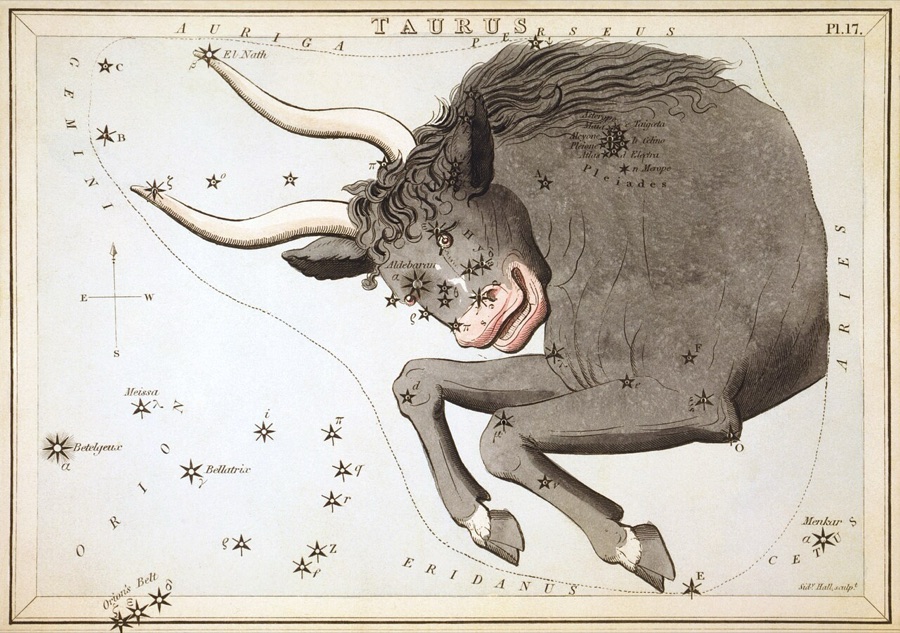
The Bull is one of the oldest figures in the sky. Babylonian sources call the constellation the Bull of Heaven, and it appears in that role in the Epic of Gilgamesh, sent by Ishtar to punish a man who refused her. The Greeks read the same stars as Zeus in bull form carrying Europa across the sea. Both stories are about desire and force, which is a long way from the placid animal in modern keyword lists.
The constellation mattered practically before it meant anything. Around 4000 BCE the Sun rose in Taurus at the spring equinox, which is why the bull turns up at the head of so many early calendars.
The glyph is a circle with a curve above it, conventionally read as a bull's head and horns. Like the other zodiac glyphs it is a medieval scribal shorthand rather than an ancient symbol, and it is not found in the Babylonian or Greek material at all.
Where this meaning came from
Taurus enters the record as a Babylonian constellation, the Bull of Heaven, and it is on the earliest surviving star lists. The twelve equal signs, as opposed to the constellations, were standardised in Mesopotamia by around 500 BCE for the practical reason that equal segments are easier to calculate with.
Everything about the sign's character comes later, from the Hellenistic synthesis worked out in Greek-speaking Egypt between roughly 100 BCE and 200 CE. That system assigned Venus to Taurus, made it fixed and earthy, and gave it the associations with wealth and the throat that persist today. Ptolemy's Tetrabiblos in the second century CE fixed the arrangement in a form that survived, through Arabic and then Latin transmission, into the Renaissance more or less intact.
The modern reading is a twentieth-century product. Alan Leo recast the signs as psychology around 1900, and the Sun sign column, invented for a British newspaper in 1930, turned twelve technical categories into twelve personality types. The gentle food-loving Taurus of the internet is barely a hundred years old and owes more to horoscope columns than to anything Ptolemy wrote.
What the astronomy actually says
The constellation Taurus is one of the few zodiac constellations that actually looks like something. Aldebaran, its brightest star, is an orange giant about sixty-five light years away, and it appears to sit in the V-shaped Hyades cluster without belonging to it: the Hyades are more than twice as far, and the alignment is a line-of-sight coincidence.
The Pleiades are in the same constellation, roughly four hundred and forty light years away. So is the Crab Nebula, the expanding remains of a star seen to explode in 1054 and recorded by Chinese astronomers at the time.
None of that is what tropical astrology means by Taurus. The tropical sign is a thirty-degree segment measured from the March equinox, and precession has moved it about one sign away from the stars it was named after. The Sun is in front of the constellation Taurus from roughly the middle of May to the middle of June, which is mostly the tropical sign of Gemini. Sidereal astrology keeps the stars instead. Neither system has ever demonstrated a mechanism, and these pages do not assume one.
The common misreading
The most common misreading of Taurus is as a compliment about being grounded. Delivered that way it flatters and tells you nothing. The tradition is describing a person whose relationship to change is difficult, and the same trait that makes them dependable in a crisis makes them very slow to leave something that has quietly stopped working. Reading only the first half is not reading.
The second is the food-and-luxury caricature. It is not wrong exactly, the sign has been associated with the physical and the pleasurable since the Hellenistic period, but it has flattened into a joke about cheese boards. What the older material actually describes is a person for whom the physical world is where meaning lives, which is a different and more serious claim.
The third is the stubbornness accusation, which is usually made by somebody who wants a Taurus to agree with them. The sign describes a high threshold for changing position. Whether that is stubbornness or integrity depends entirely on whether the position is right, and a birth chart cannot tell you which. Anybody using the word about another person is making a judgement and attributing it to the stars.
Questions to sit with
- What are you keeping that you would not choose again today?
- Is the current arrangement genuinely good, or only genuinely comfortable?
- When did you last change your mind about something that mattered?
- What would you have to give up to get the thing you say you want?
See where this sits in your own chart.