- Entry type
- Sign
- Number
- 10
- Abbreviation
- CAP
- Element
- Earth
- Modality
- Cardinal
- Polarity
- Receptive
- Modern ruler
- Saturn
- Traditional ruler
- Saturn
- Dates
- December 22 - January 19
- Symbol
- The Sea Goat
- Traditional body rulership
- Knees, bones and skin
- Matching tarot card
- The Devil
Capricorn
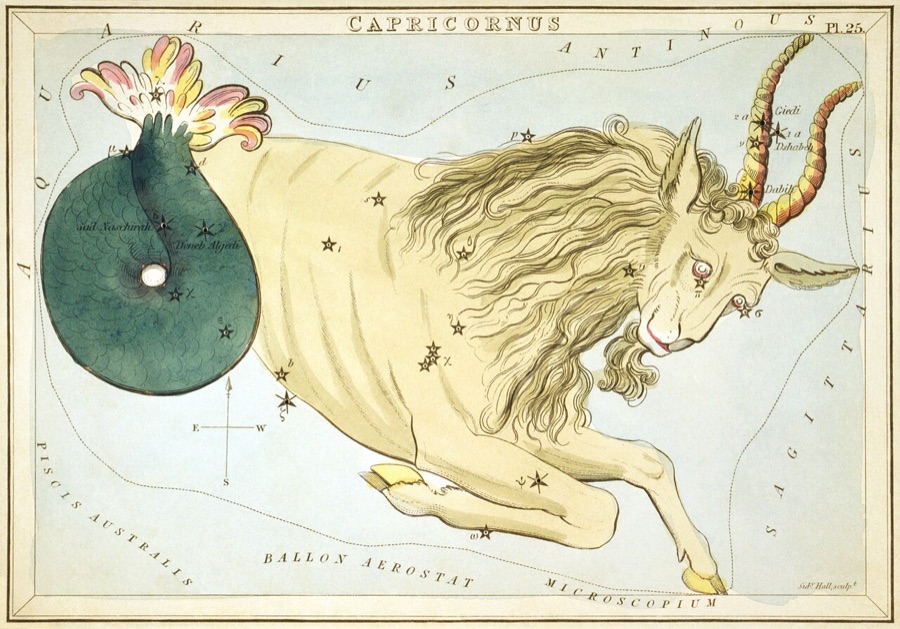
A cardinal earth sign ruled by Saturn, drawn as a goat with the tail of a fish. Capricorn describes the work of building something that outlasts you, and the cost of measuring yourself by it.
- structure
- endurance
- responsibility
- restraint
- ascent
What this describes
Capricorn is cardinal earth. Cardinal signs open a season and initiate; earth is the element of material consequence. The combination describes the impulse to start something that will still be standing later, which is a narrower and more interesting thing than ambition. Capricorn is not the sign that wants more. It is the sign that wants what it has built to hold.
The organising idea underneath it is time. Saturn, its ruler in both the traditional and the modern scheme, was the outer limit of what the ancient world could see, and the sign carries that sense of a boundary: finite hours, finite energy, a life with an edge on it. Capricorn placements tend to work backwards from the constraint rather than forwards from the wish, which makes them accurate about what is possible and prone to deciding too early what is not.
It is not a description of somebody's job or of how hard they work. A chart holds many signs at once, and Capricorn on the Moon reads very differently from Capricorn on the Ascendant, or Capricorn holding Saturn. What the sign describes is a posture toward effort rather than a quantity of it, and the same posture turns up in people whose lives look nothing alike.
What it does well
Capricorn is unusually good at the unglamorous middle of things. Where other placements produce starts, this one produces structures: the process that still works when nobody is watching it, the standard that holds after the enthusiasm has gone.
It is also honest about cost. Capricorn tends to price a plan properly, including the parts people prefer not to count, and that accuracy is why the placement gets trusted with things that matter. It says no early rather than late, which is less pleasant and considerably more useful.
The third strength is endurance without drama. Capricorn will carry something for years without announcing that it is carrying it, and the tradition's association of this sign with authority comes from that rather than from any appetite for command.
Where it goes wrong
The failure mode is treating a life as a project with deliverables. Capricorn placements are prone to deferring everything unquantifiable until an unspecified later, and the later does not arrive, because the criteria for having arrived keep moving.
There is a related problem with worth. If the sign measures itself by what it has built, rest reads as loss and any period of not producing reads as evidence about the person rather than about the circumstances. That is where the reputation for coldness actually comes from: not an absence of feeling, but a habit of postponing it.
Third, pessimism dressed as realism. Capricorn is frequently right about the constraint and wrong about whether the constraint is permanent.
In relationships
In relationships Capricorn is committed and undemonstrative, and the distance between those two things causes most of the trouble. The placement shows care through reliability: turning up, remembering, handling the thing nobody else wanted to handle. Read correctly that is substantial. Read as a substitute for saying anything, it leaves the other person guessing.
The recurring difficulty is that Capricorn treats a relationship as something to be built and maintained, which is not wrong, but it makes the sign slow to notice when maintenance has quietly replaced interest. Where a question is about how somebody feels, this placement describes how they act, and those are related without being the same.
In work
At work Capricorn is the placement most likely to end up responsible, whether or not it set out to be. It is competent at structure, patient with slow gains, and comfortable with hierarchy in a way that is often mistaken for careerism. The sign's actual interest is usually in the thing being well run rather than in occupying the top of it.
The cost is that Capricorn tends to accept work it is capable of rather than work it wants, on the grounds that capability is the more serious criterion. That is defensible for a decade and expensive over three. The Tenth House covers neighbouring ground and is frequently confused with this sign.
In money
Capricorn is the most naturally cautious placement with money in the zodiac, and the caution is structural rather than anxious: reserves, low fixed costs, a preference for things that keep their value over things that feel good now.
The characteristic error is not meanness. It is delay. Capricorn will underspend on the present for a security threshold that keeps rising, and the threshold is set by the sign rather than by the circumstances. Noticing that the number has moved is more useful than reaching it. None of this is guidance about anybody's finances, which turn on facts no chart contains.
How to read it in a chart
Capricorn slows and structures whatever it touches. On the Moon it produces emotional reserve and a tendency to handle feeling as a logistical problem. On Venus it reads as loyalty and a marked discomfort with display. On Mercury it is careful, sequential thinking, strong on consequence and slow to speculate.
Two confusions are worth naming. Capricorn is regularly conflated with Saturn itself, but a sign is a mode and a planet is an agent: Saturn shows where a limit is being enforced, while Capricorn shows the manner in which limits are met. The sign is also confused with the Tenth House, which shares the theme of standing and responsibility. The house is an area of life; the sign is a style. A chart can carry one without the other, and treating them as interchangeable loses both.
How it meets other placements
Element and modality explain more here than any list of matches. Capricorn shares earth with Taurus and Virgo, which usually means a shared assumption that things should be built to last and a shared impatience with talk. It sits comfortably with the water signs, which supply the feeling the earth signs are slow to name.
The instructive axis is Cancer, its opposite. Both are cardinal, both are organised around safety, and they disagree completely about where safety comes from: one from belonging, the other from structure. Opposition is not incompatibility. It marks one question approached from two ends.
The friction is with the mutable signs, where the argument is about whether a plan should survive new information.
The part people leave out
The part popular astrology leaves out is that Capricorn's discipline is often fear with a respectable job. The sign is admired for self-control, and self-control is genuinely one of its capacities, but a good deal of what looks like discipline is a refusal to be caught unprepared.
The second omission is what the sign does to other people. A placement that holds itself to a hard standard tends to apply that standard outward without noticing, and experiences doing so as fairness. Being measured by somebody else's Capricorn is a specific and unpleasant experience, and the person doing the measuring is usually the last to see it.
Where the symbol comes from
The symbol is not a goat. It is a goat-fish: the forequarters of a goat and the tail of a fish, and the hybrid is the older form. The Babylonian figure Suhurmasu, the goat-fish, is attested well before the Greeks and was associated with Ea, god of fresh water and of craft.
Most modern illustrations quietly drop the tail, which is a loss, because the hybrid is the interesting part. The creature climbs, and it also belongs to the water it came out of. A sign usually described entirely in terms of ascent is drawn with half its body in the element it cannot climb out of.
The glyph is a compressed figure that resolves into a horned head and a looped tail, and its exact derivation is unsettled.
Where this meaning came from
The zodiac itself is Babylonian, standardised into twelve equal thirty-degree divisions by roughly the fifth century BCE. Capricorn's figure is older than that scheme: the goat-fish appears in Mesopotamian art centuries earlier.
The sign's association with Saturn comes from the Hellenistic rulership scheme worked out in Egypt from about the second century BCE, in which each planet governs two signs arranged on either side of the Sun and Moon. Saturn, the slowest and furthest of the visible planets, was given the two signs furthest from the luminaries: Capricorn and Aquarius. That is a piece of geometry rather than a character judgement, though it has been read as one ever since.
Ptolemy's Tetrabiblos, around 150 CE, fixed the scheme in the form Europe inherited. The tarot correspondence shown on this page comes from a much later source, the Hermetic Order of the Golden Dawn in the 1880s, which paired Capricorn with The Devil. The character-based reading is younger still, from the psychological turn of the early twentieth century.
What the astronomy actually says
The Tropic of Capricorn is the clearest illustration of precession available. It is the latitude at which the Sun stands overhead at the December solstice, and it carries this sign's name because about two thousand years ago the solstice Sun sat in the constellation Capricornus. It no longer does. Precession has moved it into Sagittarius, and the line on the map keeps a name the sky stopped supporting.
The drift is steady. Earth's axis completes a precessional circle in about 25,772 years, roughly one degree every seventy-two years. Tropical astrology is anchored to the solstices and equinoxes rather than to the stars, so its dates do not move; sidereal astrology tracks the constellations, and its dates do. Neither is the correct one.
Saturn takes about 29.46 years to orbit the Sun, which is the real basis of the Saturn return: the planet arrives back where it started at roughly twenty-nine. That period is astronomical fact. What it means for a person is not, and astrology has never demonstrated a mechanism.
The common misreading
Capricorn is most often read as ambition, and the reading is too narrow. What the tradition describes is a relationship with limits and with time, which produces ambition in some lives and something much quieter in others. Plenty of Capricorn placements have no interest in status at all and are still doing exactly what the sign describes: building something to a standard, slowly, without an audience.
The second misreading is coldness. The reserve is real, but reserve is a way of handling feeling rather than an absence of it, and calling somebody unfeeling on the basis of a birth date is the kind of claim this material cannot support about anyone.
The third is the age cliche, the idea that Capricorn is born old and grows younger. It is a pleasant line with no basis in the older texts, and it appears to come from twentieth-century popular writing. It does a specific kind of damage: it tells a young person that a hard stretch is a permanent feature of who they are rather than a description of their circumstances.
Questions to sit with
- What are you building, and who is it for once you are not there to run it?
- What have you postponed until an achievement that keeps moving further away?
- Which of your limits are actual constraints, and which have you simply not retested?
- Where are you holding somebody else to a standard you have never said out loud?
See where this sits in your own chart.