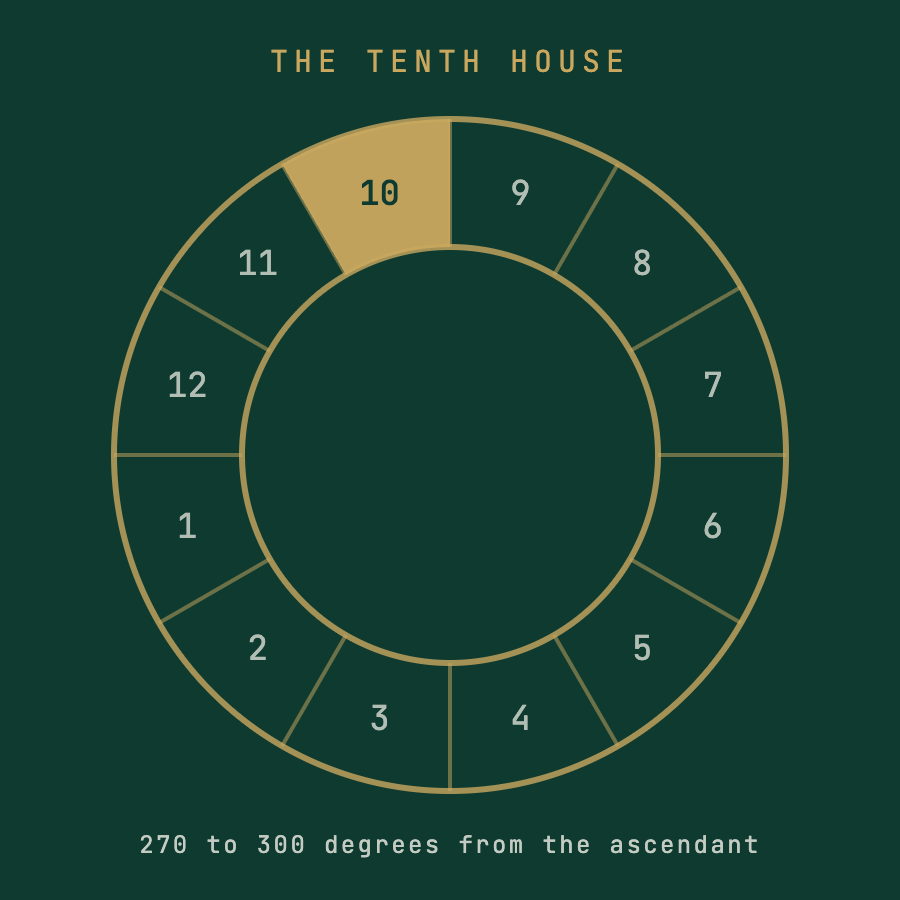
- Entry type
- House
- Number
- 10
- Element
- Earth
- Modality
- Cardinal
- Modern ruler
- Saturn
The Tenth House
The angular house at the top of the chart: career, reputation and public standing. The tenth house covers what a person is known for, which is not always what they spend their time doing.
- career
- reputation
- authority
- standing
- direction
What this describes
The tenth house covers standing. Career in the sense of what a working life amounts to, reputation, public role, and the authorities a person answers to. It sits at the top of the chart, is one of the four angular houses, and the tradition treats it as among the most visible places in a chart. It is also the house most often mistaken for a verdict on somebody's ambition, which it is not.
The distinction that matters is between the tenth and the sixth. The sixth is the work: the tasks, the routine, the conditions. The tenth is what that work is understood to be by people who are not doing it alongside you. The two come apart constantly, and most of the confusion in astrological career advice comes from treating them as a single subject.
It takes Capricorn as its natural sign and Saturn as its ruler, and it forms the vertical axis of the chart with the fourth house. That axis is a standing negotiation between public life and private base, and no chart resolves it permanently.
What it does well
A well-supported tenth house shows up as a reputation that matches the work. Somebody is known for the thing they are actually good at, which sounds unremarkable and is not: a great many competent people are known for something adjacent to their competence.
It also produces the capacity to hold responsibility in public. That is a specific skill, involving being visible, being accountable for outcomes not entirely within your control, and continuing to function while being judged. Plenty of capable people cannot do it.
Third, it supplies direction over long periods. The tenth is a slow house, and its characteristic strength is a working life that accumulates into something rather than consisting of unrelated jobs.
Where it goes wrong
The tenth house goes wrong when the standing becomes the point. A reputation is a useful by-product and a poor objective, and a difficult tenth describes somebody making decisions to protect a position rather than to do the work the position was for.
The second failure is the axis tipping. The tenth sits opposite the fourth, and effort spent on public life is not available for the private base. Where the tenth dominates completely, a person can be substantial in public and have very little to come home to.
Third, borrowed ambition. This house covers what authority expects, and it is entirely possible to build a career answering somebody else's brief, usually a parent's, and to notice only at the point where it succeeds.
In relationships
The tenth house is not a relationship house, and it exerts constant pressure on relationships. It governs the demands of public life and of work, and those demands are the most commonly negotiated thing inside a partnership after money.
It also covers how a couple is seen from outside, which matters more than modern writing tends to admit. Whether two people present as a unit, whose career takes precedence, and whose name is attached to a shared life are all tenth house questions with real consequences. A chart can indicate that this axis is heavily weighted for somebody. It cannot say how a particular couple divides it, and the tenth house never describes another person's feelings.
In work
This is the career house, and it is more specific than that label suggests. It describes the shape of a working life and its public face rather than the daily job, and it answers questions about direction, standing and recognition rather than about tasks.
Traditional texts also give it the employer, the sovereign and people in authority, which is worth keeping: how somebody deals with those above them is a tenth house matter and a real career variable.
Where a chart is read for vocation, the tenth is the beginning rather than the answer. Its cusp sign, its ruler's placement, and the sixth and eighth houses all bear on the question, and a chart does not name anybody's profession.
In money
The tenth house is where earning meets standing. It describes income arriving from position rather than from labour directly, which is the difference between being paid for hours and being paid for who you are understood to be.
The practical observation is that these follow different rules. Sixth house income scales with effort and stops when the effort does; tenth house income tracks reputation and lags behind changes in it, in both directions. That is a description of how the tradition divides the subject rather than advice about anybody's finances, which depend on circumstances a chart does not contain.
How to read it in a chart
Read the tenth as you read any house: the sign on its cusp, the ruler of that sign, and whatever occupies it.
The cusp sign describes the manner of public life. A tenth cusp in a water sign describes standing built through relationships; in an air sign, standing built on what somebody is known to have said. The ruler of that sign and its placement is the single most informative factor: the tenth ruler in the third suggests a public role built on communication, and in the twelfth, one conducted largely out of sight.
Planets in the tenth dominate the reading. An empty tenth house is ordinary and says nothing about whether somebody will have a career.
One technical point specific to this house: check which system produced the chart, because the Midheaven is the tenth cusp in quadrant systems and is not in whole sign.
How it meets other placements
The tenth forms the vertical axis with the fourth house, and the pair are the most obviously zero-sum in the chart: attention given to public standing is attention not given to the private base. Reading one without the other produces half a life.
As an angular house it groups with the first, the fourth and the seventh, the positions the tradition treats as acting most directly, and a planet on the Midheaven is about as prominent as a chart can make anything.
Between two charts, planets falling in each other's tenth describe people who affect each other's standing and direction. That is a real form of influence, and it is neither romantic nor a prediction.
The part people leave out
The part popular astrology leaves out is that the tenth house is where other people's judgement lives. It is usually described as achievement and purpose, and the older sources are colder about it: this is the place of the sovereign, the employer and the public, which is to say the people holding power over a life who never consulted it.
The second omission is the parent question, which is the same dispute that runs through the fourth house seen from the other end. Some traditions assign the mother to the tenth and the father to the fourth, others reverse it, and the sources genuinely disagree. Pages stating one confidently are concealing a real division in the material.
Where the symbol comes from
The Greek name is Mesouranema, the culmination, and the Latin is Medium Caeli, the middle of the sky. Both describe a position: the highest point the ecliptic reaches above the horizon at a given moment.
That height generated the meanings. What is at the top is what everybody can see, which gives reputation and public role. What is at the top is also what stands over you, which gives authority, the employer and the sovereign. The alternative Latin name, Regnum, is simply rule.
Like the fourth and the seventh, the tenth is not the joy of any planet. The angles take their character from the geometry instead: they are the four points where the ecliptic meets the horizon or the meridian, and the tradition regarded them as the positions where anything placed there acts most directly, without needing a planetary association to explain it.
Where this meaning came from
Houses come from the Hellenistic synthesis in Egypt from about the second century BCE, and the tenth was one of the four pivots from the start. Vettius Valens gives it action, reputation, rank and profession, and the medieval Arabic and Latin traditions kept that range intact.
For most of its history this house was about position in a hierarchy rather than about vocation in the modern sense. The idea that work should express a person's nature is recent. Older astrology assumed a place in an order and read the tenth house for how somebody would occupy it, and William Lilly in the seventeenth century still reads the tenth for questions about kings, magistrates and preferment.
The reframing of the tenth as calling and self-realisation is twentieth-century, and it followed the same psychological turn that reshaped the rest of the system. It is a genuine reinterpretation rather than a translation, and it suits a world in which most people can choose an occupation, which the writers who built this house could not have assumed.
What the astronomy actually says
Two things about the Midheaven are worth getting right, because both are commonly muddled.
The first is that the Midheaven is not the point overhead. The point directly above an observer is the zenith, and the Midheaven is where the ecliptic crosses the local meridian, which is a different place. Charts are drawn with the tenth house at the top, and that arrangement encourages the confusion.
The second is that the Midheaven does not depend on latitude. It is determined by local sidereal time alone, which is a function of longitude and of the moment. The Ascendant, by contrast, depends on latitude as well, which is why the angle between Ascendant and Midheaven is not ninety degrees except at the equator, and why it becomes increasingly distorted toward the poles.
That asymmetry is the root of most disagreement between house systems, and it is a fact about geometry rather than about meaning. Astrology has never demonstrated a mechanism connecting any of it to a working life.
The common misreading
The tenth house is most often read as a job title. It describes standing and direction rather than an occupation, and no chart names anybody's profession. Readings that produce a specific career from a tenth house placement are performing a trick: the placement is general enough that almost any occupation can be fitted to it afterwards.
The second misreading is the conflation with the sixth. The sixth is the work and the tenth is the reputation, and a great deal of unhelpful career astrology comes from answering a question about one with material about the other. Somebody miserable in their daily work and well regarded in their field has a sixth house problem, and advice about ambition will not touch it.
The third is technical and pervasive. Because most software defaults to Placidus, readers assume the Midheaven is always the tenth cusp. In quadrant systems it is. In whole sign and equal house it is not, and the Midheaven can land in the ninth or the eleventh house instead. Anyone comparing two readings of the same chart should establish which system each used before concluding that one of them is wrong.
Questions to sit with
- What are you known for, and is it what you are actually good at?
- Whose brief is your career answering, and did you write it?
- What would you lose if your standing went, and what would remain?
- Is your dissatisfaction about the work itself, or about how the work is seen?
See where this sits in your own chart.