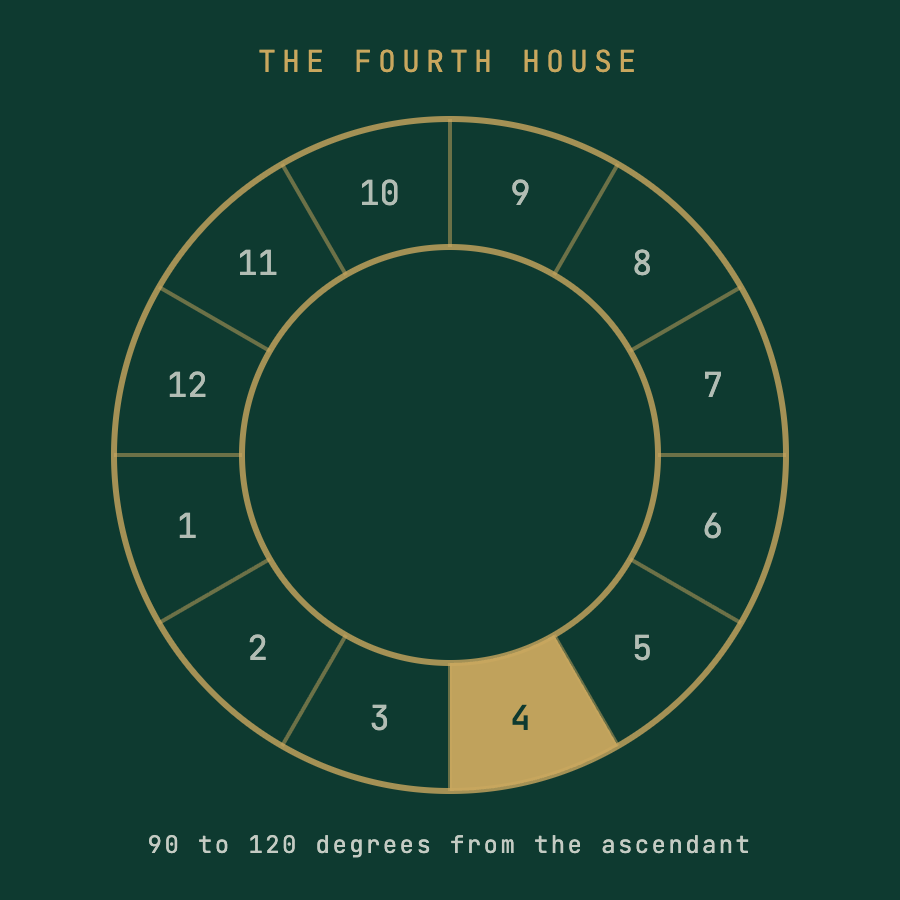
- Entry type
- House
- Number
- 4
- Element
- Water
- Modality
- Cardinal
- Modern ruler
- Moon
The Fourth House
The angular house at the bottom of the chart: home, family, land and origins. The fourth house covers where a person comes from and what they return to when everything else is set aside.
- home
- roots
- family
- foundations
- privacy
What this describes
The fourth house is the base of the chart. It covers home in the literal sense of a dwelling and land, family in the sense of where somebody came from, and the private life that the rest of the chart is conducted from. It is one of the four angular houses, and the tradition treats the angles as the places where a chart acts most directly.
Its older significations are wider than the modern ones. Hellenistic and medieval texts give the fourth house parents, property, buried things, and what they call the end of the matter: how a situation finally settles once everybody has stopped acting on it. That last meaning is worth keeping, because it is the only place in the chart that describes outcomes rather than conditions, and modern writing has largely dropped it.
It takes Cancer as its natural sign and the Moon as its ruler. Both point at the same territory: the conditions under which somebody can stop performing. The fourth is the least public part of a chart and the hardest to read about another person, because most of what it governs is never on display.
What it does well
A well-supported fourth house shows up as a base that holds. Somewhere to return to, a family situation that is not an ongoing negotiation, a private life that restores rather than costs. It is unglamorous, and it determines how much the rest of a chart can afford to spend.
It also produces a settled sense of where somebody is from, which is not the same as liking it. The fourth house works well when a person can give an accurate account of their origins without either defending or disowning them, and that account is usually what makes it possible to leave.
Third, it supplies endings. The older meaning of this house takes in how matters conclude, and a strong fourth is associated with things reaching a settled state rather than staying open indefinitely.
Where it goes wrong
The fourth house goes wrong quietly, because nothing in it is visible. A base that costs more than it restores can run for years without being identified as the problem, and the symptoms all show up elsewhere in the chart.
The second failure is inheritance in the non-financial sense. This house covers what was absorbed before anybody could evaluate it: how conflict was handled, what counted as normal, which feelings were permitted. A difficult fourth house is a person carrying a set of defaults they have never examined, because they do not experience them as defaults.
Third, it can become a refuge that stops being temporary. The fourth house is where somebody goes to recover, and it is also where a life can quietly contract to.
In relationships
In relationships the fourth house is the difference between a partner and a household. It describes living together, the practical and emotional arrangements of shared space, and whether two people's ideas of home are compatible in a way that only becomes visible after moving in.
It also carries what each person learned about relationships before they had any of their own. Most of the assumptions two people argue about are fourth house material, absorbed from a family and mistaken for common sense. That describes where the friction comes from rather than predicting that it will happen, and no house can say how a particular couple will handle it.
In work
The fourth house is not a career house, and it is the one that decides how sustainable a career turns out to be. It sits opposite the tenth, and the axis between them is a standing negotiation between public life and private base.
Where the fourth is under-supported, work expands into it, which tends to be experienced as ambition and is often just a lack of anywhere else to be. Where it is heavily weighted, somebody may have a substantial private life and very little public one, which is a legitimate arrangement that the tenth house side of the tradition is inclined to treat as a failure. The chart does not rank them.
In money
The fourth house covers property and land rather than income: the house lived in, what was inherited, what is held rather than earned. Traditional texts also assign it buried treasure and things hidden in the ground, which is charming and no longer operative.
Its practical signification is that housing is a fourth house matter, and housing is usually the largest financial fact in a life. Where a money question turns out to be about where somebody lives, this is the relevant house rather than the second. None of that is advice about property or about anybody's finances, which depend on circumstances no chart contains.
How to read it in a chart
Read the fourth house the way you read any house: the sign on its cusp, the ruler of that sign, and whatever is sitting in it.
The cusp sign describes the manner of home. A fourth cusp in a mutable sign describes a base that moves; in a fixed sign, one that does not. The ruler of that sign then says where the matter actually operates. If the fourth cusp falls in Libra, Venus rules the house, and Venus placed in the tenth would tie the private base directly to public standing.
Planets in the fourth usually take over the reading. Saturn there is the classic marker of a home that was work, Jupiter there of one that was expansive, and neither is a verdict. An empty fourth house is entirely ordinary and says nothing about the quality of anybody's family: with ten planets and twelve houses, most houses in most charts are empty.
How it meets other placements
The fourth house belongs to an axis rather than to a pair. Opposite it is the tenth house, and together they form the vertical of the chart: where somebody comes from against where they are seen. Every chart spends the same finite attention across both ends, and the balance struck is among the more informative things a chart shows.
The fourth is also angular, which groups it with the first, the seventh and the tenth. Angular houses are the ones the tradition treats as acting most directly, and a planet moving onto an angle is considered to gain in effect.
Between two charts, planets falling in each other's fourth house describe people who feel domestic together, for better and for worse.
The part people leave out
The part popular astrology leaves out is that the fourth house is not necessarily safe. It is described almost everywhere as comfort and belonging, and for a great many people the house of origins is the difficult one. Writing that assumes home is restorative is describing a fortunate case as though it were the meaning.
The second omission is the disagreement about parents. Hellenistic and medieval sources generally assign the father to the fourth house. A great deal of modern writing assigns the mother, on the strength of the Moon and Cancer associations. Both traditions exist and they contradict each other, and a page stating either as settled fact is concealing a real dispute in the material.
Where the symbol comes from
The Greek name for this place is Hypogeion, the subterranean, and the Latin is Imum Coeli, the lowest part of the sky. Both refer to position rather than to meaning: it is the point of the chart furthest below the horizon at the moment being described.
That position generated the significations rather than the other way round. What is beneath is what is buried, hence graves and hidden things. What is beneath is also what sits under a structure, hence foundations, land and origins. And what is at the bottom is what a matter finally comes to rest on, hence the end of the matter.
Unlike the third and the ninth, the fourth is not the joy of any planet. It takes its character from being an angle, and specifically from being the angle nobody can see, since it lies below the horizon and is never visible in the sky at the moment it describes.
Where this meaning came from
Houses enter astrology with the Hellenistic synthesis in Egypt from about the second century BCE. Babylonian practice had signs and planets but no division of the local sky, and the twelve places are the Greek contribution to the system.
The fourth house was one of the four pivots, the angles, from the beginning. Vettius Valens in the second century CE treats it as the place of parents, of foundations and of the conclusion of matters, and the medieval Arabic and Latin traditions carried that forward with the father specifically assigned to it.
The reassignment of the fourth house to the mother is modern. It followed from the psychological turn of the early twentieth century, which leaned on the Moon and Cancer associations rather than on the older texts, and both readings are now in circulation.
The method of calculating the cusp changed too. In whole sign houses, the oldest system, the fourth house is simply the fourth sign from the Ascendant. In the quadrant systems that dominated European practice from the medieval period onward, the fourth cusp is the Imum Coeli itself, which is a different point and frequently falls in a different sign.
What the astronomy actually says
The bottom of a chart is not the interior of the Earth. The Imum Coeli is the point where the ecliptic crosses the local meridian below the horizon, the meridian being a great circle through the observer's zenith and the celestial poles. It is a direction, not a depth.
This is the house where it matters most that a chart is drawn from a place. Planetary positions are effectively the same for everybody alive at a given moment, but the houses are not: they are set by the horizon and the meridian at one location. Two people born in the same minute in Lisbon and in Helsinki share every planetary position and share almost none of their house placements. The houses are the local part of a chart.
They are also the part that requires the time. The Ascendant and Midheaven move roughly one degree every four minutes, so a birth time out by an hour shifts them about fifteen degrees, which can change the sign on every cusp. Without a recorded time, the fourth house cannot be calculated at all.
The common misreading
The fourth house is most often read as the mother, stated flatly. The older sources overwhelmingly give it the father, and the modern reassignment came from associating the house with the Moon and with Cancer rather than from any correction to the tradition. Both readings are defensible and neither is settled, and a page presenting one without mentioning the other is passing off a choice as a fact.
The second misreading is the assumption that this house is comfortable. It is described almost everywhere as warmth, belonging and roots, and it is equally the house of what somebody had no say in. For many people the accurate fourth house reading is not consoling, and softening it is not kindness.
The third is technical and very common. Because most software defaults to a quadrant system, readers assume the fourth cusp and the Imum Coeli are the same thing. In quadrant systems they are. In whole sign and equal house systems they are not, and the IC can fall in the third or the fifth house instead. A great deal of confusion about which house a planet occupies comes from nobody saying which system produced the chart.
Questions to sit with
- What did you absorb about how a household runs before you were old enough to disagree with it?
- Does your home restore you, or does it cost you something you have not counted?
- What would you have to say about where you are from in order to describe it rather than defend it?
- Which matter in your life is waiting to reach an end, and what would ending it actually look like?
See where this sits in your own chart.