- Entry type
- Planet
- Abbreviation
- MOO
- Modern ruler
- Moon
- Matching tarot card
- The High Priestess
Moon
The Moon describes what a person needs rather than what they want: the baseline state, the habits, the thing that settles them. It moves fast enough that a birth time changes the answer.
- need
- habit
- memory
- security
- instinct
What this describes
The Moon marks need. Not desire, which is Venus and Mars, and not purpose, which is the Sun, but the conditions under which a person is able to be at rest. Older texts make it the significator of the mother, the body, and everything that changes on a cycle. The twentieth century recast it as the emotional nature. Both point at the same thing: the default state somebody returns to when nothing is being performed.
It is the most private placement in a chart and often the most accurate. What a person does when tired, unobserved or under pressure is Moon territory, and it frequently contradicts the Sun. A chart in which the Sun and Moon want different conditions describes an ordinary and very specific kind of friction: somebody whose ambitions do not soothe them.
It is also the placement that most needs a birth time. The Moon crosses a sign in about two and a half days, so a chart calculated without an hour can place it in the wrong sign entirely. Where a reading is being done from a date alone, the Moon is the first thing to become unreliable, and the Fourth House, which covers related ground, is not available at all.
What it does well
The Moon is where a person is competent without effort. Whatever it marks tends to be done well, early, and without having been learned. The placement describes an inherited fluency rather than an achievement.
It is also the source of accurate reading of other people. The Moon registers atmosphere directly, and where it is well placed somebody can tell what a room needs before anyone says it. That is a practical skill rather than a mystical one, and it is among the few things a chart describes that is easy to test against experience.
Third, it supplies recovery. A Moon whose conditions are genuinely being met means a person who can be depleted and come back, which is a more useful capacity across a life than any amount of drive.
Where it goes wrong
The Moon's failure mode is a need met by habit rather than by anything that works. The placement wants the familiar, and familiar and good are different things, so the Moon is the part of a chart most likely to keep doing something that stopped helping years ago, because stopping feels worse than continuing.
The second is invisibility. Because the Moon is private, its requirements often go unsaid, including to the person holding them, and an unmet lunar need tends to surface as irritation about something else entirely.
Third, reactivity. The Moon responds fast, before the rest of the chart has arrived, and it is the placement most likely to have committed to a position before anybody has thought about it.
In relationships
In relationships the Moon is the placement that decides whether living with somebody is restful. Attraction sits elsewhere in the chart. This is the part that determines whether being in the same room for a long evening is easy.
That is why Moon contacts matter more than Sun contacts in any serious comparison of two charts, and why the popular version has it backwards. Two people whose Moons sit in compatible signs frequently find each other's company undemanding without being able to say why. It is not a prediction of anything. Plenty of people are restful company and unsuitable in every other respect, and a chart has no view on that at all.
In work
At work the Moon describes the conditions under which a person can sustain effort, which is a different question from what they are good at. Noise, autonomy, whether the work happens alongside other people or alone, whether the day has a shape: these are Moon variables, and they are habitually treated as preferences rather than as requirements.
The practical use of the placement is that ignoring it is expensive. A role that suits the Sun and violates the Moon is the standard description of a job somebody is good at and cannot keep. That pattern is common enough to be worth naming plainly rather than reading as a failure of resolve.
In money
The Moon connects money to security rather than to value. It describes the level at which a person stops feeling exposed, and that level is set by early experience rather than by arithmetic, which is why it so rarely corresponds to an actual figure.
The useful observation is that the Moon's threshold does not move when the balance does. Somebody can reach a number they once described as safe and feel exactly as they did before reaching it. Recognising that the threshold is emotional rather than numerical is worth more than any amount of budgeting. It is not, and cannot be, advice about anybody's finances.
How to read it in a chart
The Moon is read by sign, house, phase and aspect, and it needs a birth time for any of that to be reliable. Sign describes what the need is, house describes where it has to be met, and aspects describe what interferes with it.
The commonest confusion is between the Moon and the Sun, and a recent overcorrection has made it worse. Having learned that the Sun sign is not the whole chart, much popular writing now asserts that the Moon sign is the real one. It is not. It is a different factor answering a different question, and neither outranks the other. The second confusion is with the Fourth House and with Cancer, which both cover home and origins. A planet, a sign and a house are three different kinds of thing, and a chart can carry any one of them without the others.
Retrograde
The Moon is never retrograde. Retrograde motion is an apparent reversal produced by the relative orbital speeds of Earth and another body going around the Sun, and the Moon is not in that arrangement. It orbits Earth directly, so what is seen from here is its actual motion.
It moves eastward against the stars at roughly thirteen degrees a day, always, without exception. What the Moon does have is phase, variation in speed, and a void-of-course period, meaning the stretch after its last aspect before it changes sign. That is a real technical term with a long history and it is not retrogradation. Any source offering a Moon retrograde is describing something that does not exist, and the same is true of the Sun.
How it meets other placements
Within a chart, the Moon's aspects describe what a person's need has to negotiate with. Saturn on the Moon reads as comfort that has to be earned. Uranus on the Moon reads as a requirement for room that arrives without warning. The Sun in hard aspect to the Moon describes somebody whose direction and whose rest pull in different directions.
Between charts, Moon to Moon describes whether two people are easy to live with, and Moon to Venus whether affection arrives in a form the other person recognises. The opposition is worth understanding properly here: it does not mean conflict, it means two ends of a single axis, and between two charts it frequently describes people who supply what the other one lacks.
The part people leave out
The part popular astrology leaves out is that the Moon is not gentle. It is described almost everywhere in soft language, and what it actually governs is the part of a person that will do a great deal to avoid discomfort, including things that damage the situation it is trying to protect.
There is also the question of what a need costs other people. A Moon whose conditions are treated as non-negotiable makes everybody nearby responsible for maintaining them, and because lunar needs feel like facts rather than preferences from the inside, this is very hard to notice without being told. Being told is usually unwelcome, which is why it tends to happen late.
Where the symbol comes from
The glyph is a crescent, and it is the only symbol in the system that is a direct picture of the thing it names. It shows the Moon partly lit, which is the point: a body visibly incomplete for most of the month, never appearing the same way twice in succession.
The association with the mother, with the body and with cycles is Hellenistic and older. In Babylonian practice the moon god Sin was among the most important deities and the calendar was lunar, which is why the month is named for the Moon in most languages that inherited the system.
The Moon rules Cancer, is exalted in Taurus, and is said to be in fall in Scorpio: at ease where the terms are safety and the familiar, uncomfortable where the terms are intensity and disclosure.
Where this meaning came from
The Moon is one of the two luminaries in the classical scheme, counted among the seven planets because it moves against the fixed stars. Its cycle organised timekeeping long before any of the interpretive material existed. Babylonian months were lunar, and a great deal of the earliest astronomy that survives is lunar record-keeping aimed at predicting eclipses.
Hellenistic astrologers gave the Moon rulership of Cancer and made it the significator of the mother, the body and the ordinary course of life. Ptolemy's Tetrabiblos treats it as the fastest and most changeable of the planets and gives it a role in nearly every technique, because its speed makes it useful for timing.
The modern reading of the Moon as the emotional nature is a twentieth-century development, part of the same psychological turn that produced sun-sign columns. It is less a distortion of the older material than a translation of it: what the tradition described as the body and the habitual, modern writing describes as feeling and need.
What the astronomy actually says
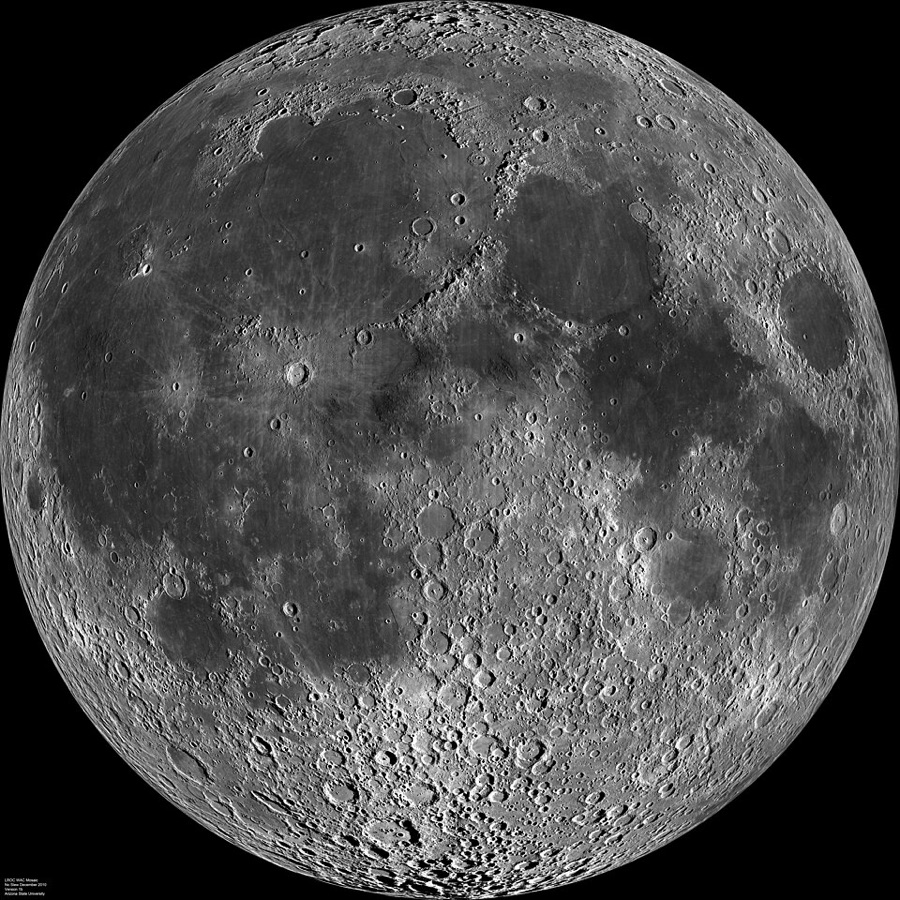
The Moon orbits Earth at an average distance of about 384,400 kilometres and takes 27.32 days to return to the same position against the stars. The familiar month, from one new moon to the next, is longer at 29.53 days, because Earth has moved along its own orbit in the meantime and the Moon has to catch up. Those two figures, the sidereal and the synodic month, are why lunar and solar calendars never quite agree.
The Moon's orbit is inclined about five degrees to the ecliptic, which is why there is not an eclipse every month, and the points where the two planes cross drift around the sky in about 18.6 years. The Moon is tidally locked, so the same face is always turned toward us, and it is receding from Earth by roughly 3.8 centimetres a year.
One claim worth checking: studies have repeatedly looked for an effect of the full moon on human behaviour and have not found a reliable one. Astrology has never demonstrated a mechanism, and this page does not claim one.
The common misreading
The commonest misreading now is an overcorrection. Having been told that the Sun sign is not the whole chart, a great deal of popular writing has promoted the Moon sign to being the real one, the true self behind the public face. That is the same mistake wearing a different placement. The Moon answers a specific question, about need and baseline state, and it is no more the whole person than the Sun is.
The second is treating the Moon as a mood report. It describes a standing condition rather than a passing state, and reading a natal Moon as how somebody feels today confuses the chart with the weather.
The third concerns the full moon. The idea that it changes behaviour in a measurable way is widespread, turns up in popular writing constantly, and has been tested repeatedly without a reliable effect being found. The astrological Moon is not making that claim, and pages that borrow it are borrowing something that does not hold up.
Questions to sit with
- What actually settles you, as opposed to what you tell people settles you?
- Which of your habits is still meeting a need, and which is only familiar?
- What do you require in order to work well that you have been treating as a preference?
- When you are tired and unobserved, what do you reach for first?
See where this sits in your own chart.