- Entry type
- Aspect
The Opposition
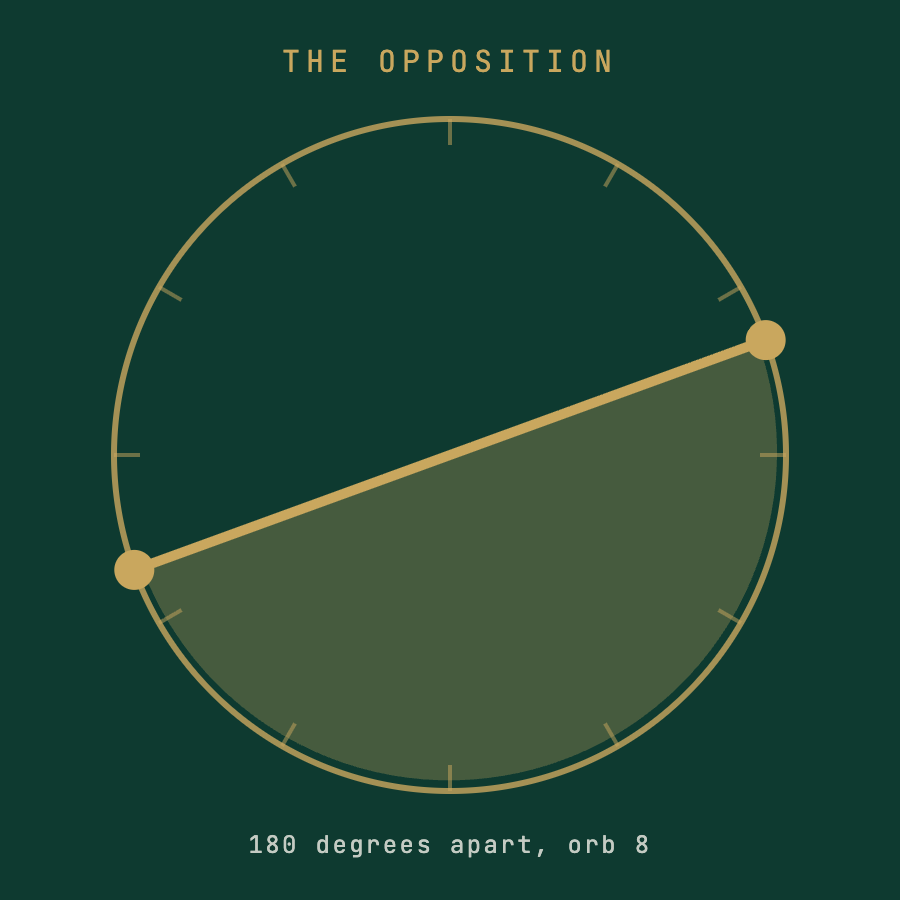
Two planets 180 degrees apart, facing each other across the chart. The opposition describes two things that both have a claim and cannot occupy the same position, and it is the aspect most often experienced as somebody else's fault.
- polarity
- projection
- tension
- awareness
- balance
What this describes
An opposition is a separation of 180 degrees, half the zodiac, putting two planets six signs apart and directly across the chart from each other. Signs six apart always share a modality and belong to complementary elements: fire with air, earth with water. That is the important detail, because it means the two ends are not incompatible in the way a square's are. They are the same tempo and compatible material, pointed in opposite directions.
The tradition classed it with the square as malefic, and Ptolemy calls it the diametros, the diameter. It is also the only aspect in which one body rises as the other sets. Medieval and Renaissance practice read it as open conflict, separation and things pulling apart, and was not interested in finding an upside.
The modern reading is projection, and it is the most useful thing twentieth-century astrology added to the aspect vocabulary. Where a square is experienced as internal friction, an opposition tends to be experienced as a person: the qualities of the far end get located in somebody else, usually in a partner, and argued with there. That is why this aspect turns up so heavily in relationship readings, and why the argument is rarely about what it appears to be about.
What it does well
What an opposition provides that no other aspect does is a view. Two planets facing each other across a chart can each see what the other is doing, and that is the origin of the tradition's word for an aspect. Whatever this configuration describes, the person is at least in a position to notice it.
Its second value is that the material is genuinely two-sided. An opposition is not a fault to be corrected; it is two legitimate claims, and the useful reading names both instead of siding with one.
Third, it tends to be the most productive aspect in a chart over a long period. Because it is experienced through other people, it gets tested repeatedly by actual relationships, and things that get tested tend to develop.
Where it goes wrong
The characteristic difficulty is that the far end gets outsourced. A person with an opposition tends to identify with one side of it entirely and meet the other side in the people around them, which produces a life in which the same argument recurs with different partners and each time appears to be about the new partner.
The second is oscillation. Where projection does not happen, the alternative is swinging: over-committing to one end, correcting hard to the other, and never finding a setting that holds. Both ends are legitimate, which is exactly what makes the swing sustainable for decades.
Third, an opposition does not resolve any more than a square does. Six signs apart is a permanent arrangement. Anybody promising integration as a finished state is describing something the geometry does not offer.
In relationships
This is the aspect that belongs to relationships more than any other, and the reason is structural: the opposition is the axis of the chart that runs from the self to the other person, and the seventh house sits at the far end of it.
In synastry an opposition between two charts describes attraction and friction arriving together. Each person carries a quality the other has disowned, which is genuinely compelling and genuinely exhausting, and it explains why these pairings are hard to leave and hard to settle.
What the aspect cannot do is tell you whose fault anything is. Both ends are the same chart. When somebody describes a partner who is always the problem, in the same way, across several relationships, an opposition is the configuration the tradition would look at first.
In work
At work an opposition describes a bind between two demands that both have a case. Autonomy against belonging, thoroughness against delivery, one's own standards against the organisation's. Neither side is wrong, which is why the person keeps arriving back at it.
The projection pattern shows up here as clearly as in relationships. Somebody who identifies entirely with one end will find the other end embodied in a colleague and will experience the whole conflict as being about that colleague, often across several jobs with different people in the role.
The practical move is to name both claims as one's own and then design the compromise explicitly rather than letting it be settled by whoever is most insistent that week. That is available to anybody, and no aspect predicts whether it gets done.
In money
An opposition has no financial content on its own; the planets and houses supply the subject. Where it touches money, it describes a standing pull between two reasonable positions rather than a shortage or a windfall.
The recognisable shape is a couple, or a person and an institution, holding incompatible views about the same resource. Spending against saving is the obvious version, and the more interesting one is where each party has taken the opposite end so completely that neither can move first.
Nothing on this page is financial advice and no aspect indicates an amount. What the geometry supports is the observation that the argument is structural, which means it will not be settled by winning it once.
How to read it in a chart
These pages use an orb of eight degrees for the opposition, the same as the conjunction and the widest of the five. Other astrologers use seven, nine or ten, and traditional practice worked from per-planet orbs instead, so whether an opposition is present at all can depend on whose convention is in use. A page that reports one without naming its orb is presenting a choice as a finding.
Closeness matters. An opposition within two degrees describes something a person will recognise immediately; at seven it is background, and treating the two the same discards information the chart is giving you.
Two refinements. Check the houses at each end, since the opposition is an axis and the houses tell you which areas of life the pull runs between. And check whether a third planet squares both ends, which makes a T-square and changes the reading substantially: the pressure then has a focal point rather than running back and forth along a line.
How it meets other placements
An opposition is an axis rather than a point, and that changes how it meets the rest of a chart. Anything aspecting one end is automatically in relationship to the other, so a single planet can reorganise the whole configuration.
The important case is a third planet square to both ends, producing a T-square. The tradition reads that as one figure and treats it as more forceful than its parts, because the tension now has a place to discharge and that place is the third planet. Add a fourth opposite it and the shape closes into a grand cross, which is read as the most demanding configuration in the standard vocabulary.
What none of this yields is a score. Counting hard aspects to decide whether a chart is difficult is a modern habit with no basis in the older practice and nothing behind it.
The part people leave out
What popular astrology leaves out about the opposition is how convenient projection is. The modern reading is that a person meets their own disowned qualities in other people, which is true and is also the most comfortable possible version, because it makes the difficulty interior and therefore solvable by insight.
Sometimes the other person really is doing the thing. An opposition describes a structure in one chart and has no way to establish whether a particular complaint about a particular partner is accurate, and readings that treat every conflict as projection hand the difficult person in the room a permanent excuse.
The third omission is that the integration language promises a resolution the geometry never offers. Six signs apart is six signs apart for life.
Where the symbol comes from
Aspects are geometry. The opposition is the circle divided by two, the simplest division available, and Ptolemy names it the diametros after the line it draws through the centre.
The interpretive reasoning is visible in the signs. Six apart puts two planets in the same modality and in elements the tradition pairs as complements rather than opponents: fire opposite air, earth opposite water. That is a more interesting arrangement than the square's, where the elements genuinely clash. An opposition joins two things that could work together and are as far apart as the circle allows, which is why the modern vocabulary of polarity and integration fits it better than the older vocabulary of conflict.
The glyph is a circle with a line through it, or two circles joined by a line depending on the source. Like the other aspect symbols it is a medieval convenience for scribes rather than anything the Greeks used.
Where this meaning came from
Aspects are Hellenistic, assembled in Greek-speaking Egypt between roughly the first century BCE and the second century CE. Babylonian astrology had planets, signs and omens and no doctrine of angles.
The opposition is the first division Ptolemy makes in the Tetrabiblos, the circle halved, and he groups it with the square among the difficult configurations. Traditional practice kept that verdict without much argument through the medieval Arabic transmission and into Renaissance Europe. William Lilly, in seventeenth-century London, reads an opposition as a plain indication that a matter will fail or that two parties will not agree, and he says so without softening.
Projection is the modern contribution and it arrives from psychology rather than from astrology. The idea that a person meets disowned parts of themselves in others is Jungian, and it was imported into chart reading during the twentieth century by Dane Rudhyar and the humanistic astrologers from the 1930s onward, then made standard by Liz Greene and the psychological school from the 1970s. It is a genuinely illuminating framework and it is about fifty years old in this application, which is worth saying whenever it is presented as what oppositions have always meant.
What the astronomy actually says
An aspect is an angular separation measured along the ecliptic, in celestial longitude, as seen from Earth. An opposition means two bodies appear 180 degrees apart in that coordinate, which is to say on opposite sides of the sky from here.
This is the one aspect with substantial physical content, and it is worth being clear that the content belongs to astronomy rather than to astrology. When an outer planet is at opposition to the Sun, the Earth is directly between the two: the planet is at its closest to us, at its brightest, and visible all night, rising as the Sun sets. Observers plan around planetary oppositions for exactly that reason.
The Sun and Moon in opposition is a full moon, and a lunar eclipse can occur then, though usually does not, because the Moon's orbit is tilted and the latitudes rarely line up. None of that is a mechanism for the astrological claim. A planet being nearer and brighter is a fact about visibility from Earth, and no process has ever been demonstrated by which it would act on a person.
The common misreading
The commonest misreading of the opposition is that it identifies a difficult person. Because the aspect is experienced through other people, the reading arrives already pointed outward, and it takes very little for a page or a practitioner to confirm what somebody already believes about a partner. The chart in front of you belongs to one person. It has nothing to say about anybody else's behaviour, and using it to certify a complaint is the most common abuse this aspect attracts.
The second is the opposite error, and it is now just as common: treating everything as projection. That framing lets genuine mistreatment be reinterpreted as the querent's own disowned material, which is a serious thing to do to somebody. Both readings are available and the chart cannot distinguish them.
The third is the promise of integration. Modern practice describes the opposition as a polarity to be balanced, which sounds like a task with an end. Two planets six signs apart stay six signs apart for the whole of a life. What can change is whether a person recognises both ends as theirs; what cannot change is that the pull remains, and a page implying otherwise is selling a resolution the geometry does not contain.
Questions to sit with
- What quality do you keep meeting in partners, and have you ever looked for it in yourself?
- Which two demands on you both have a case, so that neither ever wins?
- When you swing between two positions, what is the setting you have never tried holding?
- Is the person you keep having this argument with the problem, or the current occupant of a role?
See where this sits in your own chart.