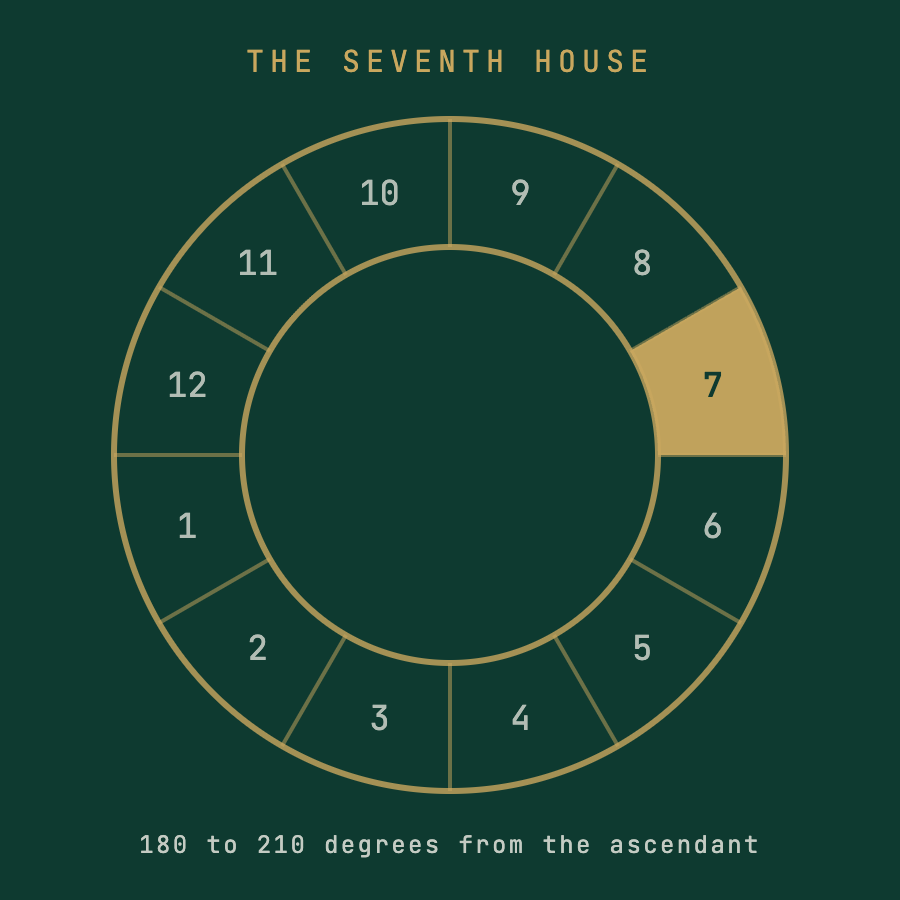
- Entry type
- House
- Number
- 7
- Element
- Air
- Modality
- Cardinal
- Modern ruler
- Venus
The Seventh House
The angular house on the western horizon: marriage, business partners and declared enemies. The seventh house covers whoever a person is dealing with directly, on terms both of them can see.
- partnership
- contracts
- negotiation
- opposition
- the other
What this describes
The seventh house covers the other party. Marriage and long partnership, business partners, the person on the far side of a contract, and, in the older texts, open enemies and lawsuits. It sits on the western horizon, directly opposite the Ascendant, and it is one of the four angular houses.
The inclusion of enemies alongside spouses is not a joke, and it is the most useful thing about this house. The tradition grouped them because both are the person a life is conducted face to face with, on terms that have been stated. What distinguishes the seventh from every other relationship signification is not affection. It is that the arrangement is explicit and both parties know they are in it.
It takes Libra as its natural sign and Venus as its ruler, and it forms an axis with the first house. That axis is the horizon itself: the self on one side and whoever stands opposite on the other, which is why the seventh is also read as what a person consistently meets in other people.
What it does well
A well-supported seventh house shows up as the capacity to make an arrangement and keep to it. Not romance, which lives in the fifth, but the more specific competence of agreeing terms with somebody and being reliable inside them.
It also produces the ability to be genuinely opposed without the situation collapsing. This is the house of the declared adversary, and a strong seventh describes somebody who can be in open disagreement with a person and still deal with them, which is rarer than it sounds and enormously useful.
Third, it supplies negotiation in the plain sense: knowing what the other side needs, saying what you need, and arriving at something that holds. The tradition's association of this house with Venus is about proportion rather than charm.
Where it goes wrong
The seventh house goes wrong through delegation of the self. Because it sits opposite the first, qualities a person does not own tend to be experienced as arriving from other people, and a difficult seventh often describes somebody who keeps meeting the same character and does not recognise the pattern as theirs.
The second failure is agreement as avoidance. A house governed by Venus is inclined to settle, and settling early is how arrangements get made that neither party can actually live inside.
Third, this is the house of the open adversary, and its failure mode is a conflict that never becomes open: an opposition conducted through hints and third parties rather than declared, which is the one form of conflict the seventh house has no equipment for.
In relationships
This is the partnership house, and it describes the arrangement rather than the feeling. Who the commitment is with, what was agreed, and how two people conduct themselves as a unit other people can see.
The fifth house covers romance and the seventh covers what romance becomes if it becomes anything, and the two are frequently mismatched in real relationships. Where a chart is read for a partnership question, the seventh describes the terms a person tends to make, which is information about them and not about anybody else. Nothing here describes a specific future partner, and a reading that produces a physical description or a timeline is inventing it.
In work
At work the seventh house is business partnership, clients, agents, and anybody the work is done with rather than for. It is also, in the traditional reading, the competition, which is worth keeping: a rival and a partner occupy the same position structurally, and plenty of working relationships are both at once.
It is not the house of the job, which is the sixth, or of the career, which is the tenth. Where a working problem is really about one specific counterparty, this is the relevant house. The distinction matters because a seventh house problem cannot be solved by working harder, and working harder is the standard response when a sixth house problem is assumed instead.
In money
The seventh house governs the other side of a financial arrangement: the counterparty, the terms, the contract. It says nothing about amounts and a great deal about who else is in the transaction.
Its practical signification is that joint financial arrangements are two houses rather than one. What is jointly held sits in the eighth; who it is held with sits here. Most money disputes between partners are seventh house problems about terms that were never made explicit, rather than eighth house problems about the money itself. That is a distinction the tradition draws and popular writing tends to blur, and none of it is financial advice.
How to read it in a chart
The seventh is read like any house: the sign on its cusp, the ruler of that sign, and whatever occupies it.
The cusp sign describes the manner of partnership. A seventh cusp in a mutable sign describes arrangements that get renegotiated; in a fixed sign, arrangements that persist well past the point of usefulness. Because the seventh cusp is always opposite the first, this sign is always the opposite of the Ascendant sign, which is one of very few fixed relationships in a chart.
The ruler of the seventh and where it sits is the most informative single factor here, because it says where partnership business actually plays out. The seventh ruler in the tenth ties partnership to public standing; in the fourth, to home.
Planets in the seventh dominate the reading. An empty seventh house is ordinary and says nothing about whether somebody will partner.
How it meets other placements
The seventh forms the horizon axis with the first house, and that pairing is the most direct in the chart: what a person is, set against what they consistently encounter. Every chart distributes the same finite attention across both, and a heavy weighting to one end is legible in ordinary life.
As an angular house it groups with the first, the fourth and the tenth, the positions the tradition treats as acting most directly.
Between two charts, planets falling in each other's seventh house are the classic signature of a relationship that becomes formal. It is a real pattern and it is not a prediction. Plenty of charts show it between people who never partner, and a chart cannot know what two people will decide to do.
The part people leave out
The part popular astrology leaves out is the enemies. Modern writing keeps the marriage signification and drops the adversary one, which makes the house pleasant and incoherent, because the two belong together: the seventh is the person you face, whatever the terms happen to be.
The second omission is what the axis actually implies. The seventh is routinely described as what a person seeks in a partner, where the older logic is closer to what they will not carry themselves. That reading is uncomfortable and should be handled carefully, because it can be used to tell somebody that a difficult person in their life is their own creation. A chart cannot establish that, and it is not a reader's business to assert it.
Where the symbol comes from
The Greek name is Dysis, the setting, and it is entirely literal: this is the place on the western horizon where planets go down. The Latin Occasus carries the same sense.
That physical fact generated the meaning. The seventh is the point directly opposite the Ascendant, and where the first house is where the sky rises into view, the seventh is where it leaves. What stands opposite you and visible, at the far edge of your own horizon, is another person.
The alternative Latin name, Uxor, means wife, and the narrowing to marriage is old. It sits alongside the adversary signification in the same sources without anybody in the tradition apparently finding the combination strange, which tells you the organising idea was never affection. It was facing something across a stated distance.
Unlike the third, fifth, sixth and ninth, the seventh is not the joy of any planet. It takes its character from the horizon.
Where this meaning came from
Houses are Hellenistic, from the Greek and Egyptian synthesis of about the second century BCE, and the seventh was one of the four pivots from the start.
Early writers give it marriage, partnership, open enemies, lawsuits and controversies together. Vettius Valens in the second century CE and Firmicus Maternus in the fourth both hold the pairing. The medieval Arabic and Latin traditions kept it, and it survived into the seventeenth century: William Lilly's Christian Astrology of 1647 uses the seventh house for questions about marriage, about thieves, and about the opposing party in a legal matter, all in the same work.
The house was also central to a practice modern astrology mostly abandoned. Horary astrology, which answers a specific question from a chart cast for the moment the question was asked, leans heavily on the seventh, since the person being asked about is the seventh house of the question.
The narrowing to relationships alone is twentieth-century, and it accompanied the general shift from astrology as a practice about events to astrology as a description of temperament.
What the astronomy actually says
The Descendant is the one point in house division that every system agrees about, which makes this a useful place to see how much of the rest is convention.
The Ascendant is the degree of the ecliptic rising on the eastern horizon. The Descendant is the degree setting in the west, and it is exactly one hundred and eighty degrees away by definition. Because half the ecliptic is exactly six signs, the Descendant always falls in the seventh sign from the Ascendant. In whole sign houses that puts it inside the seventh house; in equal house and in every quadrant system it is the seventh cusp itself. No system in ordinary use disputes it.
Compare that with the Midheaven, which is not fixed at ninety degrees from the Ascendant and shifts relative to it with latitude. The horizon axis is stable and the meridian axis is not, and most of the argument between house systems is really an argument about the second. Astrology has never demonstrated a mechanism for either.
The common misreading
The seventh house is most often read as a description of a future partner. It cannot be one. What it describes is the manner in which the person whose chart it is makes arrangements with others, and turning that into a physical description, a nationality or a timeline is fabrication dressed as technique. If a reading produces a picture of somebody who has not been met, that picture came from the reader.
The second misreading is the loss of the adversary signification. Popular writing has quietly dropped open enemies, and the result is a house that appears to be about love and then behaves strangely in charts where the actual seventh house matter is a lawsuit or a business dispute. The older reading covers both because both are the same structural position.
The third is the projection claim. The seventh house is often described as everything a person refuses to own in themselves, appearing in the people they attract. It is a useful frame held loosely. Used as a verdict it becomes a way of telling somebody that a difficult person in their life is a reflection of their own failings, which the material does not support and which a stranger holding a chart is in no position to assert.
Questions to sit with
- What did you actually agree to in your closest partnership, and was any of it said out loud?
- Which quality do you keep meeting in other people, and do you have it?
- Is there a conflict in your life that would go better if it were declared?
- Where have you settled early in order to avoid a negotiation?
See where this sits in your own chart.