- Entry type
- Sign
- Number
- 7
- Abbreviation
- LIB
- Element
- Air
- Modality
- Cardinal
- Polarity
- Active
- Modern ruler
- Venus
- Traditional ruler
- Venus
- Dates
- September 23 - October 22
- Symbol
- The Scales
- Traditional body rulership
- Kidneys and lower back
- Matching tarot card
- Justice
Libra
The sign of the other person. Libra describes the habit of deciding by comparison and the effort of holding two claims in view at once, which the tradition reads as a discipline rather than as indecision.
- fairness
- partnership
- diplomacy
- comparison
- hesitation
What this describes
Libra is the seventh sign and it begins at the autumn equinox, the second of the two moments in the year when day and night are equal. That is not decoration. The sign starts at the point of balance, and everything the tradition says about it follows from that.
It is cardinal air, which is a strange and specific combination: an initiating sign whose medium is relation rather than action. What Libra initiates is contact. It is the placement associated with approaching people, opening negotiations, and arranging the terms on which two parties will deal with each other, and the tradition is clear that this is work rather than charm. Libra is also the only sign whose symbol is an object rather than an animal or a person, which is worth holding on to.
The seventh sign is also the first of the second half. The six signs before it describe a person; the six after describe a person in relation to others, and Libra is the hinge. Placed opposite Aries, the pair divide the world into self and other, and the contrast is the cleanest in the zodiac: one sign decides and the other consults, and each is genuinely baffled by how the other manages to live.
What it does well
Libra is good at seeing the other case. Not agreeing with it: seeing it, accurately enough to state it in terms the other side would accept. That is a rare skill and it is the basis of every functioning negotiation, mediation and apology.
It is also good at the social work that keeps things running. Introducing people, smoothing an exchange, noticing that two colleagues have stopped speaking and doing something about it before it hardens. This is invisible labour and it is real.
Third, the sign has an unusual tolerance for complexity in judgement. Most people resolve ambiguity quickly because ambiguity is uncomfortable. Libra can hold a question open long enough to answer it properly, which is precisely the trait that gets it accused of dithering.
Where it goes wrong
The failure is not indecision exactly. It is that the decision gets made and then not announced, because announcing it would displease somebody. A person who has quietly concluded something and is still nodding along is doing more damage than a person who simply cannot choose.
The second is conflict avoidance dressed as fairness. Refusing to take a side is a legitimate position when both sides have a case; it is a way of not being blamed when one of them plainly does not. The sign is described as slow to distinguish the two, and slower to admit which one it is doing.
Third, the harmony can become the goal rather than the means. A relationship or a team that is calm because nothing true is being said is not working; it is only quiet.
In relationships
Libra is the sign the tradition associates most directly with partnership, and the association is structural rather than romantic: it sits opposite the sign of the self and it governs the seventh house, which is about the person across the table. Marriage, business partners and open enemies are all seventh-house matters, which tells you something about how the older writers understood the category.
What it does well is treat a relationship as something jointly designed rather than something that happens. What it does badly is disappear into it: adjusting so continuously to a partner's preferences that the preferences of the person doing the adjusting stop being available to either of them.
Venus rules this sign, and Venus in a specific chart says far more about somebody's behaviour with a partner than the Sun sign does.
In work
At work Libra is the placement the tradition puts with law, diplomacy, design and anything requiring a judgement between competing claims. The older lists are explicit about justice, and the sign's tarot correspondence is the Justice card, which is not a coincidence but a shared inheritance from the same Hellenistic scheme.
Its advantage is that it can represent a position it does not hold, which is the core competence of any negotiator or advocate. Most people cannot do this without either conceding or sneering.
The cost is authority. A person who consults before deciding is easily read as having no view, and the sign is described as being underestimated by exactly the people it has been most careful with. Saying the conclusion out loud, early, is the correction, and it is the thing this placement finds hardest.
In money
Libra is read as spending on quality and on other people, with an aesthetic filter applied to both. The tradition puts it with Venus, and the Venusian relationship to money is about what is pleasant rather than what is prudent.
The characteristic pattern is the shared expense that was never actually agreed. This placement is described as reluctant to raise money with people it likes, which is precisely how small imbalances become long resentments. The correction is unromantic and it is the same one every time: say the number out loud, at the beginning, to the person it concerns. Nothing here is financial advice; it is a note about a documented conversational habit.
How to read it in a chart
The Sun in Libra describes what somebody is trying to balance. The Moon in Libra describes a person whose emotional weather depends on the state of their relationships, which is a more precarious arrangement than it sounds. A Libra Ascendant reads as pleasant, well-mannered and slightly hard to locate on first meeting.
Because Libra governs the seventh house, the house and the sign get conflated constantly. They are different: the seventh house is a division of the local sky and describes where partnership happens in a particular life; the sign describes a manner. A chart can have a heavily occupied seventh house and nothing in Libra at all.
Libra is most often confused with Gemini. Both are air, both are sociable. Gemini is mutable and moves between positions; Libra is cardinal and is trying to reconcile them. If somebody changes their mind easily, that is Gemini. If they are visibly weighing something, it is usually this.
How it meets other placements
Element logic puts Libra with the other air signs, Gemini and Aquarius, and with fire, which it is described as engaging. Earth and water read as friction: earth wants the matter settled and water wants the feeling acknowledged, and Libra's instinct in both cases is to keep the question open a little longer.
Modality is the more informative axis. Libra is cardinal, and the other cardinal signs, Aries and Cancer and Capricorn, sit at ninety or a hundred and eighty degrees. All four are trying to set the terms, which means the friction between them is rarely about the topic and almost always about who decides.
This vocabulary describes where the pressure is likely, not whether two people should be together. That question is not one a Sun sign has ever been able to answer, and the tradition did not claim otherwise.
The part people leave out
What popular astrology leaves out about Libra is how much control there is in accommodation. A person who adjusts to everybody is also a person nobody can locate, and being unlocatable is a form of safety. The pleasantness is not always generosity; sometimes it is a way of never being available to be argued with.
The second omission is the resentment. Concessions that were never asked for still get counted, and a sign that will not raise a grievance early tends to raise all of them at once, years later, in a form nobody can respond to.
The third is that the scales are an instrument for weighing, not a state of balance. The tradition gave this sign a tool, not a condition, and the difference is the whole sign.
Where the symbol comes from
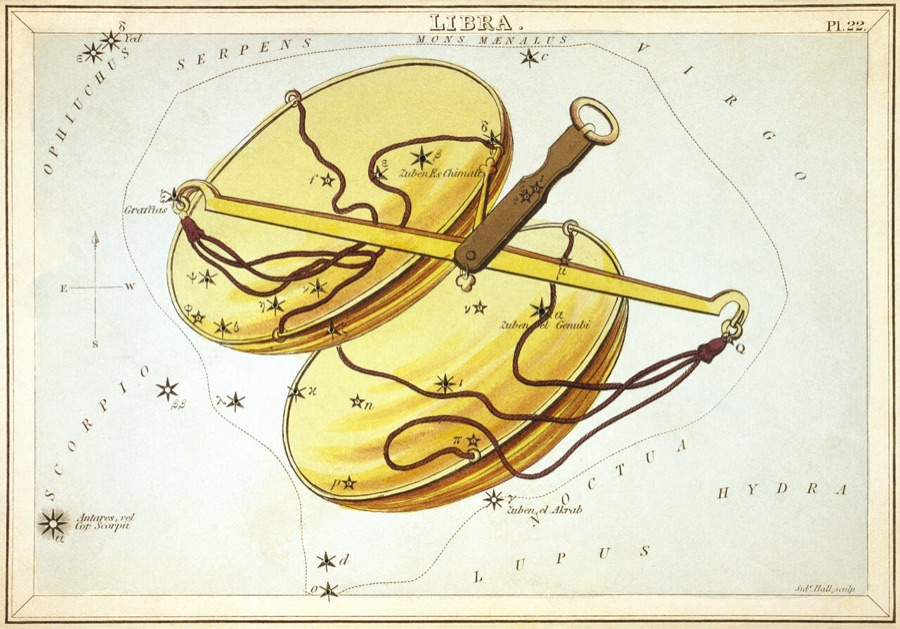
Libra is the only sign in the zodiac whose symbol is an object. Everything else is an animal or a person; this is a machine for comparing weights, and the choice is deliberate.
It is also the newest of the twelve. The stars were part of Scorpius for most of antiquity, forming the scorpion's claws, and Roman astronomers separated them out and renamed the region. The evidence is still in the star names: the two brightest are Zubenelgenubi and Zubeneschamali, from Arabic phrases meaning the southern claw and the northern claw. The scales are a late arrival wearing older labels.
The glyph is a horizontal line with a raised semicircle resting on it, usually read as a beam and a pan, or as the Sun sitting on the horizon at the equinox. Both readings are plausible and neither is documented; like the rest of the set the form is medieval.
Where this meaning came from
Libra is the youngest sign in the zodiac and the only one that had to be created. Babylonian sources include a set of scales in the region, sometimes as a separate figure and sometimes as part of the scorpion, and the boundary stayed unsettled for centuries. It was Roman practice that fixed the scales as an independent sign, and the Arabic star names still preserve the older arrangement.
The character of the sign is Hellenistic. Between roughly 100 BCE and 200 CE, astrologers in Greek-speaking Egypt gave Venus rulership of both Taurus and Libra, made Libra cardinal air, and tied it to the seventh house of partnership. Ptolemy set the scheme down in the Tetrabiblos in the second century CE, and it passed through Arabic and Latin translation into medieval Europe without much alteration.
The modern Libra, charming and indecisive and obsessed with aesthetics, is a twentieth-century compression. Alan Leo converted the signs into psychological types around 1900, and the newspaper column from 1930 turned them into stock characters. The older material is far more interested in judgement, law and the terms of an agreement than in whether somebody has good taste in curtains.
What the astronomy actually says
The best astronomical fact about Libra is written into its star names. Zubeneschamali and Zubenelgenubi mean the northern claw and the southern claw, because these stars belonged to Scorpius before Libra existed as a separate figure. The constellation boundaries used today were only fixed in 1930, when the International Astronomical Union drew formal lines around all eighty-eight.
Zubeneschamali is about a hundred and eighty-five light years away and has been described since antiquity as looking faintly green, which is odd, because no star is green: the human eye does not produce that colour from a stellar spectrum, and the reports have never been satisfactorily explained.
The autumn equinox was in Libra when the Greeks named it, which is where the association with balance comes from. Precession has since carried that point back into Virgo, so the equinox no longer occurs anywhere near the scales. Tropical astrology is unaffected, because it defines Libra as beginning at the equinox by definition; sidereal astrology follows the stars and puts things elsewhere. Neither has a mechanism.
The common misreading
The most common misreading of Libra is that it means balanced. The symbol is a scale, and a scale is an instrument for finding out that two things are not equal. What the sign describes is the act of weighing, which is effortful, often uncomfortable, and frequently ends with an unbalanced answer. A person with this placement is not serene; they are adjudicating, usually in private, and often about something nobody has asked them to adjudicate.
The second is treating the diplomacy as insincerity. Being able to state the other side's case well is not the same as agreeing with it, and this placement is regularly accused of being two-faced by people who have mistaken competence at advocacy for a lack of conviction.
The third is the aesthetics caricature. Venus rulership has been flattened into an interest in nice things, and the older material means something broader by Venus: the principle of attraction and of arranging elements into a relation. Design and justice are the same faculty applied to different materials, which is why one sign covers both, and reducing it to good taste loses the connection entirely.
Questions to sit with
- What have you already decided and not said out loud?
- Whose case are you making, and who is making yours?
- Is this peace, or is it only nobody saying the true thing?
- What did you agree to this month that you did not want?
See where this sits in your own chart.