- Card number
- 11
- Arcana
- Major Arcana
- Suit
- Major Arcana
- Element
- Air
- Rank
- Trump
- Roman numeral
- XI
- Zodiac attribution
- Libra
- Yes or no reading
- It depends
Justice
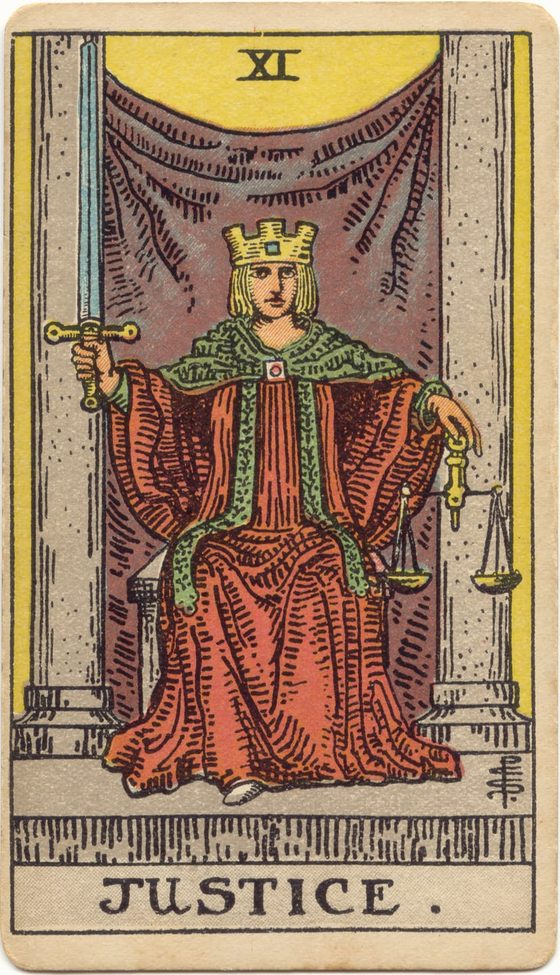
A crowned figure seated between two pillars, sword upright in one hand, scales level in the other. Justice is the card of consequence: what follows from what was actually done, weighed without much regard for what anyone intended.
- fairness
- consequence
- accountability
- law
- balance
- bias
- evasion
- imbalance
- dishonesty
- unaccountability
What the card shows
A figure sits on a low stone throne between two grey pillars, facing directly out of the card. The right hand holds a double-edged sword straight up, point toward the top edge, the blade tilted very slightly off vertical. The left hand holds a pair of gold scales, hanging level, at about hip height.
The robe is red and fastened at the shoulders, with a green mantle drawn across the chest and held by a square gold clasp set with a red stone. The crown is gold and battlemented, square merlons across the top, with a small blue-green square stone in the front. A grey-purple veil is hung between the pillars and closes off most of the background, though a narrow strip of blue shows at one side. One white shoe tips out below the hem of the robe.
Upright meaning
Justice is the card of consequence: what follows from what was actually done, rather than from what was meant. It is one of the few Majors where the figure looks directly out of the card at the reader, and the effect is deliberate. This card is not offering comfort. It is asking a question and waiting for the answer.
Upright, it usually marks a situation where the facts are going to decide it, and where those facts are more or less already in. Legal matters, contracts, a decision under review by someone with the power to make it stick. It equally covers the informal version: the moment a group of people work out what really happened and adjust accordingly. Reputation is a slow-moving form of this card.
The scales in the picture hang level, not tipped, and that matters. The card describes a weighing in progress rather than a verdict delivered. It does not say the outcome is favourable and it does not promise that it is fair, only that it will be proportionate to what is on the scales. Beside The Hierophant it reads as formal process. Beside Seven of Swords it reads as something concealed being weighed regardless.
Upright in love
In a relationship reading Justice is about the terms, spoken or not. Who does what, what each person believes they agreed to, and whether those two accounts match. It comes up when a couple has been running on assumptions nobody ever said out loud and those assumptions are about to be tested.
It is a cold card for a love question, and that is not a fault in it. It will not tell you whether you are loved. It will tell you that the arrangement is going to be examined, by one of you or by circumstance, and that whoever has been quietly carrying more is likely to finally say so. Fairness here means proportion, which is not the same as equal halves.
Upright in work
At work this is review, audit, appraisal, a contract read closely for once. The formal versions are a grievance, a legal question, a decision escalated to somebody with authority. The informal version is a project assessed on results rather than on how hard everyone worked.
The card is neutral about which way it goes. What it insists on is that the assessment will use the record, not the intention. A reading that promises vindication has gone beyond the picture. If the question is whether the querent will be treated fairly, the honest answer is that the card describes a process rather than its output, and that the record is the thing worth checking first.
Upright in money
Money in its contractual form: what is owed, what was agreed, tax, division of assets, a settlement. Justice is one of the few cards that genuinely favours going through the paperwork, because paperwork is what the card is about.
It says nothing about amounts and it is not financial advice. Where it earns its place is in separating what the querent feels is fair from what was actually written down. Those two diverge more often than people expect, and the card is pointing at the gap rather than taking a side in it.
Upright as feelings
As feelings, Justice is considered rather than warm. Someone is weighing you honestly and has not finished. Whether that reads as fairness or as coolness depends on which end of it you are: the person doing the weighing usually experiences it as care, and the person being weighed usually experiences it as distance.
Upright as advice
Go and read what was actually agreed, in writing, before you argue about it from memory. The advice on this card is nearly always documentary. Whatever your account of the situation, check it against the record first, including the parts of the record that do not favour you.
Reversed meaning
Reversed, Justice reads in two directions and they are opposed.
The first is unfairness done to the querent: a decision made on bad information, a process skipped, someone with power declining to look at the evidence. This is the reading everybody reaches for, and sometimes it is the correct one.
The second is unfairness the querent is party to. Accountability avoided, a version of events polished until it is no longer quite true, a benefit taken and never accounted for. Reversed, the card frequently marks a person arguing for an exception to a rule they would enforce on anybody else.
The picture cannot tell you which. The question can, and so can the honesty of the person asking it. A reader who defaults to the first reading is being comfortable rather than accurate, and it is worth noticing that in a spread about a dispute both parties would draw the same card. Waite's own list for the reversal runs to bigotry, bias and excessive severity, which points at the second reading rather more firmly than at the first.
Reversed in love
Either a relationship where one person consistently carries more and it goes unacknowledged, or one where a real imbalance is being denied by whoever benefits from it. Reversed, Justice often marks the private accounting a couple keeps and never says aloud. It can also mark a fight in which both people are arguing for a standard neither would accept applied to themselves.
Reversed in work
A process gone wrong: a decision made before the review, a rule applied to one person and not another, a contract nobody honoured. Or the querent's own corner-cutting catching up with them. In a workplace dispute this reversal is worth handling carefully, because the card describes a failure of proportion and both sides of most disputes believe the failure belongs to the other side.
Reversed in money
Debts and obligations not being accounted for, on either side. An agreement broken, a payment quietly not made, a settlement that took no notice of what was actually contributed. It can just as easily describe a querent who is owed nothing but feels owed. The card marks a gap between the ledger and the story, and it is not advice about how to close it.
Reversed as feelings
Someone who has already reached a judgement and is presenting the matter as still open. Or the opposite: a person too aware of their own unfairness to say plainly what they feel. Either way the reversal marks a verdict being withheld rather than an absence of one.
Reversed as advice
Apply the standard to yourself first. Write out the version of events you would accept if the other person were the one arguing it, and see whether you actually would. Reversed, the advice here is not to win the argument but to find out whether you are on the right side of it.
Symbolism in the 1909 image
The sword. Double-edged, held upright in the right hand, tilted slightly rather than perfectly vertical. Read as discernment and as the power to enforce. The double edge is the honest part: a decision that goes your way is made with the same instrument as one that does not.
The scales. Hanging level from the left hand, and empty. That emptiness is usually glossed over. Smith drew nothing in either pan, so what the card shows is a weighing that has not concluded rather than a judgement handed down.
The pillars and the veil. Two grey pillars with a grey-purple veil hung between them, closing off nearly all of the background. Compare the same device on The High Priestess, where it conceals something. Here it mostly means the decision is being made in a closed room, though Smith left a narrow strip of open blue showing at one edge.
The square clasp and the square stone. A square gold clasp at the chest, a small square stone set in the crown. Squares in Waite's iconography stand for the material world and for fixed measure, so this is the card's claim that judgement applies to actual things rather than to sentiments.
The exposed white shoe. One foot tips out from beneath the hem. It is a small detail, easy to miss, and readers disagree about it completely: some take it as readiness to step down and act, others as the human being visible under the office. The drawing does not settle the argument.
Where this meaning came from
Justice was one of the four cardinal virtues, and in the fifteenth-century Italian trumps it appears alongside Temperance and Fortitude, drawn from the same moral scheme as the paintings and sermons of the period. It carried no fortune-telling function whatsoever. The deck was equipment for a trick-taking game.
The occult interpretation arrives in eighteenth-century France with Antoine Court de Gebelin and Etteilla, whose claims of Egyptian origin were invented and are now known to have been. The Libra attribution comes from the Golden Dawn in the late nineteenth century, not from anything medieval.
The card's number is the thing readers most often trip over. In older decks Justice is VIII and Strength is XI. Waite swapped the two for the 1909 deck so the sequence would fit the Golden Dawn's zodiacal order, which is why Justice is XI here and Strength is VIII. Decks in the Marseille tradition kept the older numbering, so the same card carries a different number depending on which deck is on the table. Waite touches on the change in The Pictorial Key to the Tarot (1910) without quite explaining his reason.
The common misreading
Justice gets read as a promise that things will work out fairly. It is not that. It says a weighing is happening; it does not say the querent will like the weight. The worst damage this does is in legal questions, where a reader's reassurance can affect a real decision with real costs. The card is not a lawyer, and neither is the person reading it.
The second misreading is moral. Justice is treated as karma, as though it described a cosmic ledger settling itself. Nothing in the picture supports that. What the image shows is a person with a sword and a set of scales in a closed room, which is a description of institutional power rather than of moral order. Those are different things, and the difference is roughly what people go to court about.
The third is the assumption that the querent is the one being wronged. Justice turns up on both sides of every dispute. When it appears in a spread about a conflict, the useful reading is the one that asks what the other party's version of the ledger looks like. Not because they are right, but because the card is about proportion, and proportion cannot be assessed from one side.
Questions to sit with
- What did you actually agree to, and is any of it written down?
- If the other person described this situation, which parts of their account would be true?
- What standard are you applying here that you would not want applied to you?
- What are you owed, by whom, and have you ever said so out loud?
Pull this card in a real spread.