- Card number
- 8
- Arcana
- Major Arcana
- Suit
- Major Arcana
- Element
- Fire
- Rank
- Trump
- Roman numeral
- VIII
- Zodiac attribution
- Leo
- Yes or no reading
- Yes
Strength
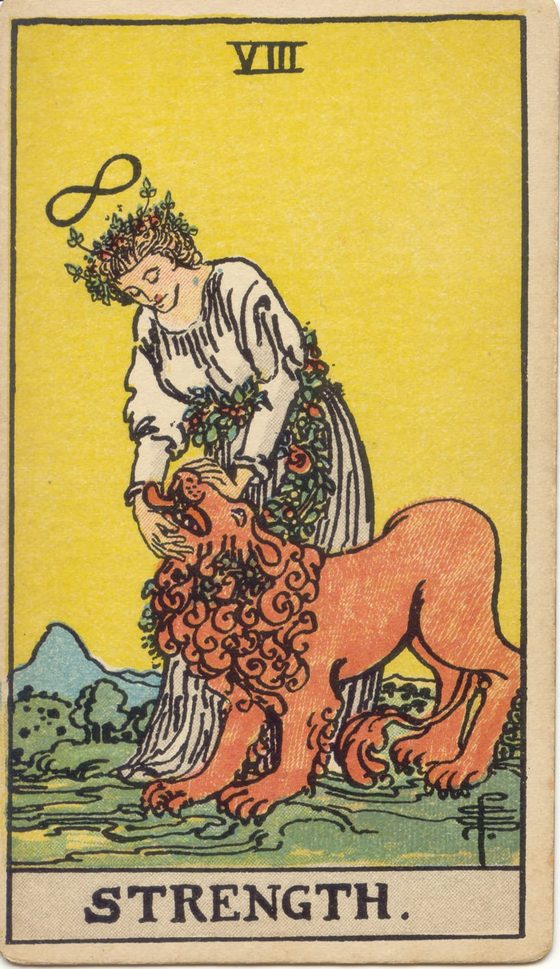
A woman in a white dress closing a lion's jaws with her bare hands. Strength is the card of force handled without force, and of the kind of patience that costs more than a confrontation would.
- patience
- composure
- courage
- self-command
- gentleness
- exhaustion
- avoidance
- self-doubt
- temper
- forced calm
What the card shows
A woman in a long white dress stands beside a lion in an open green landscape. She is bending over the animal with both hands on its head, one on the muzzle and one under the jaw, closing its mouth. Her expression is calm and she is looking down at the lion, not out of the card.
A horizontal figure eight floats above her head. A chain or garland of flowers hangs from her waist and loops around the lion's neck. She wears more flowers in her hair. The lion's tail is down and its head is lowered; it is not resisting. Behind them a single blue mountain rises against a plain yellow sky.
Upright meaning
Strength describes a difficult thing being handled without force. The lion is not restrained, tied or beaten; it is being held by someone who has decided not to be frightened of it. The card is about the choice of method as much as the outcome.
Upright, it usually reads as patience, self-command, or the ability to stay steady with something that would ordinarily provoke you. An addiction managed, a temper not lost, a person handled kindly who has not earned kindness. It is the least dramatic form of courage in the deck and the most sustained.
Read carefully, it is not a card about being nice. The lion is still a lion, and nothing in the picture says it has been changed. Beside The Chariot the two are the same problem solved twice: the one holds a course by force, this one by not needing to. Beside cards of conflict it usually describes the person who will not be provoked, which is a strong position and an isolating one. Beside cards of exhaustion it can mean the composure has become a performance, and the withdrawal of The Hermit, which follows, is the deck's next answer to that.
Upright in love
In relationship readings Strength usually describes someone staying steady through something difficult. Illness, grief, a bad patch, a temper that is not theirs. It is a card of tolerance and of the specific effort involved in not reacting.
That is admirable and it is worth asking how long it has been going on. Patience is a virtue when it is chosen and a symptom when it is the only option available. Where the question is about someone else, the card says they are being gentle with a difficult situation. It does not say the situation is fair, and it does not say they have decided to stay. The King of Cups shows the same composure held from a seated position, which is easier.
Upright in work
At work Strength is the card of holding your position without escalating. A difficult colleague dealt with calmly, a negotiation where you do not take the bait, a project defended by persistence rather than by argument.
It also describes the long unglamorous kind of competence: staying with a hard problem past the point where it stops being interesting. Upright it favours patience over confrontation, which is usually right and is not always. Where The Emperor would write the rule and enforce it, Strength keeps the relationship intact and takes longer. Neither is free, and the card does not pretend the slower route costs nothing.
Upright in money
In money questions Strength usually describes restraint held over time. Not spending, not panicking, not reacting to a number that moved. It is the card of the person who has decided in advance what they will do and is now simply doing it.
It can also describe a long repayment or recovery being managed steadily rather than fixed at a stroke. What it does not do is endorse a course of action or say when the difficulty ends. The card has no view on any particular decision and cannot see your circumstances; that is what figures and, where it matters, a qualified person are for.
Upright as feelings
As someone's feelings, Strength is warmth that is not being pushed at you. Steady interest, tolerance for your worse days, an absence of drama that can read as coolness if you are used to intensity. It suggests someone who has decided how they feel and is not being knocked off it. What it does not show is how much of that steadiness is patience and how much is simply not much feeling.
Upright as advice
Handle the difficult thing yourself and do it slowly. Strength's instruction is to stay in the room with whatever you have been avoiding or forcing, and to do neither. Pick the one situation you keep escalating, and this week respond to it once without raising your voice or your stakes.
Reversed meaning
Reversed, Strength reads two ways that look nothing alike. The first is composure that has run out: the effort of not reacting has become unsustainable, and what is left is either a temper about to go or a person who has gone numb to keep it in.
The second is the opposite: patience being used as avoidance. Tolerating something that should have been confronted, calling it maturity, and letting a situation continue because ending it would require a scene. This reading is far less flattering and turns up more often than the first.
A third version is the one about self-doubt, which the modern books lead with: the lion loose, the person convinced they cannot manage it. That is a real state and it is not the only reversal, and reaching for it automatically flatters the querent at the cost of the reading. What separates the three is the question. Somebody about to snap, somebody enduring what they should refuse, and somebody who has lost their nerve all need different things said to them.
Reversed in love
Either patience that has been spent and is now being faked, or patience that has become the mechanism keeping a bad arrangement in place. The second is the harder one to hear, because it asks whether the tolerance is a virtue or a habit. The reversal is also read as insecurity, and sometimes that is right. What it will not tell you is which of the people involved is holding the lion, and querents are often wrong about that.
Reversed in work
Composure worn thin, or conflict avoided until avoiding it has become the problem. In the first, someone is close to reacting badly and everyone can feel it. In the second, a difficult person or a broken process has been tolerated for so long that tolerating it is now policy. The reversal also covers the person who has stopped believing they can handle the work, which is a different problem and needs a different answer.
Reversed in money
Restraint that has broken, or restraint held so long it has turned into going without for no particular reason. The first is a decision made in a bad moment; the second is a habit that outlived its cause. The reversal can also describe a difficult financial situation being endured rather than addressed. That is a matter for figures and, where it matters, for someone qualified, and the card has no opinion on either.
Reversed as feelings
Feeling being held down rather than held steady, or steadiness that has curdled into distance. In the first the person is managing something and it is costing them; in the second they have stopped trying and the calm is what is left. The reversal is often read as insecurity about the relationship, which is one possibility among several and not the most likely.
Reversed as advice
Say the thing you have been being patient about, once, plainly, to the person concerned. If the patience was chosen you will lose nothing by naming it. If it was avoidance, you will find that out immediately. Either way, stop paying for the composure with your own week.
Symbolism in the 1909 image
The lion. Full-sized, unrestrained, head lowered under her hands. Read as instinct, appetite or anger. The important detail is what is absent: no cage, no chain, no weapon. Whatever is happening here depends on the animal's continued cooperation.
The flower chain. A garland running from her waist around the lion's neck, in the position a leash would occupy. It is made of flowers, which is either the whole meaning of the card or a very pointed joke about what is actually holding the animal.
The lemniscate. The same horizontal figure eight that floats over The Magician. It links the two cards, and the link is worth noticing: one figure has laid out every tool available, and this one is using none of them.
Her hands. One above the muzzle and one below the jaw, closing the mouth. It is a gesture of restraint and also of touch. Books call it mastery; the drawing is closer to a person holding an animal's face, which is what you do with something you are not afraid of.
The white dress. Plain, unarmoured, no protection of any kind. Compare the mail under the robe on The Emperor and the breastplate on The Chariot. Smith dressed this figure for a garden and put her next to a lion, and the contrast is the argument the card is making.
Where this meaning came from
In the fifteenth-century Italian decks this trump is la Forza, and the picture is usually a man with a club, or Hercules with the Nemean lion. The image of a woman quietly closing the lion's mouth is a later refinement, and it changes the argument completely.
The numbering is the interesting part. In the older decks Strength is XI and Justice is VIII. Waite swapped them for the 1909 deck, putting Strength at VIII and Justice at XI, to fit the Golden Dawn's assignment of the zodiac across the trumps: Leo before Libra. Most English-language decks have followed him ever since, and most French-tradition decks have not.
That means the card's number is not a fact about tarot but a choice made by one man in London in 1909, for reasons internal to a magical order. It is a useful thing to know before treating any numerological reading of the trumps as ancient.
In The Pictorial Key to the Tarot (1910) Waite is explicit that the card is not physical strength, and calls it fortitude in the older sense: the virtue that endures rather than the one that wins. The modern gloss of inner strength is a reasonable descendant of that.
The common misreading
The most common misreading is turning this card into a compliment. It appears, the reader says you are stronger than you know, and the reading stops there. That is pleasant and it is not what the picture shows. The picture shows work being done, continuously, on something that has not gone away.
The second is more serious. Because the card praises patience, it gets used to tell people to keep enduring things. Drawn in a spread about a difficult relationship, a bad workplace or a family situation, Strength is frequently read as advice to be gentler and wait longer. Sometimes that is right. Sometimes the honest reading is that a person has been managing a lion for years and nobody has asked why there is a lion.
The third is reading the reversal as self-doubt by default. It is one of at least three reversals, and picking it every time means never delivering the uncomfortable one, which is that the patience itself has become the problem.
Questions to sit with
- What are you being patient with, and did you choose that or inherit it?
- If you stopped managing this carefully, what is the worst thing that would actually happen?
- Who benefits from your composure, and is it you?
- Is there a lion here that nobody has asked why you are holding?
Pull this card in a real spread.