- Card number
- 14
- Arcana
- Minor Arcana
- Suit
- Cups
- Element
- Water
- Rank
- King
- Yes or no reading
- It depends
King of Cups
A man who feels everything and shows almost none of it, seated on a throne in open water. The King of Cups describes emotional control held at a cost, and the spread around it decides whether that cost is worth paying.
- composure
- diplomacy
- emotional control
- steadiness
- counsel
- coldness
- manipulation
- volatility
- withdrawal
- emotional strain
What the card shows
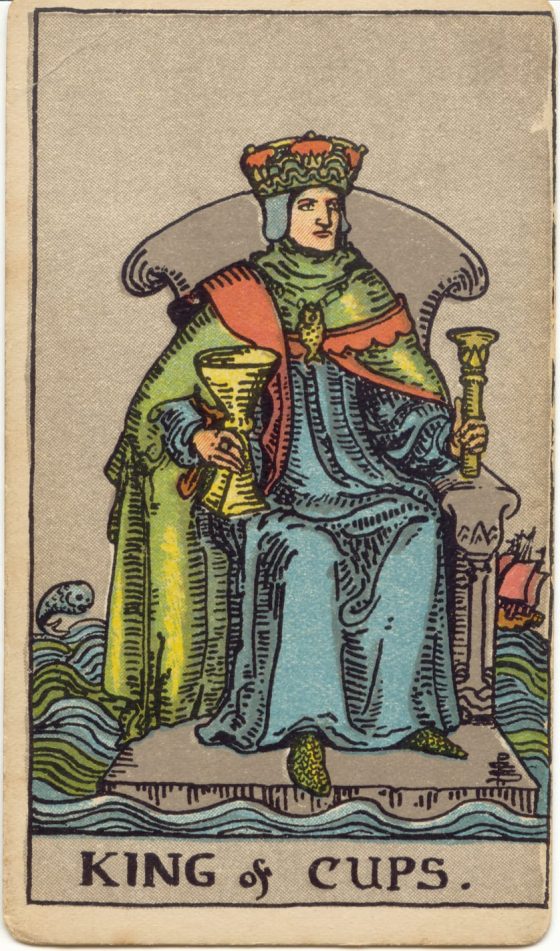
A crowned figure sits on a stone throne set in the middle of open water. The sea is choppy and comes right up to the base of the seat; there is a small square of stone under the feet and nothing else. He holds a heavy gold cup in one hand and a sceptre in the other, and looks off to one side rather than out at the viewer.
He wears a blue robe, a yellow-green cloak falling over one shoulder, and a red mantle. A small fish hangs on a chain at his chest. Behind him on the left a fish breaks the surface; on the right a ship rides the swell. Neither is close to him. The throne does not appear to be anchored to anything.
Upright meaning
The King of Cups is the court card of emotional command. That is not the same as emotional openness, and the difference is most of what the card is about. He is the figure who can sit inside someone else's crisis without escalating it, absorb distress without passing it along, and make a decision while feeling strongly about it. In a reading he often marks a person doing that job, or a situation asking the querent to.
Waite's own paragraph on this card is short and mostly concerned with the man's station and trade. Nearly everything modern readers do with it, the counsellor and the mediator and the steady friend who does not flinch, accumulated later. The reading holds up well, but it is a twentieth-century reading, not an old one.
What the card cannot tell you is whether the composure is real or maintained. The throne floats on unsettled water and nothing in the drawing anchors it. Beside Queen of Cups it reads as genuine emotional fluency shared between two people. Beside King of Swords it reads as judgement that has kept its warmth. Beside a card of exhaustion or concealment it reads as a man holding a lid down and calling it peace.
Upright in love
In a relationship reading this is often the partner who stays steady when things get hard: the one who does not retaliate, does not go cold, and can hear something difficult without turning it into a fight. That is a real quality and it is rarer than the tarot's romantics suggest.
It has a shadow the upright card does not hide. Composure can be a way of standing slightly outside the relationship. The person who is never rattled is sometimes the person who is never fully in it, and a partner can find that harder to live with than an argument. Where the question is about someone else's feelings, this card describes their conduct, not their interior.
Upright in work
At work the King of Cups is the manager people bring problems to, the negotiator who lowers the temperature in a room, the senior person whose main contribution is not technical. It suits mediation, care work, client-facing roles, anything where the difficult part is people rather than the task.
Drawn as advice it usually says the situation needs regulation rather than force. Not agreement, regulation. He is not a pushover; the sceptre is in the picture too. Drawn as a person, be careful about assuming the calm one is neutral. Whoever holds a room steady usually has a position, and often more influence than their title shows.
Upright in money
Money handled without drama. The card describes a temperament toward money rather than an amount: decisions made calmly, commitments honoured, other people's finances treated with care. It often turns up where someone else's money is in your hands, or yours in theirs.
It says nothing about whether the numbers work. A steady hand can steer steadily in a poor direction, and this card cannot tell patience apart from denial. If the question is whether to act, the King of Cups describes only the manner, not the merits.
Upright as feelings
Deep feeling under deliberate control. As someone's feelings toward you, this is care that has been thought about rather than declared: warm, reliable, and probably understated enough to be easy to miss. It is not indifference, and it is not a confession either. The card describes what is being held, not what has been said.
Upright as advice
Respond, do not react. Before the next difficult exchange, decide what you actually want out of it and say that thing first, out loud, instead of answering whatever provokes you. If you cannot manage that today, postpone the conversation rather than have a worse version of it.
Reversed meaning
Reversed, the King of Cups splits into two readings that point in opposite directions, and the spread has to decide which one is on the table.
The first is control that has curdled. Composure used as a wall, warmth deployed strategically, feeling managed so thoroughly that nobody, including him, can locate it. In its harder form this is the person who never raises their voice and is nonetheless the reason everyone in the room is careful. Manipulation sits on this reversal in most books, and it is worth taking seriously, but it is not the only reading available.
The second is the lid coming off. The regulation fails and what was being held gets spilled, usually on someone who was not the cause. Moodiness, volatility, a person who has absorbed more than they can carry and is now leaking it.
A reader who reaches for manipulation every time this card falls reversed is reciting, not reading. Pressure and depletion around it argue for the second; secrecy and power argue for the first.
Reversed in love
Either a partner whose evenness has become a way of never being reachable, or one whose composure has run out and who is now unpredictable in ways the relationship is not built to absorb. Both are failures of the same faculty. The useful question is not which is worse but which is actually happening, and that is answered by the rest of the spread rather than by this card.
Reversed in work
A manager who manages feeling instead of work, where morale gets handled and the actual problem does not. Or a formerly steady colleague coming apart under a load nobody named. Either way, the emotional labour in the situation has stopped being distributed fairly. Look at who is expected to stay calm here, and whether they ever agreed to it. Compare Temperance, which describes the same blending done well.
Reversed in money
Financial decisions made from a feeling that is not being examined: soothing yourself, punishing yourself, or keeping someone else comfortable at your own expense. It can also mark money matters where a person is being reassured rather than informed. The card flags the reasoning, not the sum, and it cannot tell you whether the position is sound. If money is being managed on someone's behalf here, ask what they have actually been told.
Reversed as feelings
Feeling that is either sealed off or spilling over. As someone's feelings, this can be care that has hardened into distance, or genuine turbulence they are no longer hiding. The reversal says the usual regulation is not working. It does not say what is underneath, and it is not a reading of absence.
Reversed as advice
Work out which reversal you are in before you act. If you are the one holding everything down, name one thing you have not said and say it to a person who can actually hear it. If you are the one spilling, make no decisions today and deal with the load first.
Symbolism in the 1909 image
The throne on water. A heavy stone seat resting on open sea with no visible support. It is the whole card in one image: stability maintained rather than possessed. Smith draws no rock beneath it, and nobody has ever satisfactorily explained what it stands on.
The cup. Held out from the body, and the only cup in the picture. He is the one court figure of this suit not gazing into it. Most books read that as mastery over the element. It reads just as easily as a man keeping his own feelings at arm's length.
The fish amulet. A small fish on a chain at his chest, echoing the live fish in the water behind him. Read as the emotional life worn openly, or as the emotional life reduced to an ornament. The drawing does not decide.
The leaping fish. To his left, breaking the surface. It is the only unmanaged thing in the frame, and he is not looking at it.
The ship. To his right, riding the swell without difficulty. Commerce, or safe passage over deep water. Either way it is at a distance, and both it and the fish sit behind his back.
Where this meaning came from
The Minor Arcana courts began as ordinary playing-card figures. In the fifteenth-century Italian decks the suit of cups had a king who was a court rank in a trick-taking game and nothing more, carrying no meaning because the deck carried none.
Divinatory meanings were grafted on in eighteenth-century France, chiefly by Antoine Court de Gebelin and then by Etteilla, who assigned readings to every card including the courts. Much of what that era claimed about tarot's Egyptian ancestry was invented outright, and the meanings it produced were often arbitrary.
The version English readers use comes from 1909, when Pamela Colman Smith drew the deck to Arthur Edward Waite's direction. Waite's note on this card in The Pictorial Key to the Tarot (1910) is characteristically thin: a fair man of business, law or divinity, responsible and kindly, with a hint of loss attached. The rich modern portrait of the emotionally literate king is a later construction, built far more on Smith's picture than on Waite's text.
That is worth saying plainly. Here the illustration outran the commentary, and the illustrator was paid a flat fee and credited with her initials.
The common misreading
The most common misreading is treating this card as a character reference. It turns up in a spread about a difficult person and gets read as proof that they are kind, wise and safe. The card describes conduct, steadiness and non-escalation and control, and conduct is not the same as intent. Plenty of controlling people are unfailingly calm.
The second is the mirror image, and it is commoner among readers who have been hurt. Every composed man becomes suppressed, cold or quietly manipulative. That reading is available on the reversal; it is not available by default. Reaching for it upright is projection with a card for cover.
The third is quieter. Because the card is flattering, it gets handed to the querent as an identity: you are the King of Cups, you are the strong one, you hold everyone together. That is a pleasant thing to be told and a rough thing to live inside. If the spread is asking who carries the emotional weight of a situation, the honest reading may be that they should put it down, not that they are good at holding it.
Questions to sit with
- When did you last say something to this person that you had not rehearsed first?
- What are you holding steady on other people's behalf, and who actually asked you to?
- Is the calm in this situation yours, or is it something you perform to keep the room from moving?
- If you stopped absorbing this, who would have to deal with it instead?
Pull this card in a real spread.