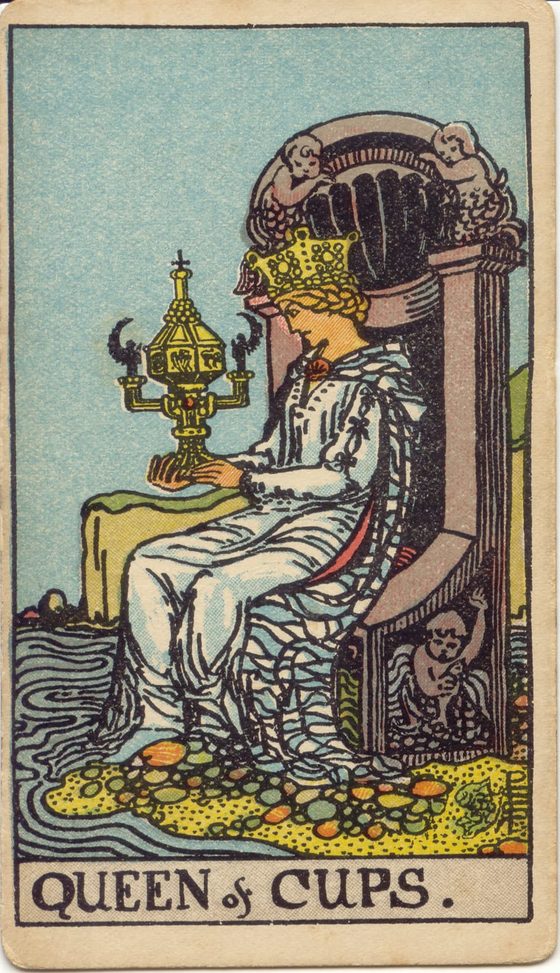
- Card number
- 13
- Arcana
- Minor Arcana
- Suit
- Cups
- Element
- Water
- Rank
- Queen
- Yes or no reading
- Yes
Queen of Cups
A queen sits on a stone throne at the water's edge, studying the only covered cup in the deck. The Queen of Cups is feeling that has been lived with long enough to be useful.
- empathy
- intuition
- care
- emotional depth
- composure
- depletion
- overwhelm
- enmeshment
- self-neglect
- withdrawal
What the card shows
A crowned woman sits on a heavy stone throne at the edge of the sea, facing left. She holds a golden cup in both hands and looks down into it. The cup is closed: it has a lid, a pair of angel handles and a small cross at the top, and it is the only covered cup in the deck.
The throne is carved with scallop shells and, on the arm, two small water-children with fish tails. Her robe is pale and falls over her feet so that the hem meets the water without a visible edge between them. The shore beneath her is made of coloured pebbles. Behind her the sea is calm and a headland runs out to the left. The sky is clear.
Upright meaning
The Queen of Cups describes emotional competence: the capacity to feel something fully and still be able to do something about it. Waite's description is more careful than the card's reputation. He calls her beautiful, fair and dreamy, as one who sees visions in a cup, and then corrects himself in the next breath: this is only one of her aspects, she sees but she also acts, and her activity feeds her dream.
That second sentence is the card. The common reading of this queen as a soft, intuitive presence drops the half of Waite's own description in which she does anything. What is drawn is a woman studying something closely while sitting perfectly still, and stillness is not the same as passivity.
In a spread the card usually marks somebody who understands a situation emotionally before it can be argued, and who is being asked to hold something for other people. That is a real position with costs the picture does not show. Where The High Priestess keeps what she knows, this queen uses it. Beside the Knight of Cups she reads as the difference between feeling expressed and feeling understood.
Upright in love
In a relationship reading the Queen of Cups describes care that is skilled rather than merely willing. Somebody who notices what has not been said and does something useful with the noticing. It is the most emotionally capable card in the suit.
The difficulty it points at is one-sidedness. This queen is more often drawn on in relationships than she is met, and a reading that admires her capacity without asking who is holding her is reading half the situation. Where the question is about how a relationship is balanced, this card frequently marks the person doing the emotional work, and the spread around it will say whether that work is shared.
Upright in work
At work the Queen of Cups is the person a team actually depends on for its temperature: the one who notices when somebody has gone quiet, who gets told things before they become announcements, and whose job description mentions none of it.
The card is not about hierarchy and does not describe seniority. It describes influence built on trust, which is real and rarely rewarded on paper. Where a question is about progression, this card usually explains why somebody is valued rather than whether they will be promoted, and those are different questions with different answers. Where the King of Cups is asked to be steady in public, this queen is asked to be accurate in private.
Upright in money
In money questions the Queen of Cups is the least interested card in the suit. It rarely describes the money. It describes the relationships around it: what somebody has been asked to carry, what is being given quietly, what is owed and never mentioned.
Where it turns up in a practical question it often marks generosity that has not been counted, or a financial arrangement that is really an emotional one wearing a financial coat. Naming which of the two is in play is genuinely useful. Doing anything about it is a decision well outside what a card can advise on.
Upright as feelings
As someone's feelings, the Queen of Cups is deep, steady and largely unspoken. Somebody who has understood how they feel and has not necessarily said any of it. It is warmer than it looks from outside and it does not perform. If the question is whether the feeling is serious, this card says yes. If the question is whether you will be told, the card does not answer.
Upright as advice
Trust the thing you noticed and did not mention. Say it once, plainly, to the person it concerns, and then stop, because this card's competence is accuracy rather than persistence. If you are the one everybody comes to, ask one person for something this week.
Reversed meaning
Reversed, this is the card where the tradition falls apart, and it is worth saying so plainly.
The modern readings run two ways. One is capacity turned inward: feeling that has stopped being manageable, or care given out until there is nothing left of the person giving it. The other is care used as leverage, with emotional insight turned to managing people rather than to understanding them.
Waite's own entry is stranger than either. He writes that the accounts vary, and then gives good woman, followed by distinguished woman but one not to be trusted, followed by perverse woman, vice, dishonour, depravity. That is not a reading. It is a list of incompatible judgements about a woman, and the older material behind it is worse.
The honest position is that this reversal has never had a settled meaning. Take the two modern readings, decide between them from the question and the spread, and treat the older list as evidence about how this tradition talked about women rather than as information about anybody's character.
Reversed in love
Reversed in love, either somebody depleted by carrying everybody else's feelings, which is by far the more common case, or emotional attentiveness being used to steer rather than to understand. The first is exhaustion and the second is control, and confusing the two does real harm in either direction. Nothing in the card identifies which is present. The surrounding spread, and what the querent already knows, will do more than the card can.
Reversed in work
At work, either the person who holds a team together running out of the capacity to do it, often unnoticed because the holding was always invisible, or an environment where personal loyalty has quietly replaced clear process. Both are recognisable. The first is more common and much easier to repair. Look at whether the surrounding cards describe fatigue or describe politics.
Reversed in money
Reversed, this usually marks money and feeling that have not been kept separate: help given that cannot be asked back for, support that has hardened into an expectation, an arrangement where nobody knows the terms because naming them would seem cold. The card points at the unclarity. Making an arrangement explicit is generally the useful move, and beyond that a card has nothing to say about anybody's finances.
Reversed as feelings
Either feeling so strong that it has become hard to separate from the situation that produced it, or warmth that is being managed rather than felt. The reversal usually describes overwhelm rather than coldness, and the ordinary reading is the right one until something specific in the spread says otherwise.
Reversed as advice
Put one thing down. Name the person whose feelings you have been carrying and stop carrying them for a week, without announcing it. Then look at what actually happens, which is usually less than you expected and occasionally more. That is the test this card is asking for.
Symbolism in the 1909 image
The closed cup. It has a lid, angel handles and a cross on top, and it is the only cup in the deck that is covered. Everything else in the suit is open and can be poured out. Read as a private interior, or as something being protected. The plainest observation is that nobody, the reader included, can see what is inside it.
The throne. Heavy carved stone set directly on the shore. It is the most solid object in the card and it stands on pebbles, at the line the tide reaches. Stability placed in the one position that is not stable.
The water-children on the arm. Two small figures with fish tails are carved into the throne. They are decoration, and they are also the only other faces in the picture. Standard readings pass over them entirely.
The robe and the hem. The pale robe spreads over her feet and runs into the water with no visible edge between cloth and sea. Smith drew that boundary as unclear on purpose. Whether it reads as sympathy or as a loss of separation is exactly the question the reversal asks.
The pebbles. Coloured stones cover the shore. They are the only detailed texture in the foreground and they are entirely ordinary. This queen is sitting on a real beach rather than inside a symbol.
Where this meaning came from
The queen was a rank in the Italian decks four hundred years before she was a personality. Cups, coins, swords and batons each ran to a king, a queen, a knight and a knave, and none of them meant anything outside the game.
The eighteenth-century French occult writers assigned meanings, and for court cards they assigned people: individuals in the querent's life, identified by age, sex and colouring. The queens fared badly under that system, which sorted them into good and bad women with very little room in between.
Smith's 1909 drawing is the source of the modern card. Waite's commentary in The Pictorial Key to the Tarot (1910) calls her beautiful, fair and dreamy, as one who sees visions in a cup, and then adds the corrective most books drop: she sees, but she also acts, and her activity feeds her dream. His upright list runs through honest, devoted, loving intelligence, wisdom, virtue, a perfect spouse and a good mother.
His reversed entry opens by admitting that the accounts vary, and then gives everything from good woman to vice, dishonour and depravity. That is the tradition failing to make up its mind, in public, on the page.
The common misreading
The Queen of Cups is most often read as pure intuition: a woman who feels things and does not do anything. Waite says otherwise in the same paragraph the dreamy description comes from. She sees, but she also acts, and her activity feeds her dream. Dropping the second half has produced a century of readings in which the most capable card in the suit is described as a mood.
The second misreading is treating her as available. In spreads about other people this card gets read as somebody who will look after the querent, and Waite's phrase about a devoted woman who will do service to the Querent encourages it. Nothing in the picture says she is offering anything. She is looking into her own cup, and it is closed.
The third is the reversal. The older reversed meanings run to perverse, dishonourable and depraved, and readers still repeat them. Those are judgements about women that the tradition inherited, not observations about a card. Where the Queen of Swords was treated that way for being clear-sighted, this queen was treated that way for feeling, and neither has anything to do with what a querent is asking.
Questions to sit with
- Whose feelings have you been holding, and who is holding yours?
- What have you noticed about this situation that you have not said out loud?
- What would you actually need in order to ask someone for something?
- Is your reading of this person's state coming from evidence, or from how much you care about them?
Pull this card in a real spread.