- Card number
- 13
- Arcana
- Minor Arcana
- Suit
- Swords
- Element
- Air
- Rank
- Queen
- Yes or no reading
- It depends
Queen of Swords
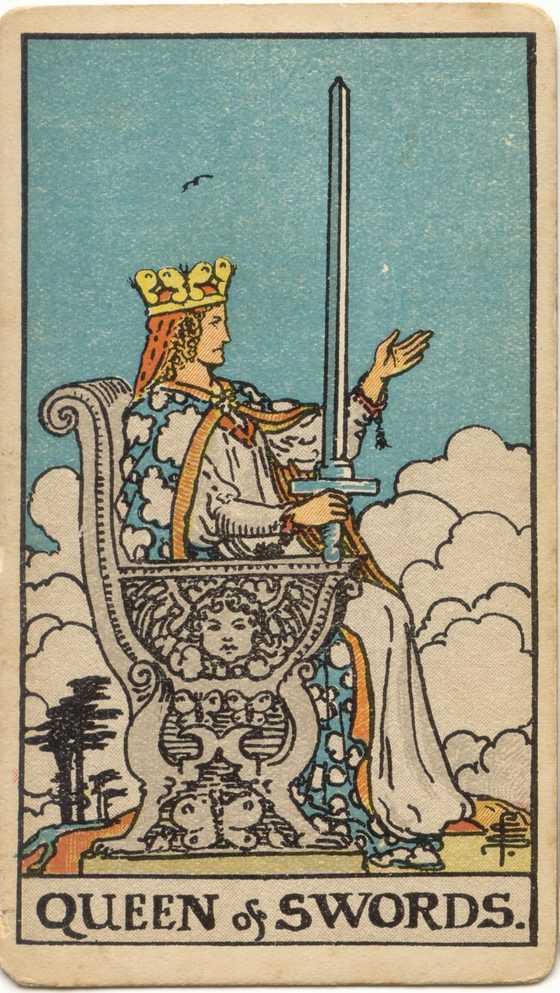
A queen seated above the clouds, sword upright, one hand open toward whoever is approaching. The card describes clear-eyed judgement formed through experience, and nothing suggests the experience was pleasant.
- clarity
- honesty
- independence
- perception
- boundaries
- coldness
- harsh words
- bitterness
- withheld truth
- isolation
What the card shows
A crowned woman sits in profile on a heavy stone throne, facing to one side. Her right hand holds a sword upright, the blade tilted slightly away from her. Her left arm is raised with the hand open and extended forward, palm turned outward.
Her crown is set with butterflies. The arm of the throne ends in a carved butterfly, and the back of it carries the head of a winged child in relief. Her cloak is patterned with clouds. She sits above a bank of cloud that runs across the lower part of the card, with a line of trees bending in the wind on the horizon behind her and a single bird in the sky above. Her expression is level, and she is not looking at the sword.
Upright meaning
The Queen of Swords is the deck's clearest thinker and its least comfortable one. She describes judgement that has been earned rather than inherited: somebody who sees a situation accurately because they have been in one like it before and paid for the lesson.
The posture holds two things at once. The sword is up, which is a boundary. The other hand is open, which is an invitation. This is not a card about coldness. It is a card about someone who will listen and will also tell you what they think, in that order, and will not soften it much for the sake of comfort.
Where it gets misused is in reading that clarity as unkindness. Directness and cruelty are different things, and the difference is whether the person is trying to help you or trying to win.
Read the neighbours. Beside Three of Swords the clarity came at a cost that is still visible. Beside Justice it is being applied to a decision that has to be fair rather than warm. Beside Queen of Cups the spread is asking which of the two the situation actually needs.
Upright in love
In a relationship reading, this card usually describes honesty. Someone who says what is true rather than what would be easier, and who expects the same in return. That is either the safest thing in the world or extremely uncomfortable, depending on what the other person has been avoiding.
It can also describe someone whose standards were set by a previous experience and are now not up for negotiation. That is not a flaw. It does mean the person is unlikely to be talked into overlooking the same thing twice.
Where the question is about whether somebody is warm, this card gives a poor answer. Warmth is not the property it measures.
Upright in work
At work this is competence with a low tolerance for nonsense. The person who reads the document, asks the question nobody wants asked, and gives an assessment that turns out to be right. In a spread about a decision, the Queen of Swords argues for the unsentimental version of it.
She also describes the cost of that reputation. People who are reliably honest inside organisations get consulted constantly and promoted less often than the ones who are pleasant.
If the question is about a difficult colleague, look at whether the card is describing them or describing the standard the querent is being measured against.
Upright in money
Money handled with clear eyes. Reading the terms, doing the arithmetic, declining the thing that sounds good and does not add up. The card describes the posture of somebody who is not going to be flattered into a decision.
That posture is worth something, and the card still says nothing about whether the numbers themselves are good. Clarity about a bad situation is clarity, and it is not a solution.
Nothing here is advice about what to do with money. What the card describes is the quality of the attention being brought to it.
Upright as feelings
As feelings, this is honest and guarded at the same time. Someone who knows exactly how they feel and has already decided what they will and will not say about it. There is often real warmth underneath, held behind a boundary that was put there for a reason. Expect directness rather than display.
Upright as advice
Say the true thing, plainly, and then stop. No cushioning, no rehearsing it into something softer, no long preamble to make it land gently. Then let the other person have their reaction without managing it for them. That last part is the whole discipline of this card.
Reversed meaning
Reversed, the Queen of Swords splits along a fault line that is already present in the upright.
The first reading is clarity turned cold. Honesty used as a weapon, precision deployed to wound, a person who is technically right about everything and impossible to be near. This is the reversal most books lead with, and it does describe something real.
The second is the opposite: judgement abandoned. The querent knows what is true and is not saying it, either to keep the peace or because the last time they said it, it cost them. Reversed, this card can describe a very perceptive person who has decided to stop noticing out loud.
There is a third worth naming. Sometimes the reversal marks grief rather than coldness. This Queen was read as widowed or bereaved in the older sources, and the reversal can describe someone whose sharpness is the shape their sadness has taken.
The spread decides. Cards about other people point to the first. Cards about the querent's own silence point to the second.
Reversed in love
Either honesty that has become a habit of criticism, or honesty that has stopped happening at all. Reversed, this card sometimes describes a partner whose observations always land as complaints. It just as often describes someone who has stopped saying the true thing because they no longer expect it to change anything. Both look like distance from outside, and they are not the same problem.
Reversed in work
A workplace where directness has curdled, or one where it has been trained out of people entirely. Reversed, this can be the colleague whose feedback is accurate and delivered to hurt, or the querent who has stopped raising things at all because the last time they raised something it was punished. King of Swords nearby shifts the reading toward authority and how it is being used.
Reversed in money
Clear thinking applied harshly, or not applied at all. Reversed, this card sometimes describes financial judgement being used to control somebody else, and sometimes the querent avoiding a clear look at their own position because the last clear look was painful. The card is about the state of the judgement, not the state of the money, and it is not advice about either.
Reversed as feelings
Feeling held behind a defence that has hardened. Either someone whose warmth has been shut off deliberately, or someone still hurt enough that honesty has become the only register available to them. In both cases what shows on the surface is sharpness. What is underneath is not the same thing in the two readings.
Reversed as advice
Check whether the true thing you are about to say is for their benefit or for yours. If it is yours, do not say it at all. If it is theirs, say it once, plainly, without the extra sentence at the end that makes it sting.
Symbolism in the 1909 image
The upright sword. Held in the right hand, blade vertical, tilted slightly away from her body. Unlike the Knight's, it is not raised to strike. It is held the way a person holds a standard, and the tilt matters: she is not pointing it at whoever is arriving.
The open hand. Raised, palm outward, fingers apart. Read variously as receiving, as beckoning, and as a signal to stop. The three are not compatible, the drawing does not choose between them, and that is why this card supports so many contradictory readings.
The butterflies. Set in the crown and carved into the arm of the throne. Butterflies carry transformation and, in older European symbolism, the soul. They are the softest element in the picture, and Smith put them on the hardest surfaces in it.
The winged child's head. Carved in relief on the throne back, a cherub in the classical rather than the sentimental sense. It belongs to the element of air and is the only face in the card besides her own.
The clouds. Banked below the throne, patterned across her cloak, and clearing above her head. She sits at the boundary between the weather and the clear air, which is the most flattering thing the card says about her, and it is said in the composition rather than in any of the words.
Where this meaning came from
Queens are part of the original equipment. The fifteenth-century Italian tarot had king, queen, knight and page in every suit because it was a card game, and the queen was a rank in play long before she was a personality.
Divinatory readings for the courts were assigned by the French occultists of the eighteenth and nineteenth centuries. The queen of this suit was given associations with a widow, a woman of sorrow, sterility and privation. Those are the readings Waite inherited, and they are worth knowing, because they explain a tone in the card that modern books tend to walk straight past.
Pamela Colman Smith drew the 1909 image to Arthur Edward Waite's direction, and Waite's entry in The Pictorial Key to the Tarot (1910) keeps the older sense. He lists widowhood, female sadness and absence alongside keen observation, and describes her face as suggesting familiarity with sorrow.
The modern reading of this card as independence, intellect and healthy boundaries is a real improvement on privation and sterility. It is also a substitution. It arrived in the second half of the twentieth century, and it quietly dropped the grief that Waite thought was the point of her.
The common misreading
The Queen of Swords is most often misread as a cold woman. Readers see the sword and the profile and produce a character sketch: bitter, hard, difficult, probably somebody's ex-wife. That reading descends from nineteenth-century keyword lists about widows and sterility, and it has long outlived any reason to keep it.
The second misreading is the modern correction taken too far, where the card becomes a compliment about boundaries and independence and nothing else. Waite wrote that her face suggests familiarity with sorrow. A reading that keeps only the strength has removed the part that explains where the strength came from.
The third is gender. Court cards get read as literal women constantly, and this one especially. It describes a way of handling a situation, and anybody at all can be in it.
And one that does real damage: using this card to tell a querent that another person in their life is emotionally unavailable. That is a claim about somebody's private interior, made from a picture, about a person who is not in the room. The card cannot support it.
Questions to sit with
- What do you already know to be true here that you have not said out loud?
- Is the thing you want to say for their benefit, or for yours?
- Which of your standards came from experience, and which came from one bad experience?
- Where are you being clear, and where are you being clear in order not to be kind?
Pull this card in a real spread.