- Card number
- 3
- Arcana
- Minor Arcana
- Suit
- Swords
- Element
- Air
- Rank
- Three
- Yes or no reading
- No
Three of Swords
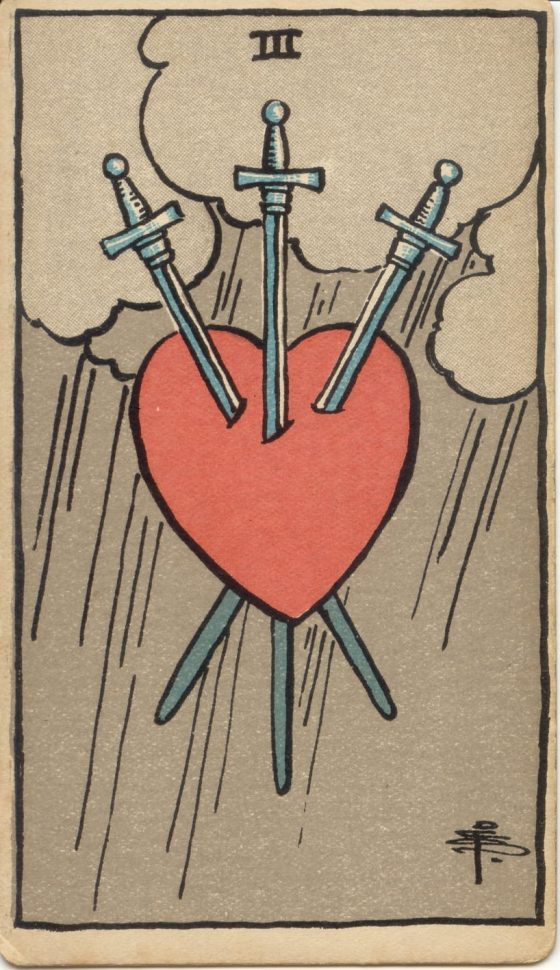
A red heart pierced by three swords under steady rain. The Three of Swords is one of the few cards in the deck that does not soften what it shows, and it names grief without saying where the grief came from.
- grief
- heartbreak
- painful truth
- separation
- loss
- recovery
- suppressed grief
- healing
- denial
- release
What the card shows
A single red heart fills the centre of the card, drawn flat and stylised in the shape used on playing cards rather than as an anatomical organ. Three swords pass through it. One enters vertically from the top and its point emerges at the bottom; the other two cross it diagonally from the upper left and the upper right. All three come out on the far side.
Behind the heart is a bank of grey cloud, and across the whole background, falling in straight parallel lines, is rain. The rain does not slant; there is no wind in the picture. There are no figures here, no ground, no horizon and no light source. Apart from the disembodied hand on the Ace, it is the only card in the suit with nobody in it.
Upright meaning
The Three of Swords is the plainest card in the deck. A heart, three blades, rain. There is no scene to interpret and no figure to identify with, which is unusual: Smith gave almost every other Minor Arcana card a person and a setting. Here she drew a diagram.
Upright it describes grief, and specifically grief with a cause you could name. Something was said, or found out, or ended. The number is worth noticing. Pain of this kind rarely arrives from one direction, and the card does not present a single wound with a single author. Three separate things have usually gone wrong before a person starts calling themselves heartbroken.
What it will not do is tell you when, or whose fault, or whether it is over. It describes a condition, not a sequence. Beside The Tower it reads as damage from something sudden and structural. Beside Five of Cups it reads as a loss being stared at rather than one that has just landed. Beside Four of Swords the reading turns toward recovery, though the card itself promises none.
Upright in love
In a relationship reading this is the card of the thing that hurt. A separation, a disclosure, a rejection, or a long-running unhappiness that has finally been named out loud. It is one of the few tarot cards that does not admit an optimistic gloss, and pretending otherwise does the querent no favours.
It says nothing about permanence. Grief and ending are not the same event, and plenty of relationships contain this card and continue. What it does insist on is that the pain is real and has a cause. If the question was whether you are overreacting, the card declines to say yes, which is not the same as telling you what to do next.
Upright in work
Bad news at work, delivered rather than feared: a rejection, a redundancy, a project cancelled, a piece of feedback that landed hard and happened to be accurate. It can also describe a workplace where something has gone quietly wrong between people and everybody knows it.
The card carries no advice, which is unusual for this suit. It marks the hit. What it suggests by leaving the frame empty is that this is not yet a moment for strategy; nobody in the picture is doing anything, because there is nothing useful to do yet. Whether the situation recovers is a question for the cards around it and for facts the tarot does not hold.
Upright in money
A financial loss that has already happened, or a piece of information about money that is unwelcome and true. Debt seen clearly, a shortfall confirmed, an arrangement that has failed.
This is not a card about what to do, and nothing here is guidance on handling a loss; that belongs to someone qualified to give it. What the card describes is the moment the news lands, and the reasonable observation that people make poor financial decisions in exactly this state. A reading can note that without advising anything at all.
Upright as feelings
Hurt, plainly. As someone's feelings, this is a person wounded by something in the situation, and the card does not distinguish between hurt you caused, hurt circumstance caused, and hurt they brought in with them. It is not the same as blame, and reading it as blame is where most of the damage gets done.
Upright as advice
Say the true thing about what happened, once, to one person who can hear it. Not a defence of it and not a plan around it, just the account. The card's advice is not to act while the rain is still falling, and there is no card in this deck that recommends hurrying it.
Reversed meaning
Reversed, the Three of Swords is read two ways that lead in opposite directions.
The first is the pain receding. The swords come out. This is the reading most books lead with: recovery, the worst of it passing, a wound that has begun to close. It is often accurate, and it is worth saying that recovery is not resolution. The card does not claim the cause was addressed, only that the acute phase is ending.
The second is the pain refused. The grief is still there and is being held off, minimised, or converted into something more manageable such as anger or busyness. Reversals in this suit often describe an internal version of the upright image, and here that means a hurt that has gone underground rather than away.
Nothing in the card chooses between them. A spread with rest and time in it argues for the first; a spread full of avoidance argues for the second. Reaching for healing every time because it is the kinder reading is not reading at all.
Reversed in love
Either a couple starting to recover from something that hurt, or one person deciding they are fine when they are not. From the outside the second looks like the first, which is exactly why it lasts. If the spread contains rest, honesty or time, read healing. If it contains avoidance or performance, read a wound being managed rather than mended, and expect it to surface again later.
Reversed in work
Recovery after a professional blow, or a grievance that has been swallowed and is now shaping how someone works. The second is easy to miss because it looks like professionalism. As advice, if you were the one hurt, notice whether you have processed it or merely stopped mentioning it. Those two produce very different behaviour six months on, and the card cannot tell you which one you have done.
Reversed in money
A financial hurt easing, or one being denied. This is the reversal where somebody stops opening the letters, and the card is fairly blunt about it. Nothing here is advice about your finances. The useful observation is only that a loss which has not been faced tends to keep costing something, and that the cost is usually paid in decisions made to avoid thinking about it.
Reversed as feelings
Hurt that is either healing or being suppressed. As someone's feelings, this can be a person genuinely coming out the other side, or one who has decided not to feel it and would tell you they are fine. The card does not distinguish, and it is not a licence to assume the second.
Reversed as advice
Do not rush the end of this. If you are recovering, let it be slow and stop testing whether it still hurts. If you are avoiding it, name the thing once, out loud or on paper, without adding the explanation you have been using to make it smaller.
Symbolism in the 1909 image
The heart. A flat valentine heart, not an anatomical one. That shape was already a printed convention by 1909, which makes it a symbol rather than a body. The card is about grief as a recognisable thing, not about injury.
The three swords. One vertical, two diagonal, all of them fully through and out the other side. The number matters more than most readers allow. This is not a single wound; it is three, from three directions, and Smith drew them all landing in the same place.
The rain. Straight parallel lines, no slant, no wind. It is weather rather than a storm. Read as tears in most books, though the more useful reading is duration: this is what grief looks like once it has stopped being an event and become a climate.
The clouds. Grey, heavy, behind the heart rather than around it, drawn as a solid mass with no break and no light behind them. Nothing in the picture suggests the weather is about to change.
The empty frame. No person, no ground, no horizon. There is nobody to identify with, which is part of why the card lands hard. Nearly every other Minor card in this deck gives you someone to stand next to.
Where this meaning came from
Like the rest of the numbered Minors, the Three of Swords began as a pip: three swords arranged on a card, in the fifteenth-century Italian packs used for a trick-taking game. It carried no meaning, because none of the cards did.
Divinatory readings were attached in eighteenth-century France by Antoine Court de Gebelin and then by Etteilla, whose lists gave this card removal, absence and separation. That much of the modern reading is genuinely old by tarot's standards, though the Egyptian ancestry claimed in the same breath was fabricated.
Waite's entry in The Pictorial Key to the Tarot (1910) keeps Etteilla's sense and sharpens it: removal, absence, delay, division, rupture, dispersion. He also remarks that the card means what its figure suggests, which is one of the few times he treats an image as self-evident.
The picture is Pamela Colman Smith's, and it is what nearly everyone now means by this card. It may be borrowed from the Sola Busca deck of the 1490s, photographs of which she is thought to have seen at the British Museum, and which contains a similar pierced arrangement. That borrowing is likely rather than proven.
The common misreading
The most common misreading is turning the card into a forecast. It appears in a spread and gets delivered as heartbreak on its way, sometimes with a timeframe attached. Nothing in the image is in the future tense. The swords are already through, and if the card is describing anything the querent usually recognises it before the reader has finished the sentence.
The second is the three-swords-means-a-third-person reading. Because there are three blades, the card gets used to announce an affair or a rival, and somebody gets convicted on the strength of a number. The count is a suit convention, not evidence, and naming an unnamed person as the cause of someone's pain is something a card cannot support.
The third is the kindest and the commonest among careful readers: rushing ahead to the recovery. The instinct to soften this card is understandable, and it costs the querent the one thing the card is good for, which is permission to say that something hurt without immediately explaining why it will be fine.
Questions to sit with
- What exactly happened here, in one sentence, without the explanation you usually attach to it?
- Which of the three swords came from someone else, and which one did you put there?
- Who have you told the true version to?
- What are you doing instead of feeling this, and how long have you been doing it?
Pull this card in a real spread.