- Card number
- 5
- Arcana
- Minor Arcana
- Suit
- Cups
- Element
- Water
- Rank
- Five
- Yes or no reading
- No
Five of Cups
Three cups spilled and two still standing. The Five of Cups is the card of grief that has not yet turned round, and it is precise about what has been lost and what has not.
- grief
- loss
- regret
- disappointment
- mourning
- acceptance
- recovery
- stuck
- forgiveness
- moving on
What the card shows
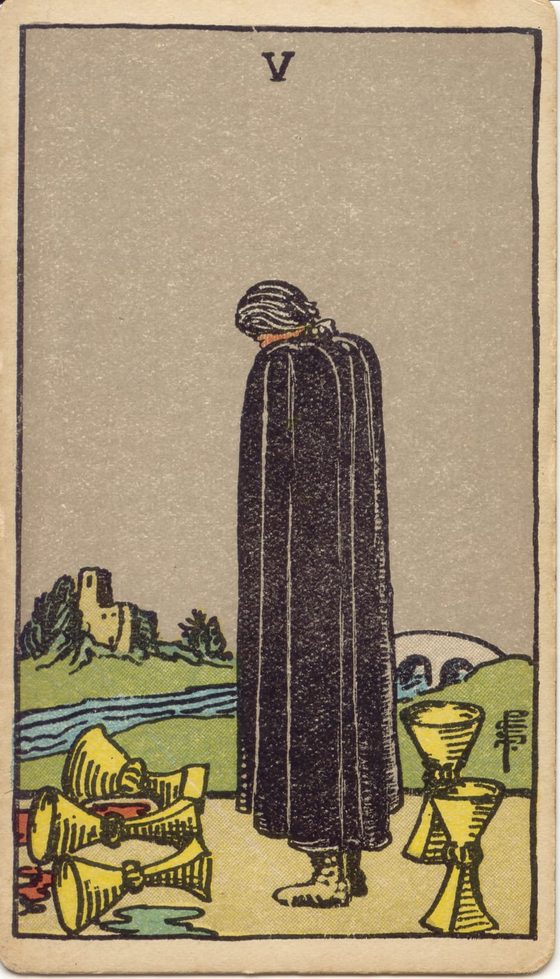
A tall figure stands in the centre of the card wrapped in a long black cloak, seen entirely from behind. The head is bowed and turned slightly down and to the left. No face is visible and no hands. Pale shoes show under the hem.
Three golden cups lie on their sides on the ground to the left, their contents spilled out across the earth in red and a paler colour. Two more cups stand upright on the ground behind the figure, to the right, untouched. A river runs across the middle distance; a small bridge crosses it to the right, and a building with a tower stands on the far bank at the left. The sky is a flat grey. The numeral V is at the top.
Upright meaning
The Five of Cups is the deck's most exact picture of grief, and its precision is the point. Three cups are over and two are standing. Something real has been lost, and it is not everything, and the figure is looking at the part that is gone.
That is not a criticism of him. Looking at what has been lost is what grief is for, and the card does not ask anybody to hurry. What it does is put the arithmetic in the frame: the remaining cups are drawn upright, behind him, in the same picture. Where Four of Cups is disinterest in what is being offered, this is attention fixed on what is gone.
Read it as the stage of a situation rather than as its outcome. Waite's gloss is loss, but not all, with an inheritance that did not arrive as expected given as an example. Neighbours set the distance: beside Six of Cups it reads as grief still living in the past, beside Eight of Cups as the point just before someone gets up and walks, and beside The Tower as the aftermath of something that was not chosen.
Upright in love
In a relationship reading this is the card of the aftermath. A break-up, a betrayal, a version of the relationship that has ended even though the relationship has not. It describes where somebody currently is rather than what happens next.
The two standing cups matter here and they are usually skipped. In a love spread they are rarely a new person; more often they are what survived: a friendship, a child, a part of yourself that was not in the relationship. Pointing at them is not the same as telling someone to move on, and readers who use them that way are asking the querent to stop feeling something on a schedule.
Upright in work
At work this is the card after something has gone wrong publicly. A project cancelled, a redundancy, a promotion that went elsewhere, a mistake with your name on it. The disappointment is real and the card does not minimise it.
What it adds is the part that is easy to lose sight of: not everything went. The skills, the relationships and the reputation that existed before the failure mostly still exist afterwards, and people consistently underestimate that in the first month. If the reading is about what to do next, this card is describing the state you are in rather than the options available, and it is worth waiting a little before deciding.
Upright in money
A loss that has already happened. Money gone on something that did not work, a deal that fell through, a sum that was counted on and did not arrive. Waite's own example for this card is an inheritance that came to less than expected.
The card is honest about the loss and equally honest that it is partial. Two cups are standing. In practice this is the card of the month after a financial setback, when the temptation is either to act fast to recover it or to stop looking at any of it. Neither is required. Count what is actually left before deciding anything.
Upright as feelings
As feelings, this is somebody grieving something and not currently able to look past it. The regard may be entirely intact; it is underneath a disappointment that is taking up the whole frame. It is not rejection and it is not indifference, and it is a poor card to press for an answer against.
Upright as advice
Turn around and count. Not to cheer yourself up: to know the actual number. Write down what has gone and what has not, in two columns, and be strict about which side things belong on. The grief is allowed to continue. It works better with accurate figures.
Reversed meaning
Reversed, the Five of Cups is read two ways and they are not the same event. The first is the head turning: acceptance beginning, the two standing cups coming into view, a person able to say what was lost without the sentence taking over the day. Waite reads the reversal this way, as news and the return of an old friend.
The second is grief that has closed over. The loss has become the account of the situation, the story told to new people, the reason given for things it is not actually the reason for. Nothing is being processed; something is being maintained. This reading is harder to deliver and it is the more common one in practice.
The spread decides. Cards of movement, return or contact argue for the first; cards of stasis, repetition or refusal argue for the second. It is worth being careful with the second reading, because it sounds like an instruction to get over something, and it is not one. Grief has no correct duration. What the card can point at is whether it is still moving.
Reversed in love
Either the beginning of getting over something, or a loss that has become the permanent furniture of a relationship. In the first, somebody is starting to talk about what happened in the past tense. In the second, an old injury is being brought into new arguments and neither person is enjoying it.
The reversal is also, sometimes, a reconciliation. Waite's own note mentions the return of someone. Treat that as one possibility among several rather than as the reading, because it is the one people most want to hear.
Reversed in work
Recovery beginning, or a setback that has hardened into an identity. In the first, the work restarts and the failure becomes something you can describe in an interview without flinching. In the second, a person is still explaining a job they left three years ago.
The reversal also covers the organisation that cannot stop referring to a bad year. Where this card sits over a team rather than a person, it usually points at a story the group tells about itself that is no longer accurate.
Reversed in money
Either a loss being absorbed and the position being rebuilt, or a loss that has produced a permanent flinch. The second is more common and it is expensive in its own way: money handled entirely defensively for years after a single bad experience.
The card describes a relationship to a past loss rather than a current balance. If the reading concerns a decision, it is worth asking whether the caution being applied belongs to this decision or to an earlier one.
Reversed as feelings
Either grief loosening its grip, or grief that has settled in and is now the way somebody relates to the whole subject. Both look like sadness from outside and they behave very differently over time. The card does not tell you which, and it does not tell you how long either one takes.
Reversed as advice
Say the loss out loud to one person who was there, in plain words, without softening it. Then do one ordinary thing that belongs to the part of your life that did not end: a meal, a shift, a walk you used to take. Both halves matter and the order matters.
Symbolism in the 1909 image
The three fallen cups. Tipped over on the ground, contents running out. Smith drew what spills as red on two of them and a paler colour on the third, which is usually read as wine and water. Whatever it was, it is on the earth and it is not going back in.
The two standing cups. Behind the figure, upright, full, drawn with the same care as the fallen ones. They are the whole argument of the card, and the figure's back is turned to them. Nothing in the picture stops him turning round.
The black cloak. It covers the entire body, hides both hands and conceals the face. It is the deck's plainest picture of mourning, and it also means the viewer is given no expression to read. The grief has to be inferred from posture alone.
The bridge. A small span across the water to the right, leading to the far bank. Waite says nothing about it. It is the only route out of the scene that Smith drew, and it is behind the figure along with everything else he is not looking at.
The building on the far bank. A tower or small castle with a tree beside it, across the river. Usually read as home, or as what remains. It is drawn small and far away, which is honest about how reachable it feels from where the figure is standing.
Where this meaning came from
The Five of Cups was a pip card for most of its life: five cups arranged on a plain ground, worth what its number was worth in a trick-taking game. The Italian decks of the fifteenth century had no divinatory apparatus at all.
The meanings were added in eighteenth-century France. Court de Gebelin's claim that the tarot preserved Egyptian wisdom was an invention, and Etteilla's published card-by-card system built the first fixed vocabulary on top of it. The Golden Dawn's title for this card, given in the 1890s, is Lord of Loss in Pleasure.
The scene is Smith's, drawn in 1909. The cloaked figure, the spilled cups, the river and the bridge do not appear on any earlier version. Waite's entry in The Pictorial Key to the Tarot in 1910 is unusually specific: a dark cloaked figure looking sideways at three fallen cups, with two behind him, and the reading given as loss, but not all, with an inheritance that fell short and a marriage broken as his examples.
The phrase but not all is the whole card, and it is Waite's own. Almost everything else modern readers say about the Five of Cups is an elaboration of those three words.
The common misreading
The Five of Cups is most often misread as an instruction. Look at what you still have is the standard delivery, and it turns a picture of somebody grieving into a lesson about attitude. The card contains the two standing cups; it does not contain a deadline for noticing them. Telling a person in the first week of a loss to count their blessings is not a reading, it is a way of making the conversation more comfortable for the reader.
The second misreading goes the other way and treats the card as catastrophe. Three cups are down. Two are not. Read as total loss it is simply inaccurate, and Waite's own phrase for it is loss, but not all.
The third is subtler. Because the figure's face is hidden, readers routinely tell querents what he is feeling: regret, guilt, self-pity. None of that is in the drawing. Smith gave us a bowed head and a black cloak, and everything beyond posture is being supplied by the person doing the reading. In a spread about somebody else, that supplied content can do real damage.
Questions to sit with
- What exactly has gone, written as a list rather than as a feeling?
- What is still standing that you have not counted?
- Who else knows what happened, and have you said it out loud to any of them?
- Is this grief still moving, or has it become the way you describe yourself?
Pull this card in a real spread.