- Card number
- 6
- Arcana
- Minor Arcana
- Suit
- Cups
- Element
- Water
- Rank
- Six
- Yes or no reading
- It depends
Six of Cups
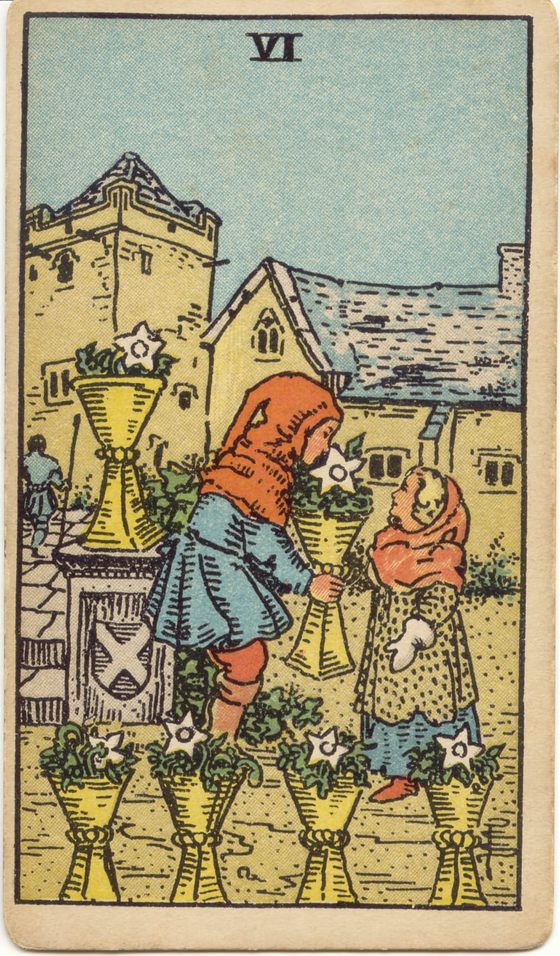
Six cups filled with white flowers, handed between two children in a walled garden. The Six of Cups is the card of the past arriving in the present, which can be kindness or can be a place to hide.
- nostalgia
- memory
- reunion
- innocence
- generosity
- clinging
- sentimentality
- idealised past
- moving on
- release
What the card shows
In a courtyard of an old manor, a small figure in a red hood and heavy patterned cloak leans toward a smaller child and holds out a cup. The cup is packed with white five-petalled flowers, more like a planter than a drinking vessel. The child reaches for it with both hands, face tilted up.
Five more cups stand about the yard, each filled with the same white flowers. One sits on a low stone plinth to the left. The buildings behind are pale stone with a squared tower, and the light is flat and yellow. On the path at the upper right, a figure carrying a pike walks away from the scene and is nearly out of frame.
Upright meaning
The Six of Cups describes the past showing up in the present and being welcome there. Something returns: a person, a habit, a way of talking to each other that had lapsed. Waite called it a card of memories, and specifically of childhood, which is narrower than most modern books make it.
Upright, the exchange in the picture is generous and uncomplicated. Somebody gives something without an invoice attached. In a reading this often marks simplicity restored after a period of negotiating everything: a friendship that resumes at the point it stopped, an old skill picked up again, a place revisited without disappointment. It is a small card. The kindness in it is domestic scale, not a rescue.
What the card does not settle is whether returning is the right move. Nostalgia and continuity look identical in a still picture. Beside a card of departure like the Eight of Cups the six reads as a farewell to something being outgrown; beside the Ten of Cups it reads as roots holding. It can describe a gift you are being handed and a gift you are handing over, and the picture does not say which end you are on.
Upright in love
In a relationship reading the Six of Cups usually points backwards. An old partner resurfaces, or a couple falls back into an easier register they had before things got complicated. Both readings are common and neither is a forecast.
The honest version of this card in love is that familiarity is being offered, and familiarity is not the same as suitability. It can describe two people who are genuinely good to each other in an unforced way. It can equally describe someone returning to a relationship because the shape of it is known, which is a different reason from wanting it. The card cannot tell you which is happening. The rest of the spread and your own memory can.
Upright in work
At work the Six of Cups often marks a return: a former employer, an old colleague, a project that was shelved and is being taken off the shelf. It can also describe an environment where people help each other without keeping score, which is rarer than it sounds and worth naming when it appears.
The card carries a caution most books skip. Work that feels like coming home can be work you have already outgrown. If the appeal of a role is that you know how it goes, the Six is describing comfort, not fit. Where the question is about a specific offer, look at whether the surrounding cards describe growth or repetition; the Seven of Cups nearby suggests the offer is being imagined more than examined.
Upright in money
In money questions the Six of Cups tends to describe flows that are not really transactions: a gift, a loan from family, money that arrives without an expectation of return, or the same going the other way. It is the least commercial card in the suit.
It can also mark a return to an old arrangement, a dormant account, an inherited object. What it does not do is size anything. The card describes the character of the money, generous and informal, and says nothing about the amount or about whether the informality will hold up later.
Upright as feelings
As someone's feelings, the Six of Cups is warmth attached to a shared history rather than to the present. Fondness, ease, the pleasure of being known without having to explain yourself. It is affectionate and it is not urgent. It rarely reads as desire. Whether that fondness would survive being asked for something is not in the card.
Upright as advice
Make the call you have been meaning to make, and make it without an agenda attached. If you cannot think of a reason to get back in touch beyond wanting to, that is the correct reason. Then notice what the conversation is actually like, rather than what you remembered it being.
Reversed meaning
Reversed, the Six of Cups splits in two directions that pull against each other.
The first is being held by the past: memory used as a place to live rather than a place to visit. The returning person or habit is not feeding anything; it is occupying the space where something current would have to go. Where the Five of Cups mourns what is gone, the reversed Six can be found keeping it.
The second is Waite's own reversed reading, which almost nobody quotes. In The Pictorial Key to the Tarot he gives it as the future, renewal, that which will come to pass presently. On that reading the reversal breaks the loop rather than tightening it: the past releases its claim and the ground ahead is unfamiliar.
Two readings, opposite in direction, in the same position. The card does not choose. If the spread is full of backward-looking cards, the first applies. If the surrounding cards describe movement, take the second seriously, because it has the older paper trail.
Reversed in love
Reversed in love, either an attachment maintained by history alone, with two people staying in touch with a version of each other that no longer exists, or the opposite: a clean release from an old connection that has finally stopped pulling. The first feels tender and costs something. The second often arrives quietly and is only noticed later. Which one is on the table depends on whether the spread describes holding on or moving on.
Reversed in work
At work, either nostalgia for a former role or team that makes the current one impossible to inhabit properly, or a genuine break with how things used to be done. The reversal can mark someone who talks about the old company more than the current one. It can equally mark the end of that talk. Look at whether the cards around it describe stagnation or a change already underway.
Reversed in money
Reversed, money and the past tangle. Old debts between people who never wrote anything down, a gift that turns out to have had terms attached, or the reverse: an informal arrangement finally being closed and settled. The reversal points at the informality itself, which is where the trouble usually lives. That is an observation about the arrangement, not a recommendation about the money.
Reversed as feelings
Either feeling defined entirely by what someone used to be to you, which is affection aimed slightly to one side of the actual person, or feeling that has quietly finished with the past and is looking forward. The reversal marks the direction of the attention, not its warmth.
Reversed as advice
Work out which way the card is pointing before you act. If you are living inside the memory, put a limit on it: an hour, one conversation, then back. If you are the one being pulled backwards by someone else, stop apologising for having changed.
Symbolism in the 1909 image
The white flowers. Six cups, each filled past the brim with a white five-petalled bloom. They are not drinks. The cups have been made into planters. Most books read the white as innocence. What the drawing shows more plainly is that vessels meant for holding liquid have been given over to something that will not keep.
The two figures. The larger one is described as a child in some readings and as a dwarf in others, and Waite's own text hedges between them. The size difference carries the meaning, and the card reads differently depending on whether you see two children or an adult stooping to one.
The departing figure. In the upper right, someone carrying a pike walks away down the path. The usual reading is that the guard has left and the garden is safe. It is equally readable as the only adult in the scene going somewhere else.
The stone plinth. One cup stands on a low pedestal at the left, set apart from the five on the ground. Nothing in the picture explains why that one is raised, and no standard reading accounts for it convincingly.
The manor behind. Pale stone, a squared tower, no faces at the windows. It is a wealthy setting drawn without much warmth, which sits oddly against the sweetness the card is usually given.
Where this meaning came from
The Six of Cups begins as an ordinary pip card. In the fifteenth-century Italian decks the suit cards carried no scenes at all: six cups meant six cups, a rank in a trick-taking game, with no picture to interpret and nothing to read.
Divinatory meanings for the minor cards arrive with the eighteenth-century French occult layer, principally through Etteilla, who assigned readings to all seventy-eight cards and whose lists still echo through modern books. The claims that period made about Egyptian origins have not survived scrutiny.
The picture English readers actually know is from 1909. Pamela Colman Smith illustrated all fifty-six minor cards with full scenes, and it is those scenes rather than any older tradition that most present-day meanings describe. Waite's commentary in The Pictorial Key to the Tarot (1910) gives the Six as a card of the past and of memories, looking back on childhood, on things that have vanished. Then, in the same passage, he offers a second reading in which the children are playing in an unfamiliar precinct and the card is about new environment and new knowledge. The ambivalence is in the source text. It is not a modern softening of it.
The common misreading
The Six of Cups is the card most often read as permission. Someone asks whether to let an old partner back in, draws this, and takes the warmth in the picture as a yes. The card describes a return being offered. It says nothing about whether accepting it is wise, and the drawing contains no information about the other person's intentions at all.
The second misreading is treating nostalgia as harmless. In a spread about a stuck situation, this card frequently marks the mechanism of the stuckness rather than a consolation for it. A past that keeps being visited is a past that is still being paid for.
The third is narrower and worth knowing. Most modern books give the reversed Six as being stuck in the past. Waite gave the reversed Six as the future and renewal. A reader who only knows the popular reversal is working with half the card's range, and the half they are missing is the one with the older provenance.
Questions to sit with
- What specifically are you hoping will be the same as it was?
- Who is doing the offering here, and what would they want in return if you asked them outright?
- Is this a relationship you are continuing, or one you are restarting from memory?
- What have you changed since the period you keep looking back at?
Pull this card in a real spread.