- Card number
- 7
- Arcana
- Minor Arcana
- Suit
- Cups
- Element
- Water
- Rank
- Seven
- Yes or no reading
- No
Seven of Cups
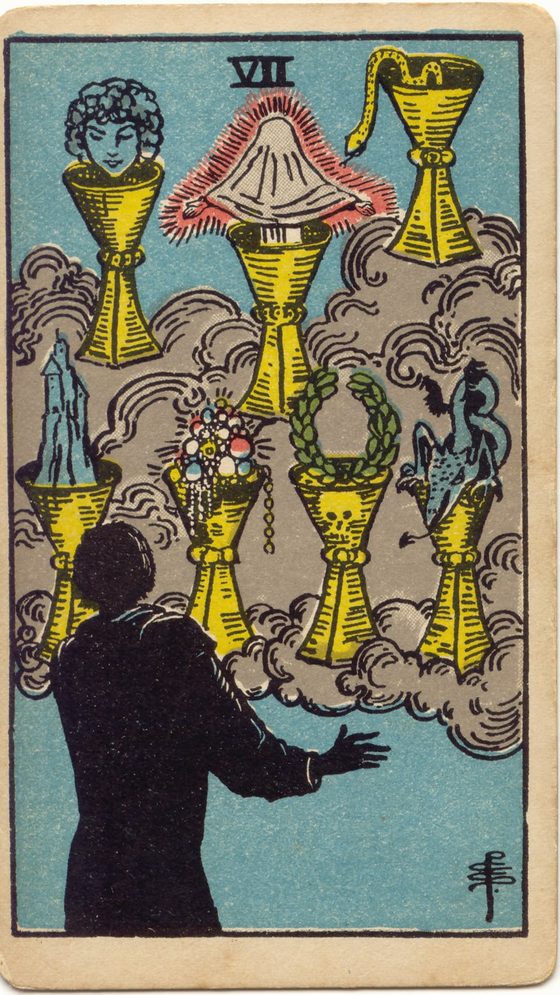
A figure in silhouette faces seven cups rising from cloud, each holding something different. The Seven of Cups is the card of too many options seen at once, none of them yet examined at close range.
- illusion
- choices
- fantasy
- daydreaming
- wishful thinking
- clarity
- decision
- willpower
- disillusion
- focus
What the card shows
A figure stands with its back to the viewer, drawn as a flat black silhouette with no features at all. Both arms are raised. In front of it a bank of grey cloud carries seven golden cups arranged in two tiers, each one holding something different.
The contents, running from the left: a human head, a veiled figure giving off light, a snake, a castle on a crag, a heap of jewels, a laurel wreath above what appears to be a skull worked into the face of the cup, and a red dragon. The cups are drawn at the same size and with the same weight of line. Nothing in the picture marks any one of them out as the real one.
Upright meaning
The Seven of Cups describes a mind full of options that have not been costed. Several choices are visible and none of them has been tested against anything. Waite's phrase for the card is things seen in the glass of contemplation, and he is explicit that nothing permanent or substantial is suggested by it.
Upright, this is less a warning about fantasy than a description of the stage before choosing. Seven options is not a real menu. It is usually a symptom of not having decided what you want, since a person who knows tends to see two or three. Where the Ace of Cups is one thing offered plainly, the Seven is seven things imagined at equal distance. The figure is a silhouette because at this stage nobody definite is doing the looking.
The card does not say the options are false. Some of these cups hold things a person could genuinely have. It says they are all being viewed from the same distance, which is exactly where everything looks equally available. Beside the Eight of Cups it reads as the pause before someone finally walks; beside The Devil it reads as the pull of a choice that is not actually on offer.
Upright in love
In a relationship reading the Seven of Cups usually describes options held in the head rather than in life. Several possible people, or several possible versions of one person, none of them met on their own terms.
It can also describe idealisation inside an existing relationship: a partner being measured, favourably or not, against an imagined alternative. The card does not claim the alternative is unreal. It says it has not been lived with. Where the question is whether to leave or stay, this card is describing the state of the deliberation rather than recommending an answer to it.
Upright in work
At work the Seven of Cups is the card of the long list. Several directions look plausible and none has been researched to the point where it stops looking plausible. It often turns up when somebody is between things and enjoying the between more than they will say.
It can also mark a genuine abundance of offers, which is a real position and a harder one than it sounds. The observation buried in the card is that options are not assets until one is taken. A shortlist of seven is a shortlist of none. Look at the surrounding cards for whether there is pressure to decide or room to keep looking.
Upright in money
In money questions the Seven of Cups points at plans that have not been costed. Several schemes, several possible sources, and no numbers written next to any of them.
The card is not saying the plans are bad. It is saying the comparison is being made on imagination rather than arithmetic. That is a description of a state of mind, not advice about what to do with money. The useful response to it is simply to make the options concrete enough that they can be compared at all.
Upright as feelings
As someone's feelings, the Seven of Cups is attraction that has not settled on a shape. Interest, fantasy, an image of you that may or may not resemble you. It is not indifference and it is not commitment. Often it describes someone enjoying the possibility more than they have engaged with the person. The card cannot tell you what they will do with it.
Upright as advice
Pick the two cups you would actually reach for and write down what each would cost this month, in hours and in money. Anything that does not survive being written down was never a real option. Then put the rest of the list away and choose from what is left.
Reversed meaning
Reversed, the Seven of Cups reads two ways.
The common modern version is clarity: the cloud thins, the options collapse to one, and a person finally knows what they are choosing. Waite's own reversed reading is close to this and blunter. He gives it as desire, will, determination, project. Not confusion cleared so much as appetite arriving.
The other reading is the opposite. The reversal can mark options being removed rather than resolved, or a choice made to escape the discomfort of holding several. A decision taken to stop deciding is not clarity, though it feels identical from the inside for about a week.
The picture does not separate them. What separates them is whether the person can say why they chose, in terms that would have made sense before the choice. If the surrounding cards describe pressure, suspect the second. If they describe capacity and movement, the first is more likely.
Reversed in love
Reversed in love, either the fog lifting, with one person becoming real and the others losing their pull, or a choice made under pressure and not examined since. The reversal can also mark someone declaring a preference chiefly to end an uncomfortable ambiguity. Look at whether the spread describes relief or resignation, because those are the two faces this reversal wears and they are not interchangeable.
Reversed in work
At work, either a decision finally taken after a long period of circling, with a project that now has a name and a date, or a narrowing that happened to someone rather than by them: offers withdrawn, a list shortened by other people. Waite's reversed reading and most modern books both give the first. The second is worth holding in reserve when the rest of the spread is heavy.
Reversed in money
Reversed, the schemes either get costed or get abandoned, and often both in that order. The reversal frequently marks the moment a plan meets a spreadsheet and only one version of it survives, which is uncomfortable and useful. It can equally mark commitment to a single plan examined no more carefully than the seven it replaced. The card describes the narrowing. It says nothing about the quality of what was narrowed to.
Reversed as feelings
Either feelings that have resolved into something specific and directed, or feelings hardened into a decision before they were understood. The reversal describes focus. It does not describe accuracy, and a person can be very certain about someone they have not actually looked at. The card is silent on which of those is happening.
Reversed as advice
Name the one thing you actually want, out loud, to another person. If you cannot say it without a list of caveats attached, you are still looking at the cups rather than reaching for one. Then act on it this week, in a way small enough to be reversible.
Symbolism in the 1909 image
The silhouette. The figure is drawn entirely in black, no face, no detail of dress. It is the only person in the card and the least specified thing in it. Read as anyone, or as someone who has not yet become anyone in particular.
The veiled figure. One cup holds a shrouded shape giving off light, the only content deliberately hidden. Books read it as the spiritual option, or the unknowable one. The drawing simply declines to show it, which is a different claim from saying it is higher.
The snake and the dragon. Two cups hold creatures, and neither is doing anything. They are usually read as temptation and as fear. Smith drew them at rest, and a snake sitting quietly in a cup is closer to an ornament than a threat.
The wreath and the skull. The laurel cup is the one most readers walk past. The wreath sits above what appears to be a skull worked into the face of the cup beneath it. Victory and death in the same object, drawn small enough to miss.
The cloud. Everything rests on cloud rather than on a table or a shelf. Nothing in this card has a floor under it, and that is the one element every reading agrees about.
Where this meaning came from
Like every minor card, the Seven of Cups spent its first three centuries as a number. In the Italian decks of the fifteenth century the suit of cups ran one to ten with no scenes at all. A seven of cups was a rank in a trick-taking game, and games do not require symbolism.
The layer that turned pip cards into meanings is eighteenth-century and French. Etteilla published divinatory readings for all seventy-eight cards in the 1780s, and the habit of assigning a sentence to each minor card dates from that period rather than from anything older. The Egyptian pedigree claimed alongside it was invented.
The scene described on this page is from 1909. Pamela Colman Smith gave every minor card a picture, and the Seven of Cups is one of the clearest cases of an image creating a meaning: the modern reading of illusion and too many choices comes directly from the seven contents she drew, not from any earlier tradition. Waite's gloss in The Pictorial Key to the Tarot (1910) calls them chalices of vision, warns that nothing permanent or substantial is suggested, and gives the reversed card as desire, will, determination, project.
The common misreading
The Seven of Cups is most often read as a warning against dreaming. That is not what the card describes. It describes options held at a distance, which is an ordinary and often necessary stage. The error is not in having them; it is in mistaking the view for the choice.
The second misreading does more damage. Because one cup holds a shrouded, glowing figure, readers routinely rank the contents, treating the spiritual option as the true one and the jewels and the castle as decoys. Smith drew them all the same size on the same cloud. The hierarchy is imported by the reader, and it tends to flatter whatever the reader already preferred.
The third: this card gets used to tell people their plans are fantasies. It cannot support that. Nothing in the drawing separates an achievable option from an impossible one. Where The Moon is about what cannot be seen clearly, the Seven is about what can be seen too easily, and a reader who claims to know which cup is real is reporting their own opinion of someone else's life.
Questions to sit with
- Which of these options have you actually done any arithmetic on?
- If you had to remove four of them tonight, which four would go first, and why those?
- What are you getting from keeping the list open?
- Who could tell you something concrete about one of these, and have you asked them?
Pull this card in a real spread.