- Card number
- 1
- Arcana
- Minor Arcana
- Suit
- Cups
- Element
- Water
- Rank
- Ace
- Yes or no reading
- Yes
Ace of Cups
Something offered, not yet taken. The Ace of Cups is the beginning of feeling, an opening in the emotional life, and the card describes the offer rather than what anybody does with it.
- new love
- openness
- compassion
- intuition
- beginnings
- withheld
- overwhelm
- blocked
- emptiness
- misplaced
What the card shows
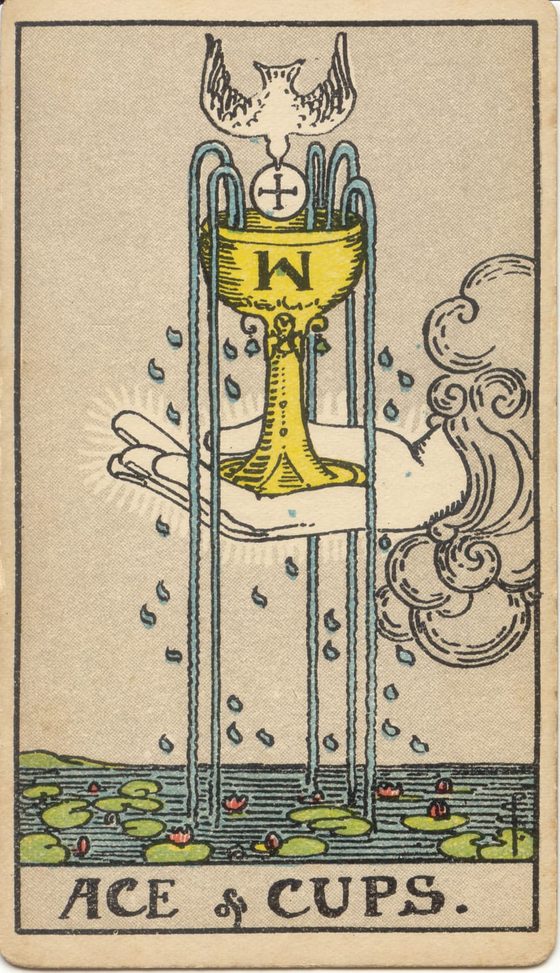
A hand comes out of a grey cloud on the right of the frame, palm up, holding a large golden cup by its base. The bowl of the cup is marked with a single letter, drawn as a W. Rays spread behind the hand. The cup is broad and shallow and its base is ornate.
Above it a white dove descends with its wings out, holding in its beak a round white disc cut with an equal-armed cross. The disc is directly over the mouth of the cup. Five streams of water pour from the cup and fall the height of the card. Small drops hang in the air on either side. At the bottom is still water crowded with lily pads and small open flowers.
Upright meaning
The Ace of Cups is the suit's starting point: the moment feeling becomes available. Every ace in the deck is a beginning offered rather than achieved, and this one is emotional. New affection, a reconciliation, the return of a capacity to be moved by things, all of them read here.
What makes it a difficult card to read well is that the hand is doing all the giving. Nobody in the picture has taken the cup. The Ace describes something on offer and stops short of describing acceptance, which is why it turns up so often at the start of situations that did not go anywhere. That is not a failure of the card. It is the card being accurate about where in the sequence it sits.
Neighbours change the weight. Beside Two of Cups it reads as an opening that gets met; beside Three of Cups the opening is social rather than romantic; beside The Hermit or another card of withdrawal it reads as an opening arriving at someone not currently able to receive it. Beside Four of Cups, which shows the same offering hand ignored, it is close to a warning.
Upright in love
In a relationship reading this is the card of the opening move. A feeling that has become undeniable, a first meeting that matters, an apology that reopens something closed. It reads as genuine and it reads as early.
The Ace does not tell you what the other person does with it. Where the question is whether somebody feels the same, this card describes a cup being held out, and the drawing gives you no second hand. What it does say, reliably, is that the offer is real rather than strategic. That is worth more than it sounds and it is not the same as a future.
Upright in work
At work the Ace of Cups is the least transactional card in the suit's opening. It marks work that has started to matter to you again, a team you actually like, a project chosen for reasons that are not on the spreadsheet.
Practically it often shows up around the beginning of something collaborative: a partnership offered, an invitation to join, a piece of work that arrives because somebody thought of you. The card is silent on terms and money. If the question is whether to take it, this card is describing the appeal, and the appeal is only half of a decision.
Upright in money
The Ace of Cups is the weakest card in the deck for a money question, and that is useful information. It describes emotional value, not financial value, and it will happily appear over a decision that feels right and costs a great deal.
Where it has something to say, it is about generosity: money given or received without a ledger attached, help from family, work done for someone because you wanted to. If you drew this on a question about whether something is affordable, the honest answer is that the card is not addressing the question. Find the numbers elsewhere.
Upright as feelings
As feelings, the Ace of Cups is the moment before anything is said. Something has opened and has not yet been managed, edited or defended. It is unguarded rather than certain, which is why it can be so quickly withdrawn. The card describes a state, and states are not commitments.
Upright as advice
Accept the thing being offered, or say plainly that you are not going to. The Ace's failure is neither refusal nor acceptance; it is leaving the hand extended while you decide indefinitely. Give one answer this week to the person actually waiting for it. The card is about the offer being answered.
Reversed meaning
Reversed, the Ace of Cups is read two ways that pull against each other. The first is the offer withheld: feeling that exists and is not being expressed, affection kept back because expressing it would cost something, an opening declined before it was tested. Nothing is broken here; it is simply not being said.
The second is the cup overflowing in the wrong direction. Feeling poured out indiscriminately, emotional intensity that is more about the person producing it than about anybody receiving it, an opening offered to someone who has not asked for it. Waite's own note leans this way; he glosses the reversal as instability and change.
The spread decides which. Cards of restraint, secrecy or self-protection argue for the first; cards of excess or disorder argue for the second. There is a third possibility that gets skipped: the reversal can simply mark a beginning that arrived at the wrong time, with nothing wrong with the feeling or the person, only the timing.
Reversed in love
Either something felt and not said, or something said far too early and too loudly. Both are the same card and the difference matters, because one needs courage and the other needs a pause.
The reversal also covers the quieter case of an opening that was made and not answered. That is not evidence of anything about the person who did not answer; the card describes your side of the exchange. Where a spread is about someone else's feelings, this position is the one most often over-read.
Reversed in work
Work that has stopped meaning anything, or a collaboration entered on enthusiasm that never got a structure. In the first, competence continues and the interest has quietly gone. In the second, everyone is fond of each other and nobody has agreed what happens when it goes wrong.
The reversed Ace also marks the offer you have been sitting on. If there is an invitation open in the situation, the card is usually pointing at the fact that it has been open for a while.
Reversed in money
Generosity that has become a habit nobody can afford, or a tightness that has less to do with the balance than with what money has come to mean. Both are the reversal and both are about the feeling rather than the sum.
Watch for the specific pattern of giving money instead of giving attention. It is common, it is usually well meant, and it is expensive in both directions. The card cannot tell you what to do about it, and this is not a page that will.
Reversed as feelings
Feeling present and deliberately unexpressed, or feeling expressed with more force than the situation has earned. From outside these look nothing alike and get read identically, as too much or too little. The card describes a valve, not a quantity, and it says nothing about how long the feeling lasts.
Reversed as advice
Say the smaller version of the thing you are not saying. Not the whole feeling, and not to everybody; one true sentence to the one person it concerns. If the reversal is running the other way and you have been overflowing, stop explaining yourself for a week and see what is still there.
Symbolism in the 1909 image
The hand and the cloud. The same device opens all four aces: a hand appearing from cloud, offering. It has no body and no owner. Whatever is being given does not come from anyone in the reading, which is exactly why the card describes an arrival rather than an achievement.
The letter on the bowl. Drawn as a W, and read by different writers as a W for water, an inverted M, or simply an ornament. Waite does not explain it. It is one of the clearest cases in the deck of readers being certain about something the artist left ambiguous.
The dove and the disc. A white dove lowers a round wafer marked with an equal-armed cross into the cup. The imagery is plainly eucharistic, and Waite, who was a Christian mystic as much as an occultist, meant it that way. Most modern readings quietly drop the church and keep the blessing.
The five streams. Water falls from a cup that nobody is pouring. Commonly read as the five senses. Note that the cup is full and overflowing before anyone has accepted it, so the abundance in this card is not conditional on the offer being taken.
The lilies. The pool at the bottom is crowded with pads and open flowers, the only part of the picture that is already alive. The water arriving from above lands in water that was there already.
Where this meaning came from
Cups are one of the four Latin suits, cups, coins, batons and swords, used in Italian and Spanish playing cards since the fourteenth century and still in use. In the fifteenth-century Italian decks the tarot grew from, the Ace of Cups was simply the one of that suit, and it meant nothing beyond its rank in the game.
The interpretive tradition begins in eighteenth-century France with Court de Gebelin's claim of Egyptian origins, which was false, and with Etteilla's commercial system of card meanings, which was the first to give every card a fixed reading. The Golden Dawn later assigned the suits to the elements, putting Cups with water; that pairing is barely a century and a half old.
Smith's 1909 drawing is a departure. Earlier Ace of Cups images show a decorative goblet and little else; the dove, the wafer and the lily pool are hers and Waite's, and they push the card toward the sacramental. Waite's entry in The Pictorial Key to the Tarot in 1910 calls it the house of the true heart, joy and abundance, and links it directly to the Grail material he had written about elsewhere.
Smith was paid a flat fee for the whole deck of seventy-eight cards and signed each drawing with a monogram.
The common misreading
The Ace of Cups is the card most often read as a promise of love arriving. It is not a forecast. It describes an opening in the emotional situation, and openings are answered or they are not. The picture contains one hand, extended, and nobody taking the cup; a reading that skips that detail is reading the caption rather than the card.
The second misreading is treating overflow as guarantee. The cup pours before anyone touches it, and that is easy to read as inexhaustibility. What it actually shows is that the offer does not depend on being accepted, which cuts the other way too: the feeling can be entirely real and go nowhere.
The third is more specific to love spreads. Drawn on a question about somebody else, the Ace is routinely read as evidence of their feelings. There is no second person in this drawing. If the spread has not otherwise established what the other person is doing, this card cannot tell you, and reading it as though it can is how people end up waiting.
Questions to sit with
- What is currently being offered to you that you have not answered?
- When did you last say something true about how you feel, and who did you say it to?
- Is there a gap between what you feel here and what you have been willing to show?
- If nothing comes back, is this still worth offering?
Pull this card in a real spread.