- Card number
- 2
- Arcana
- Minor Arcana
- Suit
- Cups
- Element
- Water
- Rank
- Two
- Yes or no reading
- Yes
Two of Cups
Two people meeting as equals. The Two of Cups is the card of an exchange being made rather than a bond being completed, and it describes the terms of the meeting, not how long it lasts.
- mutual
- partnership
- attraction
- agreement
- connection
- imbalance
- miscommunication
- one-sided
- distance
- tension
What the card shows
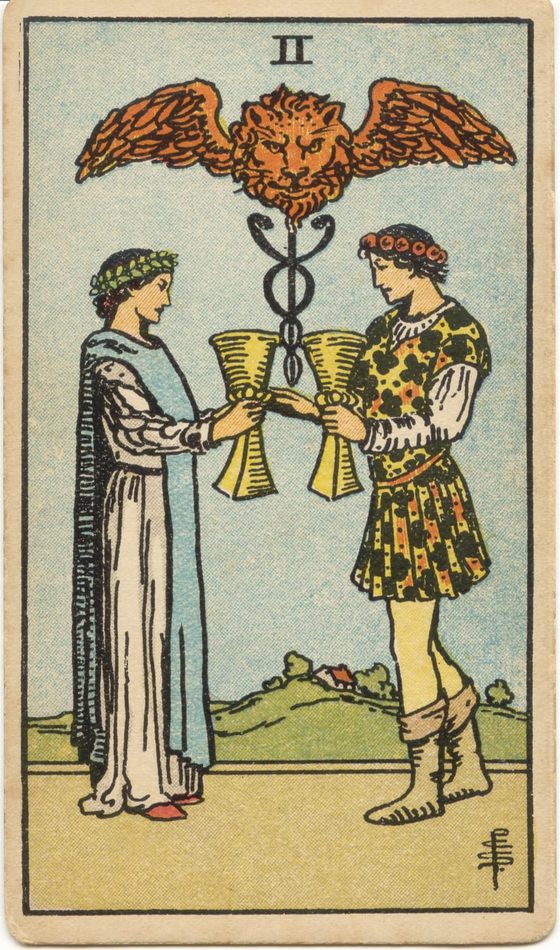
Two figures stand facing each other on level ground, close enough to touch. Each holds a golden cup, and each is extending it toward the other; the cups are almost meeting between them. The figure on the left wears a long white gown under a pale outer robe and a wreath of green leaves. The figure on the right wears a short patterned tunic, striped hose and a wreath of red flowers.
Above and between them stands a winged staff with two snakes wound around it. On top of the staff is a large red lion's head with wings spread on either side. Behind the figures the ground rises into a low green hill with a small house on it and trees to one side. The sky is empty. The numeral II is at the top of the card.
Upright meaning
The Two of Cups is the answer to the Ace. Where the Ace of Cups shows a cup held out and nobody taking it, this card shows the second hand. Two people, level ground, one cup each, both extended. It is the deck's clearest picture of a mutual exchange.
That mutuality is the whole content, and it is more specific than romance. The card covers partnership of any kind that runs on equal footing: a friendship that has become real, a reconciliation, two people agreeing to work together on terms they both set. The distinction the card does draw is between an exchange and a transaction. Waite reads it as love and friendship together and does not separate them.
What the card does not describe is duration or depth. Both figures are standing; nothing has been built yet. Neighbours settle the reading: beside Four of Wands it reads as something that gets formalised, beside The Lovers it becomes a question of choice rather than exchange, and beside Five of Cups it is a meeting whose ending is already in the spread.
Upright in love
This is the strongest mutuality card in the deck for a relationship question, and it is worth being precise about what that means. It describes both people extending something. Not one person's feeling, not a promise about the future: an exchange that is currently happening on level ground.
Drawn on a question about whether somebody feels the same, it is about as close to a yes as the tarot honestly gets. That still leaves everything else open. The card says nothing about compatibility, timing, other commitments or whether either of them is any good at relationships. Read the cards around it for those.
Upright in work
At work the Two of Cups is the partnership card, and specifically the one where both sides are giving something. A co-founder, a collaborator, a colleague who has become an actual ally rather than a person you are polite to.
It also covers negotiation that goes well: an agreement where neither party walked away feeling they lost. That is rarer than it sounds and it is worth naming when it happens. The card is not about hierarchy and it reads badly over questions about promotion or authority, because the picture insists on two people at the same height.
Upright in money
Money that involves another person on equal terms: a shared account, a joint purchase, a business with two names on it. The card is about the arrangement rather than the amount, and what it describes is symmetry.
That symmetry is the thing to check. Financial arrangements between people who feel equal are not always equal on paper, and the Two of Cups is a picture of a moment, not of a contract. Where the reading concerns money and another person, the card supports the relationship and says nothing about whether the terms are sound. Write them down anyway.
Upright as feelings
As feelings, this is regard that has already been returned. Not longing, not anticipation: something has passed between two people and both of them know it. It is a card of recognition more than of intensity, which is why it often feels calmer than a love card is supposed to feel.
Upright as advice
Meet the other person where they are standing, which means going the same distance they have. Do not offer more than you have been offered and do not offer less. If there is a specific thing you have been waiting for them to say first, say it, and then let them answer.
Reversed meaning
Reversed, the Two of Cups pulls apart in two directions. The first is imbalance: the exchange is still happening and one person is putting in more. Nothing dramatic has gone wrong. One cup is fuller than the other and everybody involved has noticed and nobody has said so.
The second is a break in communication rather than in feeling. Two people who both still want the same thing and have stopped being able to say it: an argument that calcified, a misunderstanding that nobody corrected early enough. The regard is intact and the exchange has stopped.
There is a third reading the books are quieter about, and it turns up often: the card reversed can describe a connection that was never mutual in the first place, read as mutual by one side. That is uncomfortable and it is worth putting on the table. Which of the three applies is decided by the rest of the spread and by what the querent already knows and has not said.
Reversed in love
Either a relationship where the effort has quietly become one-sided, or two people who still want each other and have lost the thread of the conversation. The first needs an honest accounting; the second needs someone to go first.
Be careful with the third possibility. Reversed, this card sometimes describes a mutuality that was assumed rather than established. If the spread is about someone you have not actually spoken to about any of this, that is the reading to consider before the other two.
Reversed in work
A partnership where one side is carrying it, or a collaboration that has stopped talking. In the first, the resentment usually arrives before the conversation does. In the second, two people who agree are working from different versions of the plan.
The reversal is also the card of the handshake that was never written down. If the reading concerns an arrangement made informally between people who trusted each other, the correction is administrative rather than emotional.
Reversed in money
Shared money that has stopped being shared evenly, or a joint arrangement neither person will raise. The reversal usually marks the gap between what was agreed and what is actually happening, and that gap is easier to close early.
There is a common version worth naming: one person contributing money and the other contributing something harder to count, with both quietly keeping score. The card cannot tell you what is fair. It can tell you that somebody in the situation is doing the sum.
Reversed as feelings
Feeling that is still there and has stopped moving between the two people, or feeling that was only ever running one way. Both read as a stalled connection from outside. The card describes the traffic between two people, not the contents of either one, and it will not tell you whose side the block is on.
Reversed as advice
Ask the question you have been answering on their behalf. You have a version of what the other person thinks, and it was assembled without them. Put it to them in one plain sentence and stop talking. If the imbalance is on your side, stop matching what has not been offered.
Symbolism in the 1909 image
The caduceus. The winged staff with two snakes wound round it is the herald's wand of Hermes, an emblem of exchange, messages and trade. It sits precisely between the two figures, above the cups. Whatever passes between them passes under it.
The lion's head with wings. Waite does not explain it, and nobody since has explained it convincingly. It has been read as the winged lion of Venice, as an alchemical emblem, and as the physical passion sitting above the polite exchange below. Smith drew it in red, the only strong red in the upper half of the card.
The two cups. Identical, held at the same height, each extended toward the other. Nothing in the drawing makes one figure the giver. This symmetry is what separates the card from every other Cups image in the suit.
The wreaths. Green leaves on one figure, red flowers on the other. Laurel and roses, usually read as victory and desire, and the fact that they are different is the point: the exchange is between two people who are not the same.
The house on the hill. Small, red-roofed, set back behind them with trees. It is the only structure in the picture, and it is a long way off. Read as the domestic future by many books; note that the drawing keeps it firmly in the background.
Where this meaning came from
In the fifteenth-century Italian decks that tarot descends from, the Two of Cups was a low card in a trick-taking game and showed two cups and an ornament. It carried no meaning, because that deck was not used for divination.
Meanings were attached from the 1780s onward: Court de Gebelin's false claim of Egyptian origin, then Etteilla's published system, then the Golden Dawn's elemental and astrological framework in the 1880s and 1890s. The Golden Dawn's title for this card is Lord of Love, and Waite and Smith were both members of that order.
The picture is Smith's invention. Earlier Two of Cups cards show two goblets and nothing else; the two figures, the caduceus and the winged lion are all from 1909, and they change the card from a number into a scene. Waite's entry in The Pictorial Key to the Tarot in 1910 reads it as love, passion, friendship, affinity and union, and he specifically mentions the exchange of cups.
This is the first card in the suit with two people in it, and the whole subsequent reading of the Two of Cups rests on Smith's decision to draw them the same size.
The common misreading
The Two of Cups is most often misread as a soulmate card. Modern books have loaded it with destiny language it does not carry: the drawing shows two people making an exchange, and it says nothing about whether they are meant for each other or whether the exchange lasts a month.
The second misreading is assuming it means romance. Waite lists friendship and affinity alongside love, and in practice the card turns up over business partnerships, reconciliations between family members and the moment two colleagues stop competing. Reading every Two of Cups as a romance is how readers manufacture love interests that the querent then goes looking for.
The third is subtler and it concerns the reversal. Because the upright is so warmly read, the reversed card gets treated as a small setback in a good situation. It can equally describe something that was never mutual. That reading is unpleasant to deliver and it is the one people most often need, and it should be offered as a possibility rather than a verdict.
Questions to sit with
- What have you actually been given here, as opposed to what you have hoped for?
- If you stopped putting in effort for two weeks, what would remain?
- Have you told the other person what you want from this, in those words?
- Is this exchange equal, or has it only been comfortable?
Pull this card in a real spread.