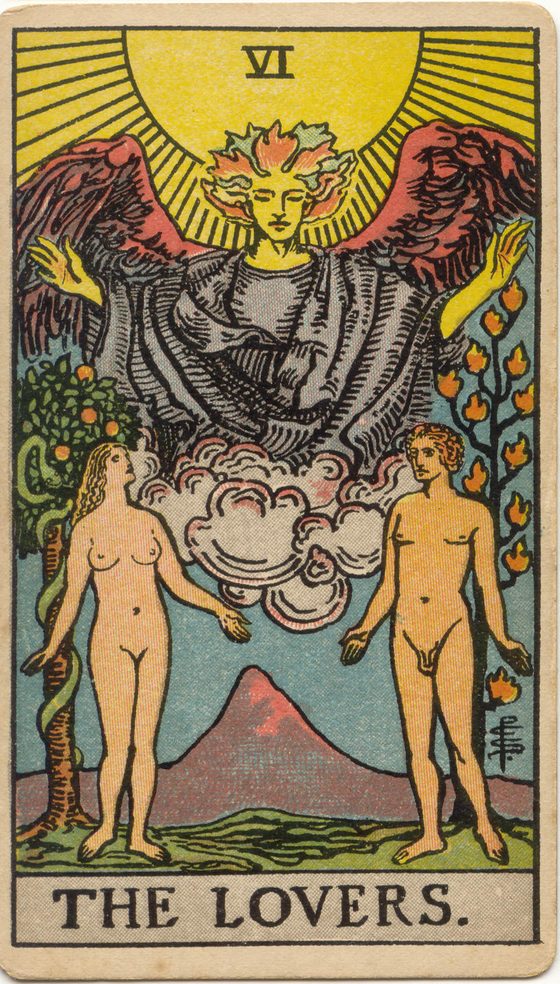
- Card number
- 6
- Arcana
- Major Arcana
- Suit
- Major Arcana
- Element
- Air
- Rank
- Trump
- Roman numeral
- VI
- Zodiac attribution
- Gemini
- Yes or no reading
- It depends
The Lovers
A naked man and woman under an angel, with a tree behind each of them. The Lovers is less about romance than about a choice that cannot be made without giving something up.
- choice
- union
- values
- alignment
- openness
- misalignment
- avoidance
- conflicting values
- indecision
- imbalance
What the card shows
A naked man and a naked woman stand apart on open ground. A large winged figure fills the upper third of the card, robed in purple, with arms raised and open over both of them. Behind the angel the sun is drawn as a plain disc with rays.
Behind the woman is a tree with fruit on it and a serpent wound around the trunk. Behind the man is a tree with twelve flames growing from its branches. Between and behind them stands a single grey mountain. The woman is looking up at the angel; the man is looking at the woman. Neither is looking at the other's face at the same time.
Upright meaning
The Lovers describes a choice with a value in it. Not a preference between two similar options but a decision that will define what kind of person makes it: what you are prepared to give up, what you will not, and who else is affected. The card is famous for romance and is actually about commitment in the wider sense.
Upright, it usually reads as alignment: a relationship, a decision or a piece of work where what you want and what you value point the same way. That is a real and uncommon condition, and it is worth saying plainly that it does not last automatically.
The picture is more ambivalent than the reputation. The two figures are not touching and are not looking at each other. Waite reads the angel as the higher self supervising the union; Smith drew the scene from Eden, which is a story about a choice with a cost. Beside The Hierophant the pair mark the difference between a bond you chose and a bond you inherited. Beside the Seven of Cups it reads as a decision that has too many attractive options and not enough information.
Upright in love
In relationship readings this is a strong card and a demanding one. It describes a connection where both people are visible to each other, without much cover. That is what the nakedness in the picture is for, and it is not primarily about sex.
It also frequently marks a decision inside a relationship rather than the relationship itself: whether to commit, whether to tell someone something, whether to end one thing in order to have another. Querents hope for the first reading and get the second surprisingly often. Where the question is about another person's intentions, the card describes a situation that requires a choice from them. It does not tell you which way they will go.
Upright in work
At work The Lovers is a card about values rather than opportunity. A choice between two roles where the money is not the deciding factor, a partnership that will require actual trust, a decision about what you are willing to build.
It also shows up around collaboration where the working relationship matters more than the brief. Upright, the card says the alignment is real and the choice can be made honestly. It does not say the choice is easy or that the option you are not taking will still be there afterwards. Something is being given up, and the card is clear about that even when the reader is not.
Upright in money
In money questions The Lovers describes a decision where the numbers are not the whole answer. Money entangled with a relationship: joint accounts, a shared purchase, lending to family, choosing lower pay for work you can defend.
The card's contribution is to insist that the value question is a real part of the decision and not a soft one. What it cannot do is tell you whether the arrangement is sound. That is a matter of terms, figures and, where anything significant is involved, someone qualified to look at them. Two people agreeing warmly about money is not the same as two people agreeing about the same money.
Upright as feelings
As someone's feelings, The Lovers is attraction that has been thought about. Not a passing interest but one the person has weighed against what else they want, and has not yet resolved or has just resolved. It is warm and it is unsettled. The card describes a person facing a choice about you, which is a different thing from a person who has made one.
Upright as advice
Write down what you would be giving up by choosing each way, in one sentence each. The Lovers is not advice to follow your heart; it is advice to find out what your heart is actually choosing between. Then make the choice and stop revisiting it. The Chariot, which follows, is the card for the part that comes after.
Reversed meaning
Reversed, The Lovers reads two ways that are not the same complaint. The first is misalignment: what a person wants and what they value have come apart, and they are living in the gap. A relationship that works in every respect except the one that matters, or a job that pays for a life you do not want.
The second is the choice being avoided. Both options kept open, nothing given up, the decision deferred until circumstances make it. This is the more common of the two and it is rarely described honestly, because from inside it feels like keeping your options open rather than like refusing to choose.
The reversal is often read as a relationship ending. It can be, and it is not the primary meaning. A reader who announces separation on this card is jumping several steps: the card describes a decision under strain, and plenty of decisions under strain are resolved rather than abandoned. What decides is the question and the cards around it, not the direction the card fell in.
Reversed in love
Two people wanting different things and not saying so, or one person unable to choose and calling it fairness. The reversal also covers a connection where the attraction is genuine and the values are not compatible, which is a specific and painful situation that no amount of goodwill fixes. It is not a verdict that the relationship is over. It is a description of a strain, and strain is information rather than a forecast. The settled domestic version this card is often mistaken for is the Ten of Cups, which is a different card making a different claim.
Reversed in work
Work that has drifted away from what you would defend, or a partnership where the two parties turn out to want different outcomes. It also covers the deferred career decision: staying because leaving requires choosing, which looks like patience from the outside and feels like something else from within. In collaboration it can mark a mismatch of purpose that was never discussed because discussing it early would have been awkward.
Reversed in money
Money decisions made against your own stated values, or shared money where the two people involved have never actually agreed what it is for. The second is extremely common and rarely surfaces until something goes wrong. The reversal is a prompt to have the conversation, not a verdict on anyone's spending. As always, the card describes the dynamic and cannot assess the arrangement; that needs figures and, if it matters, someone qualified.
Reversed as feelings
Attraction pulling against something the person will not give up, or feeling that has been kept deliberately unresolved because resolving it would require an action. In both cases the feeling is real; what is missing is a decision. The reversal says nothing about whether they like you. It says they have not settled what to do about it.
Reversed as advice
Set a date to decide and tell one other person what it is. The reversal's failure is not choosing wrongly; it is the indefinite postponement that feels like care. If you cannot choose yet, write down exactly what information would let you, and go and get that instead of waiting.
Symbolism in the 1909 image
The angel. Winged, robed in purple, arms open over both figures. Waite identifies him as Raphael. He is the largest thing in the frame and he is not doing anything: no gesture of joining, no instruction, no direction. He watches.
The tree with the serpent. Behind the woman, fruit on the branches and a snake around the trunk. This is Eden, unmistakably, and Eden is a story about knowledge acquired at a price. Most modern readings of this card quietly drop that part.
The tree of flames. Behind the man, twelve flames in place of leaves. Usually read as the twelve signs of the zodiac, or as desire. The pairing puts knowledge behind one figure and appetite behind the other, which is tidier than the drawing warrants but is what the arrangement suggests.
The direction of the gazes. She looks up at the angel; he looks at her. Nobody in the picture is meeting anyone's eyes. It is the single most quoted detail on this card and the least explained: read as him reaching the higher through her, or as two people in the same scene attending to different things.
The mountain. A single grey peak directly between them, at the horizon. It is the only obstacle in an otherwise open landscape, and it sits precisely where the two figures would meet. Books rarely mention it. It is hard to unsee.
Where this meaning came from
In the fifteenth-century Italian decks this card is l'Amore or gli Amanti, and it is not the picture modern readers know. Early versions show a couple with Cupid overhead; some fifteenth and sixteenth-century versions show a man between two women, which is where the choice reading originates.
The eighteenth-century French occultists read that composition as a moral allegory: a young man choosing between virtue and vice. Etteilla's version of the card is explicitly about a decision rather than a romance, and that layer never entirely left.
Waite threw the older composition out. For the 1909 deck he had Pamela Colman Smith draw Adam and Eve under an angel, and in The Pictorial Key to the Tarot (1910) he is scornful about the man-between-two-women version, calling the older readings a card of married life and other trivialities. His replacement puts the emphasis on innocence and on what comes after it.
The Golden Dawn assigned the card to Gemini. The modern habit of reading it as a straightforward romance card is later still, and it works against both the old French version and Waite's own, which agree on very little except that a choice is involved.
The common misreading
The most common misreading is that this card means a soulmate is coming. It is the reading querents most want and the one the picture supports least. There is no arrival in the image and no promise in Waite's text. The card describes a situation involving choice and exposure, not an event on a timetable.
The second is treating it as a verdict on an existing relationship. Upright it is not a certificate that the relationship is right, and reversed it is not notice that it is over. Both readings hand the querent a conclusion the deck cannot reach. What the card can do is name the value at stake, which is more useful and much less satisfying.
The third is quieter. Because the card is beautiful, it gets used to make a difficult spread feel resolved. But a choice with a real cost in it is not resolution; the couple in the picture are standing in Eden shortly before the most famous bad decision in Western literature, and Smith knew exactly what she was drawing.
Questions to sit with
- What are you giving up by choosing this, and have you said that out loud?
- Is the difficulty here about what you want, or about what you value?
- If you keep both options open for another year, what does that cost, and who pays it?
- What would you have to be honest about for this choice to be a real one?
Pull this card in a real spread.