- Card number
- 5
- Arcana
- Major Arcana
- Suit
- Major Arcana
- Element
- Earth
- Rank
- Trump
- Roman numeral
- V
- Zodiac attribution
- Taurus
- Yes or no reading
- It depends
The Hierophant
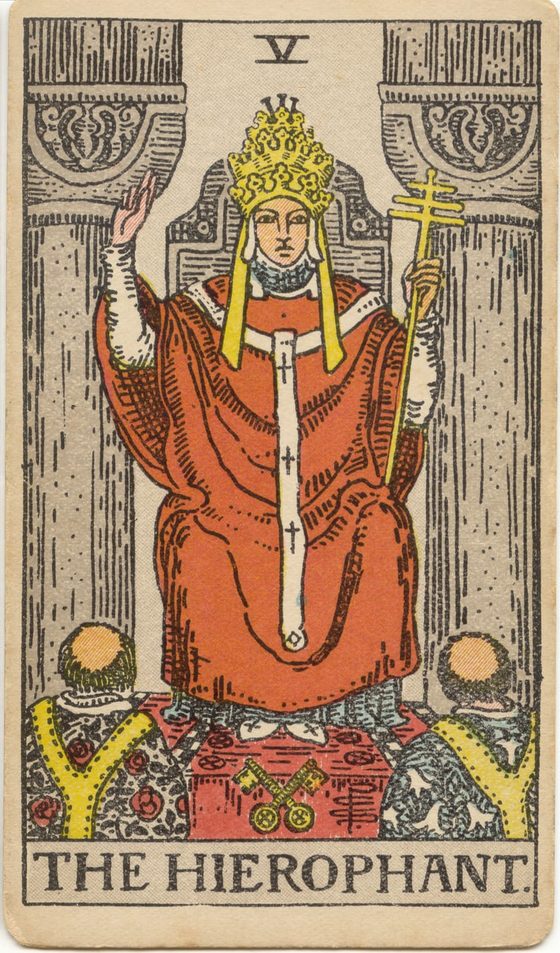
A robed figure on a throne between two pillars, with two tonsured men kneeling below. The Hierophant is the card of received tradition, and of what it costs to learn something from an institution rather than from experience.
- tradition
- institution
- teaching
- conformity
- ritual
- dogma
- dissent
- hypocrisy
- unorthodoxy
- broken faith
What the card shows
A figure in red vestments sits on a stone seat between two plain grey pillars. He wears a triple crown and raises his right hand with two fingers up and two folded. In his left hand is a staff topped with a triple cross. His feet rest on a low platform.
Two crossed keys lie on the floor in front of him, one gold and one silver. Below the platform two men kneel with their backs to the viewer, both tonsured; one wears a robe patterned with roses, the other with lilies. The pillars are undecorated and the space between and behind them is grey and closed. There is no landscape and no sky.
Upright meaning
The Hierophant describes learning that comes through an institution. A tradition, a curriculum, a church, a professional body, a family's way of doing things. Somebody else worked this out first, wrote it down, and is now handing it on. The card is about the handing on, not about whether the content is true.
Upright, it usually favours doing things the established way. Take the course, get the qualification, follow the protocol, ask the person who has done it before. That is often the correct advice and it is rarely the advice a querent wants. Where The Emperor holds authority by position, this figure holds it by transmission: he is teaching, and two people are listening.
The card carries its own criticism inside it. The two figures kneeling have their backs to us and are dressed alike, and the picture has no window in it. Conformity and instruction look identical from outside. Beside The High Priestess, the pair mark the difference between knowledge held privately and knowledge held by an organisation. Beside cards of pressure it more often describes the expectation than the way out of it.
Upright in love
In relationship readings The Hierophant usually describes the formal side of a connection. Marriage, meeting families, moving in, the public and legible version of something that was private. It is the card of doing it properly.
It can also mark a relationship being conducted according to a script nobody chose: expectations from parents, from a community, from a religion, from how things are supposed to go. That script is sometimes a comfort and sometimes a cage, and the card allows both. Where the question is about someone else, it says they are thinking in terms of what is appropriate. It does not say whether they want to. Compare The Lovers, which is the same subject with the institution removed.
Upright in work
At work this is the card of formal training and established method. Apprenticeship, mentoring, accreditation, the documented process that exists because someone made every mistake already. It also describes large institutions themselves: universities, hospitals, churches, the civil service, firms with a house style.
Upright it leans toward learning the standard before departing from it. In a spread about a stalled career it often points at a credential or at a relationship with someone senior rather than at a new idea. The Three of Pentacles shows the same transmission from the working end, where the apprentice is actually cutting stone. The Hierophant is the version where the knowledge is still being talked about.
Upright in money
In money questions The Hierophant points at conventional arrangements and established institutions: banks, pensions, insurance, the ordinary machinery most people use. It reads as the standard route rather than the clever one.
It can also describe money that comes with conditions attached by a family or a community, which is a different kind of cost. The card is describing where a decision sits, not recommending anything: it has no opinion on your circumstances, cannot assess a product, and is not a source of financial advice. Someone qualified is, and that is a distinction this particular card ought to make easy to remember.
Upright as feelings
As someone's feelings, The Hierophant is attachment that has been fitted into a category. They have decided what you are to them, and the decision is doing some of the feeling's work. It reads as serious and considered rather than spontaneous. What it does not tell you is how much warmth is inside the category, only that a category has been chosen.
Upright as advice
Find the person who has already done this and ask them how, instead of working it out from first principles. The Hierophant's advice is unglamorous: use the existing answer. Book the appointment, read the standard text, join the thing. Novelty is cheaper after you know what the convention is for.
Reversed meaning
Reversed, The Hierophant reads two ways that are close to opposite. The first is a break with the institution: leaving a church, a profession, a family expectation, a method you were trained in. Doing it your own way because the received version has stopped fitting.
The second is the institution itself failing. Dogma held after it stopped being useful, a teacher who has stopped learning, a professional body protecting its members from the people they serve. Hypocrisy is the specific accusation this reversal carries most often, and it is the reading with the most history behind it: the card was a pope, and reversed cards of popes have meant exactly this for four hundred years.
The two readings put the querent on opposite sides. In one they are walking out; in the other they are the one being walked out on, or the one still inside defending something. The card does not choose, and the difference matters enormously to the person asking. Read the question, not the reputation.
Reversed in love
A relationship being conducted outside the expected shape, or one collapsing under the weight of that shape. In the first, two people have quietly decided the standard arrangement does not suit them and are getting on with it. In the second, the arrangement is still in place and nobody in it believes in it any more. The reversal can also mark a formal step being refused, which is a decision and not necessarily a rejection.
Reversed in work
Working outside the accepted method, or working inside a method that has rotted. The first covers independent practice, unconventional routes into a field, and the useful heresy of asking why a process exists. The second covers an organisation whose procedures now serve the procedures. Reversed, the card is also the one for credentials that no longer mean what they used to, which is worth naming because it is expensive to discover late.
Reversed in money
Money handled outside conventional structures, or conventional structures that have stopped serving the person inside them. The first is not automatically reckless and the second is not automatically a scandal; both are simply descriptions of where a decision sits relative to the standard route. The card cannot evaluate any arrangement, conventional or not. Anything with real money attached is a question for figures and for someone qualified to read them.
Reversed as feelings
Feeling that has outgrown the label put on it, or a label being kept in place after the feeling has gone. Both are common and they look identical from outside, which is why this reversal is a poor tool for working out what somebody thinks of you. What it does say is that the official version and the actual one have come apart.
Reversed as advice
Ask one question you have been treating as settled, and ask it of the person whose authority made it settled. If the answer holds, you have lost nothing. If it does not, you have found the part of the tradition you were following out of habit. Do this once, specifically, rather than deciding to question everything.
Symbolism in the 1909 image
The crossed keys. One gold, one silver, lying on the floor at his feet. They are the keys of Peter from Catholic iconography, the authority to bind and to loose. They are on the ground rather than in his hand, which most books pass over and which is the most interesting thing about them.
The two kneeling figures. Tonsured, backs to the viewer, one robed in roses and one in lilies. Read as the two initiates, or as desire and purity again. Their faces are hidden, so nothing in the picture tells you whether they are convinced.
The triple crown and triple cross. Both mark three levels: three worlds, three orders, three degrees of initiation, depending on which book you read. The specificity varies and the point does not, which is that this authority is graded and someone is at the top of it.
The raised hand. Two fingers up, two folded, the standard gesture of blessing. It is also, unmistakably, a gesture that only works if someone is receiving it. Nothing on this card functions without an audience.
The grey pillars and the closed room. Plain, undecorated, and with nothing visible past them. Smith gave The High Priestess a veil with water behind it; here there is nothing behind at all. Whether that means depth or simply walls is left open, and the ambiguity is more useful than the usual gloss.
Where this meaning came from
The card began as il Papa, the Pope, in the fifteenth-century Italian trumps, sitting opposite the Papess. Both were removed or renamed at various points by printers who did not want trouble with the church; in some decks he became Jupiter.
The eighteenth-century French occultists gave the deck its interpretive layer and its invented Egyptian ancestry. The word hierophant is theirs rather than Waite's in origin: it is the Greek title for the priest who displayed the sacred objects at the Eleusinian mysteries, and it was chosen precisely to move the card away from Rome.
Waite kept that name for the 1909 deck, and in The Pictorial Key to the Tarot (1910) he is unusually defensive about the card. He insists it does not mean the pope, then describes a figure with a papal crown, papal keys and a papal blessing. The picture Pamela Colman Smith drew is straightforwardly Catholic whatever the caption says.
The Golden Dawn assigned the card to Taurus, which is where that attribution comes from. The modern reading of it as conformity, tradition or institutional pressure is twentieth-century and owes as much to readers' feelings about churches as to anything in the deck.
The common misreading
The most common misreading is treating this card as automatically negative. Modern readers, many of whom left an institution to get here, tend to see a church and read oppression. Sometimes that is right. Often the card is describing a competent teacher, a well-designed process, or the accumulated experience of people who solved this problem before you were born.
The second runs the other way. Because the figure is enthroned and blessing, the card gets read as a guarantee that the authority in question is trustworthy. It is not. The Hierophant describes the transmission of received knowledge and has nothing to say about the quality of what is being transmitted. A bad tradition is transmitted by exactly the same mechanism as a good one.
The third is narrowing it to marriage. It is a frequent reading in relationship spreads and a lazy one, and it leaves people waiting for a proposal that the card never mentioned. The formality this card describes is just as often a job contract, a conversion, a family obligation, or a decision to do something the way it has always been done.
Questions to sit with
- Whose version of how this should be done are you following, and did you ever agree to it?
- Is there an established answer here that you have avoided looking up?
- What would you lose, concretely, if you stopped belonging to this?
- Who taught you the rule you are about to apply, and do they still believe it?
Pull this card in a real spread.