- Card number
- 3
- Arcana
- Minor Arcana
- Suit
- Pentacles
- Element
- Earth
- Rank
- Three
- Yes or no reading
- Yes
Three of Pentacles
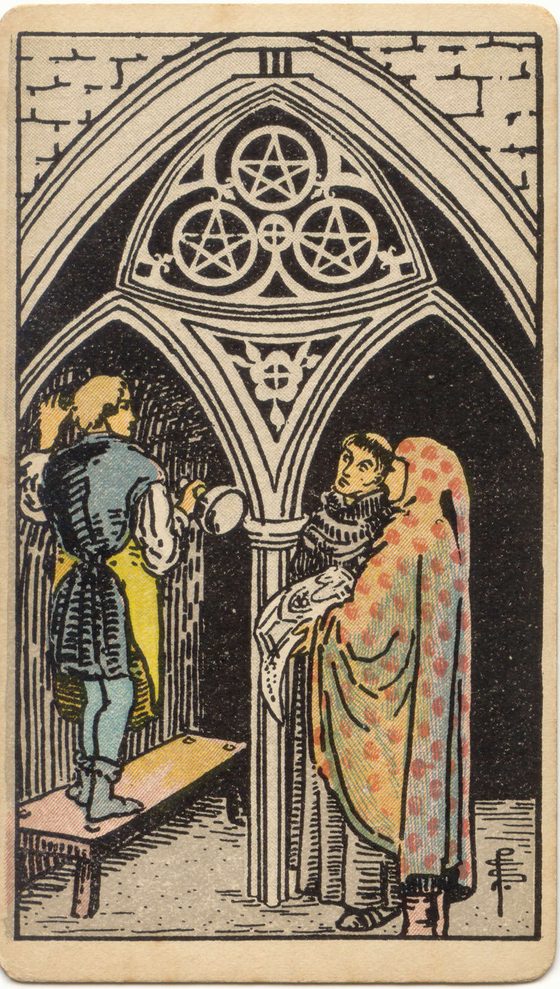
A mason works on an arch while two other people stand below with the plan. The Three of Pentacles describes work that only exists because several kinds of competence are in the room at once.
- collaboration
- craftsmanship
- planning
- apprenticeship
- sign-off
- misalignment
- unclear roles
- credit taken
- poor scope
- mediocrity
What the card shows
A young workman stands on a low wooden bench inside a dark stone building, turned toward the pillar of an arch with a tool raised in one hand. He wears a dark patterned tunic over a yellow undergarment, with blue hose. His head is turned away from the stone and down toward the two people standing on the floor beside him.
Those two stand together at the foot of the pillar. The nearer one is bareheaded, in a ruffed collar, holding an open sheet of paper in both hands and looking up. Behind him a taller figure is wrapped in a long hooded robe patterned all over with dots, only the face showing. Above them, three pentacles are set into the tracery of the arch, one at the top and two below it. The background behind the arch is solid black, and the building is unfinished.
Upright meaning
The Three of Pentacles describes work being done by more than one person, where the different contributions are not interchangeable. The mason cannot draw the plan and the planners cannot cut the stone. That is the whole card: a task at the point where skill, design and sanction have to meet, and where none of the three is sufficient alone.
It usually comes up early. The building is unfinished, and the figure with the tool has stopped mid-stroke to listen. What the card marks is the moment where the work is still being agreed, not the moment it is delivered. That is why it reads as promising rather than triumphant: the collaboration is functioning, and functioning is not the same as finished.
Read it as a description of a situation, not a verdict on it. Beside Eight of Pentacles it points toward skill built through repetition, work done alone. Beside The Hierophant the institutional element sharpens: this is work inside a structure that has rules about who is allowed to do what. Where the surrounding cards are about conflict, the same picture reads as three people who need each other and do not much like it.
Upright in love
In a relationship reading this card is unromantic in a useful way. It describes a partnership as a working arrangement: two people building something that requires both of them, with a division of labour that has been discussed rather than assumed.
It also turns up when a relationship involves other parties in a practical sense: families, children, a shared business, a house. The card is comfortable with that. What it is not is a card of intensity. If the question was about passion, this answer is about logistics, and a reader who dresses it up as passion is being polite rather than accurate. Compare Two of Cups, which is about the bond itself rather than what the bond is building.
Upright in work
This is the card most often read as recognition at work, and that is roughly right, though the recognition is specific: your part of a shared job has been seen and accepted by the people whose acceptance matters. Not applause. Sign-off.
It fits apprenticeship, early project work, being brought into a team on the strength of one skill. It also fits the less flattering version, where you are the person on the bench and the decisions are being made on the floor below you. The card does not say which. Look at whether the spread puts the querent in the position of doing the work or approving it, and read from there rather than from the flattering assumption.
Upright in money
Money attached to a specific piece of work rather than money in general. A commission, a contract, a fee agreed in advance because the scope was agreed in advance. The card is about the terms more than the amount.
Where the question concerns a joint financial arrangement, a business with partners, a shared purchase, a project with a budget, the card describes the arrangement functioning as designed. That is a statement about the structure, not a forecast about the returns, and this page cannot tell you whether the numbers are good ones. What it can say is that the Three of Pentacles rewards written scope and punishes assumed scope.
Upright as feelings
As someone's feelings, this is respect rather than warmth. They value what you do and they have said so to other people. It is a solid position and a slightly cool one. The card describes an assessment that has been made carefully, which means it is unlikely to change quickly in either direction.
Upright as advice
Show the work to the people who have to approve it before you finish it, not after. The Three of Pentacles is the card of the review that happens while the stone is still soft enough to change, and its failure mode is a beautiful thing nobody asked for.
Reversed meaning
Reversed, this card usually splits two ways. The first is the collaboration failing: work done without the plan, or a plan handed down without anyone asking whether it can be built. Waite's own reversed line is blunt about it, mediocrity and pettiness and weakness in work, and that reading survives because it is often what people are looking at.
The second reversal is about credit rather than competence. The work is fine. What has gone wrong is the accounting of who did it. One person is standing on the bench and two are standing on the floor, and the version that reaches the outside world may not resemble that arrangement at all. This is the reading books tend to skip, and in working life it is the more common of the two.
The spread decides. If the surrounding cards describe effort and exhaustion, read the first. If they describe other people, status, or something being presented, read the second. A reader who always reaches for poor teamwork is reciting a keyword, not reading a picture.
Reversed in love
The division of labour has stopped being agreed and started being assumed. One person is doing the visible work and the other the invisible work, or both are doing the same work twice because nobody said who had it. Reversed, this card is rarely about feeling and usually about arrangement, which makes it easy to dismiss and slow to repair. The conversation it points at is dull, specific and overdue.
Reversed in work
Either the work is genuinely below standard, or the credit for it has gone somewhere else. Both are ordinary and they call for different responses: one for revision, one for a record. The reversal also covers a third and duller case, a project where nobody has been told what the standard is, so nobody can meet it. Before deciding which, ask who wrote the specification and whether the person doing the work has read it.
Reversed in money
Scope and payment have come apart. Work that grew after the fee was set, or a fee set before anyone knew what the work was. This reversal shows up constantly in freelance and contract readings, and it is almost always a documentation problem wearing the costume of a money problem. The card marks where the disagreement lives; it does not tell you what to charge, and it cannot tell you whether the contract is a good one.
Reversed as feelings
Respect that has cooled into tolerance, or appreciation that exists but has never been said out loud where it counts. Reversed, this card often describes someone who thinks well of you privately and has not troubled to make that public, which is a real thing and not the same as indifference.
Reversed as advice
Write down who is responsible for what, and send it to the other people involved. If the problem is quality, that document tells you where the gap is. If the problem is credit, it is the only evidence you will have. Either way the fix is the same boring artefact.
Symbolism in the 1909 image
The three pentacles in the arch. Set into the tracery above the workman, one at the top and two below, ringed by carved circles. They are part of the building, not objects anyone is holding. This is the only card in the suit where the coins are architecture.
The sheet of paper. Held open in both hands by the bareheaded figure. Usually called the plan or the architect's drawing. Nothing on it is legible in the drawing, which is worth noticing: the card shows that a plan exists, not that it is any good.
The bench. A low wooden platform, plainly temporary. He is raised above the other two by a piece of site equipment, not by rank. The elevation is the job, and it comes down at the end of the day.
The two onlookers. One bareheaded in a ruffed collar with the plan in his hands, one taller and wrapped in a long spotted hood. Books read them as the architect and the churchman, designer and patron. Smith gives no attribute that settles which is which, and the pairing of a plain collar with an ornate hood may be doing more work than either identification.
The unfinished building. Bare stone, no glass, no fittings. The card is set inside a job in progress, which is why it resists being read as achievement.
Where this meaning came from
In the fifteenth-century Italian decks the three of coins was a pip: three discs on a plain ground, with no scene and no meaning. The tarot of that period was a card game, and the trumps were trumps.
Divinatory readings were attached in eighteenth-century France, by Court de Gebelin and then by Etteilla, along with an Egyptian origin story that has since been shown to be fabricated.
The scene most readers picture is Pamela Colman Smith's, drawn in 1909. Waite describes it in The Pictorial Key to the Tarot (1910) in a single line, a sculptor at his work in a monastery, and gives the divinatory meanings as metier, trade and skilled labour, with a note that some accounts raise it to renown and glory. His reversed meanings are mediocrity, puerility and pettiness.
The Golden Dawn title behind the card is Lord of Material Works, Mars in Capricorn. Smith's decision to set the scene in a monastery rather than a workshop is her own, and it is the reason the card carries an institutional flavour that neither the Golden Dawn attribution nor Waite's one-line gloss requires.
The common misreading
The Three of Pentacles is widely sold as a card of recognition, and that is where most of the trouble starts. What is drawn is a review, not an award. Two people are looking at unfinished work and comparing it against a plan. Whether they approve of it is not shown.
The second misreading is the flattering one. Readers tend to place the querent on the bench, holding the tool, because that is the interesting position. In many actual situations the querent is one of the figures on the floor with the paper, and the card is describing their responsibility to be clear about what they are asking for. That is a less pleasant reading and often a more useful one.
The third: the card gets treated as proof that teamwork is going well. It shows three roles present, not three people getting along. A team can be functional and miserable at the same time, and this picture cannot tell them apart. If the surrounding cards are about tension, believe them rather than the tidy arch. Compare Five of Wands, where people are in the same space with none of the coordination.
Questions to sit with
- Who has to approve this work, and have they actually seen it yet?
- Are you the one on the bench or the one holding the plan in this situation?
- What part of the job are you assuming someone else is covering?
- If this succeeds, whose name will be on it, and is that the arrangement you agreed to?
Pull this card in a real spread.