- Card number
- 5
- Arcana
- Minor Arcana
- Suit
- Wands
- Element
- Fire
- Rank
- Five
- Yes or no reading
- It depends
Five of Wands
Five people with staves and no agreed rules. The Five of Wands is competition, friction and crossed purposes, the kind that comes from everyone acting at once rather than from anyone intending harm.
- competition
- friction
- rivalry
- disagreement
- testing
- avoidance
- resolution
- inner conflict
- buried tension
- cooling off
What the card shows
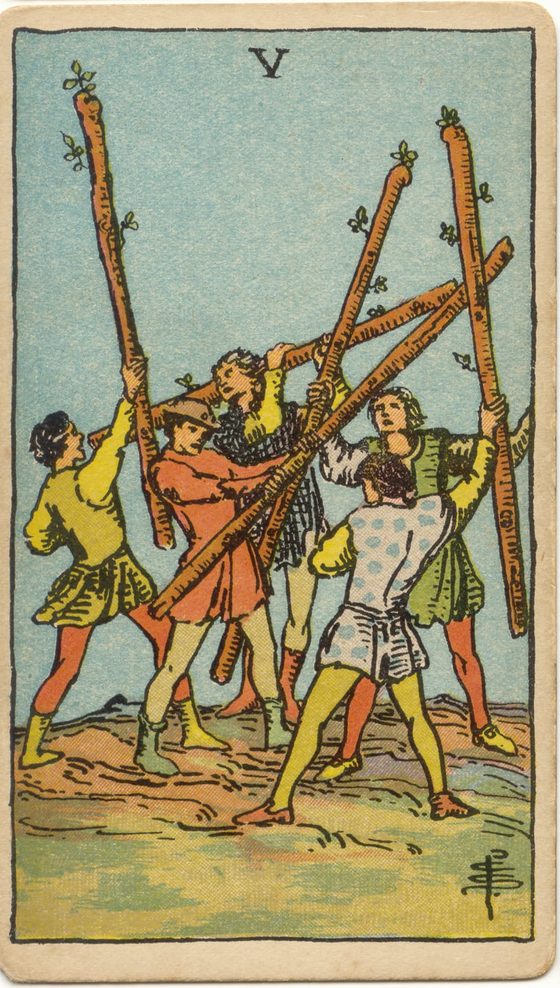
Five young figures stand on open ground, each holding a long staff. The staves are raised at different angles and cross each other overhead, forming a tangle rather than a pattern. No two figures are dressed alike: one wears a striped tunic, another a patterned smock, another plain hose in a different colour.
Look at where the staves actually land. None of them connects with anyone. One is swung high and away, one is held level and low, one is planted like a walking stick. The figures are not grouped into sides. The ground under them is bare and light, the sky above is plain, and there is no building, horizon feature or animal anywhere in the frame.
Upright meaning
The Five of Wands is friction without a villain. Five people are all pushing at once, none of them coordinating, and the result looks like a fight from a distance and like a scramble up close. Nothing in the drawing suggests malice. It suggests that nobody agreed on the rules before starting.
Upright, the card usually describes competition, an argument with several people talking over each other, or a project where everyone is contributing and nobody is in charge. It can be productive. Friction is how ideas get tested, and the suit of Wands treats conflict as energy rather than as damage. The cost is that energy spent against each other is energy not spent on the thing.
It follows directly on the settled ground of Four of Wands, which is part of its meaning: the stable arrangement has been disturbed by more people wanting more things. What the card cannot tell you is who is right, or whether the contest resolves. Beside a card of clear direction it reads as healthy rivalry. Beside Seven of Wands it reads as one person about to be worn down by the many.
Upright in love
In a relationship reading this is the argument that keeps restarting because it is not really about the thing being argued over. Small disagreements, bickering, two people whose timing is off and who are both slightly braced. It rarely describes a serious rupture. It describes wear.
It can also mark a situation with more than two people in it: rivals, an ex still in the picture, families with opinions. The card does not say who prevails, and it does not say what anyone else feels. It says the field is crowded and nobody has agreed how to share it.
Upright in work
At work the Five of Wands is the meeting where five people have five plans and none of them is wrong. Competing priorities, a crowded market, a hiring process with strong candidates, a team pulling in different directions because the brief was never settled. The energy is real; the coordination is missing.
This is one of the few cards where the useful reading is structural rather than personal. If the same argument keeps recurring, the problem is usually that nobody has authority to close it. Read the card as a description of how the work is organised, not as a verdict on the people in the room.
Upright in money
Money that is being contested rather than lost: a shared bill nobody wants to settle, a bid against other bidders, a negotiation where both sides are holding out. Costs creep up while the argument runs.
The card describes the noise around a financial decision, not the decision itself. It has nothing useful to say about what any of it is worth, and reading it as a signal to compete harder is reading a picture as an instruction. If the question is whether to keep bidding, that is arithmetic and appetite, and neither is in the card.
Upright as feelings
As feelings this is agitation rather than dislike. Someone stirred up, competitive, enjoying the contest more than they would admit, or worn thin by it. There is engagement here; indifference does not argue. What the card will not tell you is whether the agitation is aimed at you or simply happening near you.
Upright as advice
Name the rules before continuing. Most Five of Wands situations are not disputes about the issue; they are disputes about who decides, running unacknowledged. Ask, out loud and specifically, what would settle this and who gets to settle it. If nobody can answer, that is the actual problem.
Reversed meaning
Reversed, this card reads two opposite ways and the spread has to decide. The first is conflict avoided. The disagreement is still there, everyone can feel it, and it has gone underground because open argument felt too costly. Nothing is resolved; it is simply quieter.
The second is conflict ending. The contest has run its course, the noise is dropping, and people are going back to work, which is the ground Six of Wands stands on. The card gives no timeline for it, and it does not say the outcome favoured anyone in particular.
A third possibility sits between them: the friction has stopped being external and turned inward, so the argument is now inside one person rather than between several. All three are standard, and none of them is the default. Look at what surrounds the card. Near cards of exhaustion the avoided reading is more likely; near cards of movement, the resolving one. Choosing by habit is not reading.
Reversed in love
Either an argument both people have decided not to have, which usually means it will surface later in a worse form, or a rough patch genuinely subsiding. The two readings look identical for the first week. If the surrounding cards describe strain, read it as avoidance; if they describe movement, read it as recovery. The card does not report on what the other person has privately concluded.
Reversed in work
A team that has stopped arguing, which is either alignment or resignation. Reversed, the card is worth checking rather than celebrating: quiet meetings can mean the brief is finally clear, or that people have stopped bothering to object. It can also describe competition that has moved off the table and into private conversations. Ask whether disagreement is now cheaper or more expensive than it was last month.
Reversed in money
A contested cost that has gone quiet without being settled, or a bidding situation that has genuinely cooled. Reversed, the card often points at a shared expense nobody has raised in a while and everyone is still assuming someone else is handling. The reversal is a prompt to check what was actually agreed, in writing, rather than a statement about whether the number is good.
Reversed as feelings
Irritation that is not being expressed, or irritation that has genuinely passed. Someone holding their tongue and someone who has let it go look the same from outside, and this card does not distinguish them. What it does say is that the heat has come off the surface.
Reversed as advice
Say the thing that is not being said, once, plainly, to the person it concerns. If the conflict has actually resolved, saying it costs nothing. If it has only been buried, this is the cheapest moment to dig it up. Waiting makes the same conversation more expensive.
Symbolism in the 1909 image
The five staves. Crossed overhead at competing angles. Read as conflicting wills. The detail books tend to skip is that they form no pattern at all: this is not a formation, it is five separate gestures happening in the same space.
The absence of contact. No staff strikes anyone. Nobody is wounded, nobody is defending. Whether Smith drew a real fight, a rehearsal or a game is genuinely unclear from the picture, and readings that insist on one have decided something the drawing did not.
The mismatched clothing. Every figure is dressed differently, in different colours and patterns. Usually read as difference of background or interest. It is also the clearest sign that these are not two sides: there are no teams to identify.
The bare ground. Flat, pale, featureless. Nothing is being fought over that is visible in the frame. Whatever the stake is, it is not in the picture, and the card is often read as a quarrel about nothing for exactly that reason.
The open sky. Plain and untroubled above the scuffle. Read as friction without lasting consequence, though that is an inference from an empty background rather than something drawn.
Where this meaning came from
Like every numbered card in the minor arcana, the five of batons started as a playing card. In the fifteenth-century Italian decks it was a rank in a suit used for trick-taking, with no scene on it and no meaning behind it. The pips were pips.
The divinatory layer was added in France in the eighteenth and nineteenth centuries, by Antoine Court de Gebelin and then more systematically by Etteilla, whose printed lists assigned meanings to every card. Their attributions for this one clustered around strife, litigation and contradiction, and those words travelled forward into English books more or less intact.
Pamela Colman Smith's 1909 drawing is what changed the card's texture. Waite's instruction produced a scene rather than five crossed sticks, and the scene she drew is notably light: young figures, no injuries, no blood, no clear sides. Waite's own gloss in The Pictorial Key to the Tarot (1910) calls it imitation of warfare, and mock contest, a phrase most later writers quietly dropped in favour of plain conflict.
Smith received a flat fee and no royalties for the deck. Her decision to draw this card as a scuffle rather than a battle is the reason modern readers hear competition here instead of war.
The common misreading
The Five of Wands gets read as a warning that someone is against you. The picture does not support that. Nobody in it is aimed at anyone; the staves miss. Turning a scramble into an enemy is the single most common thing readers do with this card, and it usually says more about the question than the card.
The second misreading is treating the conflict as a problem to be removed. In the suit of Wands, friction is how anything gets tested. A team that never argues is not necessarily working well, and a reading that recommends smoothing this over may be recommending the worse outcome.
The third is scale. This is a five, not a ten. It is not Ten of Swords and it is not a rupture. Read as catastrophe, it makes a bad week sound like a crisis, and the reader ends up managing an alarm they created. The honest reading is small, noisy and survivable, which is a duller sentence and a truer one.
Questions to sit with
- What exactly is being contested here, and has anyone said it out loud?
- Who has the authority to end this argument, and do they know that they do?
- Are you competing because you want the thing, or because you dislike losing?
- What would you drop if the contest stopped being enjoyable?
Pull this card in a real spread.