- Card number
- 7
- Arcana
- Minor Arcana
- Suit
- Wands
- Element
- Fire
- Rank
- Seven
- Yes or no reading
- It depends
Seven of Wands
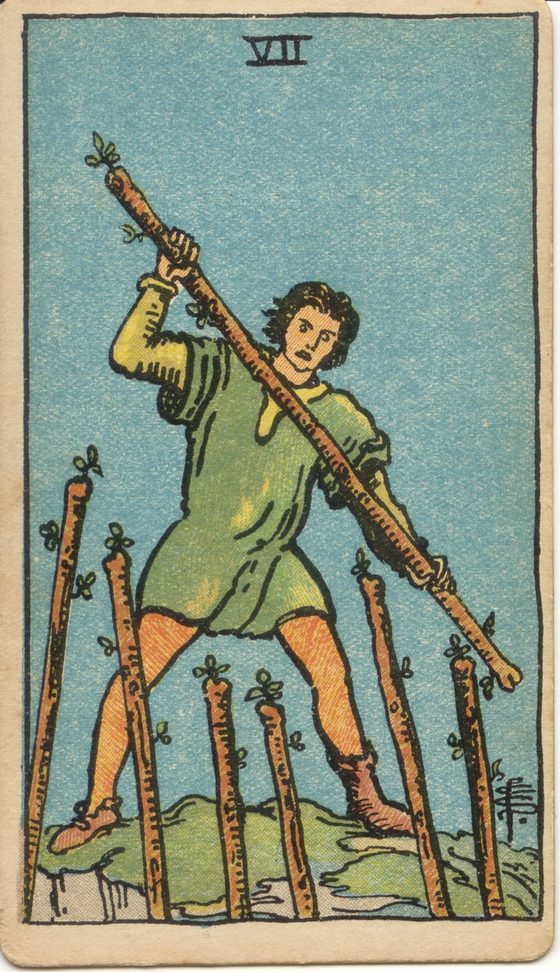
One person on high ground, six staves pushing up from below. The Seven of Wands is holding a position under pressure. It describes the defence, not whether the position is worth defending.
- defence
- perseverance
- conviction
- standing firm
- challenge
- overwhelm
- giving up
- imagined siege
- exhaustion
- letting go
What the card shows
A figure stands on rising ground, holding a staff diagonally across the body like a bar. The stance is braced: weight back, both hands on the shaft, head slightly forward. Below and in front, six more staves push up from the bottom edge of the card, angled toward him. Nobody is holding them in the picture.
The ground he stands on is green and uneven. The sky behind is pale and empty. One detail is easy to miss and hard to unsee: his footwear does not match. He is wearing a boot on one foot and a lower shoe on the other. Whether Smith intended this or the plate was drawn in haste has never been settled.
Upright meaning
The Seven of Wands is one against many, with the ground in his favour. He is higher than the staves coming at him and he is still braced. That combination is the whole card: an advantage that has to be actively held, and the effort of holding it.
Upright it usually describes standing your ground, defending a decision, a boundary, a piece of work, or a position you reached that other people now want. Unlike Five of Wands, this is not a scramble among equals. The sides are uneven and everyone can see it. The card credits the defence. It does not say the defence succeeds. Persistence is a virtue in this suit, and it is also the thing that keeps people in fights they could have left.
The harder question sits underneath. Nobody is visible holding the six staves, which means the card cannot tell you whether the opposition is organised, incidental, or partly imagined. Beside Six of Wands it reads as a won position now under challenge. Beside cards of exhaustion it reads as someone defending out of habit, long after anyone stopped attacking.
Upright in love
In a relationship reading this is defending something: the relationship against outside pressure, or a boundary inside it that keeps getting tested. It can describe a couple standing together against family, circumstance or opinion, and it can describe one person holding a line the other keeps crossing.
The useful distinction is who the six staves belong to. If the pressure is external, the card is about solidarity. If it is internal, the card is about being worn down, and defending your position every week is not a relationship dynamic anyone sustains. The card describes the effort. It has nothing to say about what your partner privately intends.
Upright in work
At work this is defending your work in a room that is pushing back. A proposal under attack, a role somebody else wants, a standard you are the only one still enforcing. The high ground in the picture is real: you usually do have the better position, or you would not be the one being challenged.
What the card asks is whether the defence is worth the energy it takes. Some positions are worth holding for years. Others are hills people die on because retreating feels like losing. The card cannot tell you which one you are on, and anyone who says it can is guessing about your job. Nine of Wands shows what this costs if it runs long.
Upright in money
In money questions this is a position being defended: a price you are not dropping, a claim you are pursuing, a budget under pressure from several directions at once. It reads as holding rather than growing.
The card is honest about the cost. Defending takes time and attention, and both are expensive in ways that do not show up in the figure being argued over. Whether the position is worth what it costs to hold is a calculation, and the card does not do calculations. It only says that you are currently the one holding it.
Upright as feelings
As feelings, this is defensiveness: someone braced, expecting to be challenged, possibly by you. It is not indifference and it is not hostility. It is the posture of a person who believes they will have to justify themselves. Whether that expectation comes from you or from somewhere else entirely is not something the card knows.
Upright as advice
Hold the line, and write down what would make you stop. Pick the condition now, while you are clear-headed: the point at which this stops being worth defending. Without that, the defence continues by default, and default is how people spend years on something they no longer want.
Reversed meaning
Reversed, this card most often reads as the defence collapsing. The position was held too long or with too little support, and the person has run out of the energy that was keeping it up. Overwhelm, capitulation, or simply putting the staff down. The card does not say what was lost.
The opposite reading is equally standard and much less comfortable: the defence was never necessary. There was no siege. Reversed, the card can describe someone braced against opposition that is not there, defending a position nobody was contesting, treating ordinary disagreement as attack. That reading is unflattering, which is exactly why readers skip it, and it sits close to Eight of Swords.
A third possibility is release: stepping down from a position deliberately, because holding it stopped being worth the cost. This is not the same as being beaten, though it looks identical from outside. Which of the three applies is decided by the spread. Near cards of pressure, read exhaustion. Near cards of isolation, read imagined siege. Near cards of movement, read a choice.
Reversed in love
Either someone who has stopped defending the relationship and let the pressure in, or someone who has been treating an ordinary partnership as a fight for months. The second is the reading worth sitting with. If every conversation feels like it needs a defence, the question is whether the other person is attacking or whether you arrived braced. The card marks the posture; it does not assign the cause, and it does not report on what your partner thinks.
Reversed in work
Giving up a position, being worn down by repeated challenge, or discovering that the challenge was never coordinated in the first place. Reversed, this card often points at someone who has been defending a standard alone until they stopped caring about it. It can also mark a healthy decision to let something go. Look at whether the surrounding cards describe pressure applied or pressure imagined, because the two ask for opposite responses.
Reversed in money
A price finally conceded, a claim dropped, or a defensive financial posture that has been costing more than the thing it protects. Reversed, the card is worth reading as a prompt to check whether holding out is still rational or has become a matter of pride. That is a question about your own numbers and your own patience, and neither is visible in a card.
Reversed as feelings
Someone who has stopped bracing, either because the pressure lifted or because they gave up on the argument. It can also describe defensiveness that has turned inward into doubt. The card shows the guard coming down and does not say whether that is relief or surrender.
Reversed as advice
Check whether anyone is actually attacking. Name the specific people and the specific things they have said or done in the last month. If the list is short or empty, the siege is in your head and the defence is costing you for nothing. If the list is long, stop defending alone and ask someone for help.
Symbolism in the 1909 image
The high ground. He is standing above the staves that threaten him. Read as advantage, and it is a real one. It is also the reason he cannot move: the moment he steps down, the position is gone.
The six staves from below. They enter from the bottom edge of the card and stop. No hands, no faces, no bodies. Smith drew opposition without drawing opponents, and that absence is the single most useful thing in the picture.
The mismatched shoes. One boot, one lighter shoe. This is the detail readers argue about most. It is usually read as improvisation, or as having been caught unprepared. Whether it was intentional is genuinely unknown, and readings that build a whole meaning on it are building on a possible printing accident.
The staff held across the body. Not raised to strike. Held horizontally, as a bar. The gesture is blocking, not attacking, which separates this card from every reading that turns it into aggression.
The empty sky. Nothing above, no weather, no witnesses. Whatever this is, it is not being watched, which is the plainest difference from the card before it.
Where this meaning came from
The seven of batons was, for its first three centuries, a card in a game. Italian tarot decks of the fifteenth century used the four suits for trick-taking, and the pips carried rank and nothing more.
The divinatory tradition arrives through eighteenth- and nineteenth-century France. Etteilla's lists, which turned the deck into a system of fixed meanings, associated this card with negotiation, discussion, and uncertainty of outcome. The modern emphasis on courage and defiance is not there yet.
Pamela Colman Smith's 1909 drawing supplied the image everyone now reads: one figure, higher ground, six staves from below. Waite's commentary in The Pictorial Key to the Tarot (1910) glosses it as valour, a man in a difficult position facing a number of adversaries, and notes that he holds the advantageous ground. Nearly every later reading of standing your ground descends from those two sentences.
The mismatched footwear has generated a century of interpretation. There is no documentary evidence of Smith's intention. She was paid a flat fee for the whole seventy-eight card deck, worked quickly, and left no notes on this one. The accident and the intention read the same on the printed card.
The common misreading
The Seven of Wands gets read as proof that people are against you. Look again at what is drawn: six staves and no people. Smith gave the opposition no hands and no faces. A reader who supplies the enemies is adding the most consequential element in the picture and then treating it as something the card said.
The second misreading is treating persistence as automatically right. This card is often handed to someone as encouragement to keep fighting, when the more useful reading is that they have been fighting a long time and nobody has asked whether it is worth it. Courage and stubbornness look identical from the inside and the card does not distinguish them.
The third is the shoes. A great deal has been built on the mismatched footwear, and none of it rests on evidence about what Smith meant. Using it as a definite symbol of improvisation is a good example of how tarot meanings accumulate: a detail is noticed, a plausible reading is offered, and within a few decades it is repeated as though it were in the original brief.
Questions to sit with
- Who exactly is opposing you here, and can you name them?
- What would have to happen for you to stop defending this?
- Is this position still worth what it takes to hold, or has it become a habit?
- Are you defending the thing itself, or the fact that you already committed to it?
Pull this card in a real spread.