- Card number
- 6
- Arcana
- Minor Arcana
- Suit
- Wands
- Element
- Fire
- Rank
- Six
- Yes or no reading
- Yes
Six of Wands
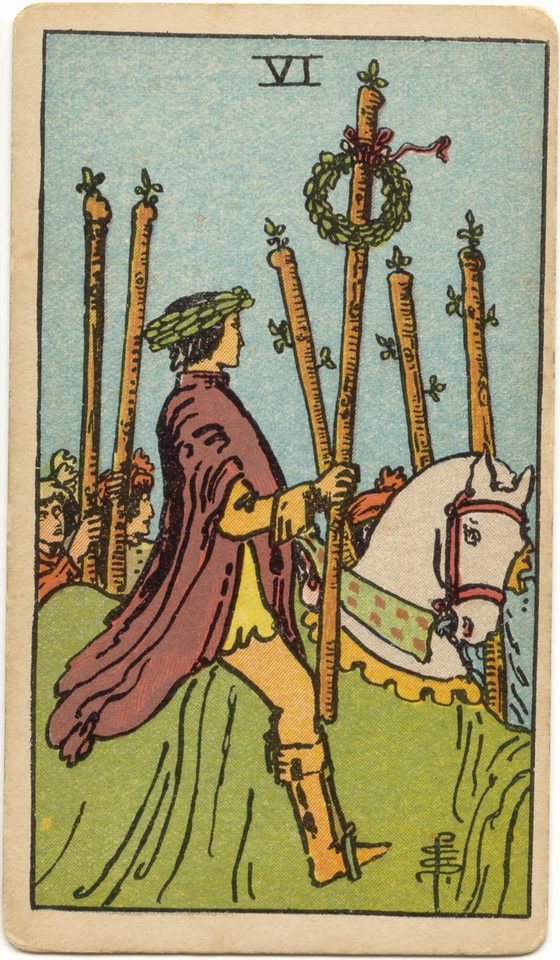
A rider crowned with laurel, moving through a crowd on foot. The Six of Wands is public recognition after effort. It describes the moment of being seen, and says nothing about whether the recognition is deserved.
- recognition
- success
- confidence
- public credit
- vindication
- unrecognised
- credit taken
- self-doubt
- showmanship
- anticlimax
What the card shows
A rider sits on a white horse, moving at a walk. He wears a laurel wreath on his head and carries an upright staff with a second wreath tied near its top. His cloak is red; the horse is draped in a long green cloth that reaches almost to the ground.
Around and behind him walk figures on foot, close enough to touch the horse. Five more staves are held up among them, so the rider's makes six. The faces of the walkers are mostly hidden: the picture shows the backs of heads, shoulders and hands. Only the rider is drawn in full and only the rider is elevated. The background is plain, with no landscape and no building.
Upright meaning
The Six of Wands is the card of being publicly credited. A contest has ended, someone has come out ahead, and the result is now visible to people who were not involved. It arrives immediately after the scramble of Five of Wands, and the sequence matters: recognition here is the settlement of a conflict, not a gift.
Upright it usually reads as success, confidence, a win that other people acknowledge. The confidence is the part worth attending to. Smith drew the rider looking straight ahead rather than at the crowd, which reads as someone who has already accepted the verdict and is thinking about what comes next. It is a quieter version of the forward drive in The Chariot. There is no gloating in the drawing, and no relief either. The crowd is doing the celebrating; he is doing the riding.
The card describes the moment, not the substance behind it. It cannot tell you whether the achievement was real, whether the credit landed on the right person, or how long the standing lasts. Beside cards of solid work it reads as an earned result. Beside Seven of Wands it often reads as a position that will have to be defended almost immediately.
Upright in love
In a relationship reading this is a connection that has come through something and can now be spoken about openly. A reconciliation that held, a decision made in public, a partner who says the good thing out loud rather than assuming you know it.
It can also describe wanting to be chosen visibly, which is a real need and not a shameful one. Where the question is about someone else, the card describes the standing of the relationship rather than the interior of the other person. It says the situation looks good from outside. That is worth having and it is not the same as knowing what they think.
Upright in work
At work this is the card of visible success: the promotion announced, the project praised in front of the department, the pitch that won. It is specifically the public part. A quiet competence nobody mentions is a different card.
Two things follow from that. Recognition changes how people treat you, including people who were previously peers, and the Six of Wands sits at the start of that shift rather than after it. And credit is distributed by other people, on their own logic. If the card turns up when the win was collective, the honest question is who is on the horse and who is walking, and Three of Pentacles is the card that answers it better.
Upright in money
In money questions the Six of Wands tends to mark a result that has arrived and been acknowledged: a raise confirmed, a payment released, an application approved. The waiting part is over.
What it does not describe is the size or the durability of the sum. Recognition and money are related but not the same, and this card is much better at the first than the second. If the question is what to do with the result, that belongs to arithmetic and to people who can see your actual numbers. The card marks the moment; it does not price it.
Upright as feelings
As someone's feelings, this is pride in you that they are willing to show other people. Warm, uncomplicated, and slightly public: the feeling of wanting to be seen with you rather than the feeling of wanting to be alone with you. It can also describe someone who feels they have won you, which is flattering and worth watching.
Upright as advice
Accept the credit out loud, then name the people who are walking beside the horse. Say the names. Both halves are the instruction. Deflecting recognition wastes it, and taking it alone when it was not earned alone costs you the people you will need next time.
Reversed meaning
Reversed, the Six of Wands divides into two readings that point in opposite directions. The first is recognition that has not come. The work was done, the result was real, and the credit went elsewhere or nowhere. This is the reading most books give, and it is often correct.
The second is the opposite problem: recognition that arrived and has become the point. The rider has started riding for the crowd. Confidence has thinned into needing to be seen, and the actual work is now secondary to how the work looks. That reading is less flattering and it is at least as common.
A third, quieter version is simple deflation after a win, the flatness that follows an achievement once the announcement is over. The spread decides which of these you are holding. Near cards of effort unrewarded, read the first. Near cards of display, read the second. Reaching automatically for a lack of recognition means you have stopped looking at the rest of the table.
Reversed in love
Either a relationship where one person's contribution goes consistently unacknowledged, or one where the performance of being a good couple has drifted ahead of the private reality. Both readings sit in this position and they describe different problems. The first is about being unseen; the second is about being seen too carefully. The card marks the mismatch, not the motive, and it makes no claim about what the other person intends.
Reversed in work
Work that went unnoticed, credit taken by someone else, or a promotion that did not arrive. It can equally describe a workplace where visibility has replaced output, and being seen to work has become the work. Which one applies is a question about the organisation, and it is usually answerable by looking at who gets promoted. The reversal describes a pattern, not a single event, and it does not forecast your next review.
Reversed in money
A payment or a result that has been announced but not delivered, or spending aimed at looking successful rather than at being solvent. The second is the more useful reading and the one people skip. Reversed, the card asks whether the appearance of a good position and the position itself have come apart. Checking that is a matter of records, not of cards, and the answer is not in the picture.
Reversed as feelings
Pride that has curdled slightly, or pride that is being withheld. Someone who thinks well of you and will not say so where it counts, or someone whose good opinion has become conditional on how you reflect on them. The card marks the withholding without explaining it.
Reversed as advice
Ask for the credit directly, once, from the person who can actually give it. Not hinting, not waiting to be noticed. If the answer is no, you have learned something concrete about where you stand, which is more useful than another year of assuming. Then decide what to do with it.
Symbolism in the 1909 image
The laurel wreath. Two of them: one on the rider's head, one tied to his staff. Read as victory, from Roman triumph. The doubling is the interesting part, because he is both wearing the honour and carrying it, which reads either as abundance or as a man holding his own trophy.
The white horse. Slow, not galloping. The same colour animal Smith used for cards of transition elsewhere in the deck. Its pace is a procession pace. Nothing about the drawing suggests speed or escape.
The green drape. A long cloth over the horse, nearly to the ground, hiding most of the animal. Usually read as ceremony. It also means the thing carrying him is largely concealed.
The crowd on foot. Close, numerous, faces mostly turned away or cropped. Read as public acclaim. Whether they are supporters, an escort, or simply people going the same way is not settled by the picture, and the ambiguity is the point.
The five raised staves. Held by the walkers, making six with the rider's. The number carries over from the previous card. Whether these are the same five people who were quarrelling is a reading, not a fact.
Where this meaning came from
In the Italian decks where tarot began, the six of batons was a rank in a suit and nothing else. The game was trick-taking; the pips were counters. No procession, no rider, no laurel.
Meanings were attached in France from the late eighteenth century onward. Etteilla's printed lists, which did most of the practical work of turning pips into a divinatory system, gave this card associations with servants, expectation and news awaited. That is noticeably different from the modern reading, and it is a useful reminder that the tradition is not continuous.
The triumphal scene is Pamela Colman Smith's, drawn in 1909 to Arthur Edward Waite's brief. Waite's note in The Pictorial Key to the Tarot (1910) describes a laurelled horseman with footmen at his side, and reads it as good news and expectation crowned. The Roman triumph is the visual source: the wreath, the mounted figure, the crowd on foot.
Most of what a modern book says about confidence and public recognition traces back to that image rather than to anything older. Smith was paid once, credited by initials, and left out of the deck's name.
The common misreading
The Six of Wands is routinely read as a guarantee that you will win. It is not a forecast. It describes what a moment of recognition looks like, and a card cannot know whether that moment is coming. Used as a promise, it sets up the reader to be wrong in a way that is remembered.
The second misreading is subtler. Because the image is a triumph, readers assume the achievement underneath is proportionate. Public credit and real accomplishment come apart constantly, in both directions, and this card sits on the credit side. Someone can be on the horse for work they did not do, and the drawing would look exactly the same.
The third is about the crowd. Their faces are turned away or out of frame, and readers fill them in as admirers. Smith did not draw admiration; she drew proximity. Reading warmth into a group whose expressions are not visible is inventing the friendliest available version of other people, which is precisely the habit this card should make you suspicious of.
Questions to sit with
- What exactly are you being recognised for, and is it the thing you actually did?
- Who else worked on this, and have you said their names where it counts?
- If nobody had noticed, would you still consider this a success?
- What are you now expected to keep doing because of this, and did you agree to it?
Pull this card in a real spread.