- Card number
- 7
- Arcana
- Major Arcana
- Suit
- Major Arcana
- Element
- Water
- Rank
- Trump
- Roman numeral
- VII
- Zodiac attribution
- Cancer
- Yes or no reading
- Yes
The Chariot
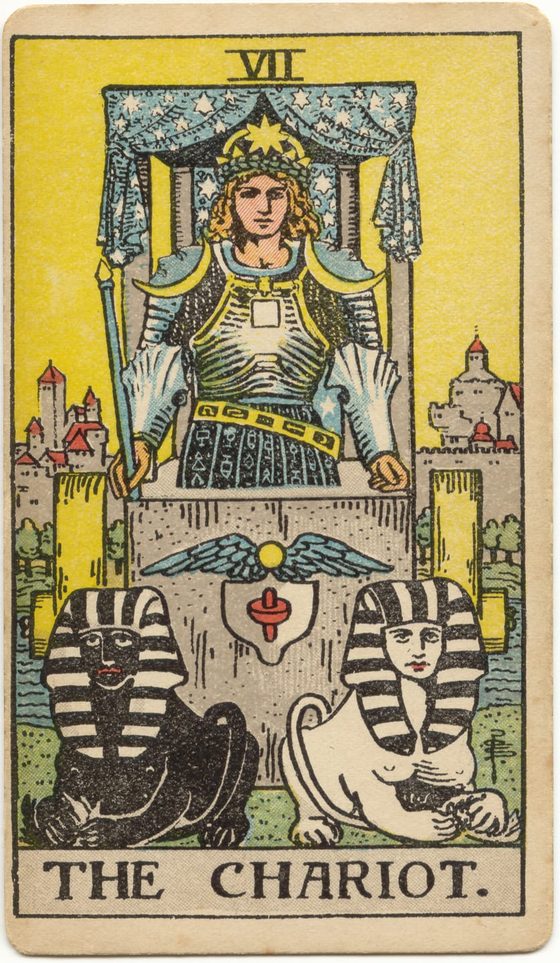
A crowned figure standing in a stone chariot drawn by two sphinxes. The Chariot is the card of a direction held under strain, and of forward motion that depends entirely on the driver not letting go.
- willpower
- direction
- momentum
- discipline
- focus
- loss of direction
- force
- scattered effort
- aggression
- stalling
What the card shows
An armoured figure stands upright inside a heavy square chariot, facing forward. He wears a laurel and a star-topped crown, a breastplate, and a skirt patterned with squares and symbols. Crescent moons with faces are set on each shoulder. In his right hand is a short wand; he holds no reins.
Two sphinxes are harnessed at the front, one black and one white, both lying down rather than running. A canopy of stars is held over the chariot on four posts. On the front of the vehicle is a winged disc above a red and blue emblem. Behind, a walled city with towers, and a river running across the middle distance. The chariot is not visibly moving.
Upright meaning
The Chariot describes control held against opposing forces. Two animals of opposite colour are harnessed to the same vehicle, and the whole card depends on them going the same way. It is a picture of willpower doing continuous work, not of a problem that has been solved.
Upright, it usually reads as progress through effort and focus. Something is moving because a person is holding it on course: a deadline being met, a recovery being maintained, an argument being won by refusing to be distracted. In a spread about stalling, it is the card that says movement is available. It is what follows the decision in The Lovers: the choice has been made and the work is holding to it.
What it does not say is that the effort is sustainable or that the direction is right. The driver carries no reins in Smith's drawing, which means the control is being exerted some other way and is not visible. Beside Strength, which follows it, the two make a pair worth reading together: force applied from outside, and the same problem handled by persuasion. Beside cards of exhaustion, The Chariot usually describes what has been costing the energy.
Upright in love
In relationship readings The Chariot describes a connection being actively steered. Someone is putting effort into keeping it on course, often through a period that would otherwise pull it apart: distance, illness, disagreement, competing demands.
It is a card of determination rather than ease, and determination has a shelf life. The honest question it raises is who is doing the steering and whether both people know. A relationship held together by one person's continuous effort is being held together, which is real, and it is also a specific arrangement worth naming. Where the question is about someone else, the card says they are pursuing something. It does not say what they feel while doing it.
Upright in work
At work this is the card of drive and of projects that move because somebody insists. Deadlines hit, competing stakeholders held in line, a launch that happens on the date it said it would. It also fits ambition in the plainest sense: wanting the thing and going after it.
Upright it favours pressing on rather than reconsidering. That is good advice when the direction is settled and poor advice when it is not, and the card cannot tell the difference. Where The Emperor holds a position, The Chariot moves one. Compare the Two of Wands, which is the moment before the direction is chosen; The Chariot is what happens after, when changing your mind has become expensive.
Upright in money
In money questions The Chariot describes a plan being held to. A repayment schedule that is being met, a savings target being pursued, spending kept inside a line by effort rather than by circumstance.
The card is about the discipline, not the sum. It says the direction is being maintained; it says nothing about whether the direction is a good one, and it is not a recommendation to press ahead with anything specific. That judgement needs the actual figures and, where it matters, someone qualified to read them. Willpower applied to a bad plan produces the same picture as willpower applied to a good one.
Upright as feelings
As someone's feelings, The Chariot is intent rather than tenderness. They have decided they want this and are moving toward it, and the wanting is doing most of the visible work. It can read as flattering and single-minded, and it can read as a person who is pursuing an outcome rather than getting to know a person. The card describes momentum, not warmth.
Upright as advice
Pick the one direction and hold it for a fixed period, then review. The Chariot's advice is not to try harder in general; it is to stop splitting the effort. Name the single objective, put a date on it, and refuse every other worthwhile thing until that date.
Reversed meaning
Reversed, The Chariot reads two ways that produce the same stalled feeling by opposite routes. The first is loss of control: the two sphinxes pulling apart, effort still being applied and no longer holding anything together. Scattered energy, a plan that has come off its rails, force applied harder to something that has stopped responding to force.
The second is control that has become the problem. Direction held so tightly that nothing can adjust, aggression standing in for progress, a person driving something forward that everyone else has quietly stopped pushing. This version rarely feels like a reversal from inside; it feels like commitment.
There is a third that appears often enough to keep in the set: no direction at all, energy available and nothing chosen to spend it on. Which of the three applies is not decided by the card. It is decided by whether the querent's problem is too much grip, too little, or nothing to grip. A reader who defaults to lack of control is reading half the card.
Reversed in love
Either the effort holding the relationship together has run out, or it has turned into pushing. In the first, both people are still there and nobody is steering. In the second, one person is driving hard toward an outcome and calling the other's reluctance an obstacle. The reversal is worth reading carefully in questions about pursuit, because the picture does not distinguish between determination and pressure, and neither does the person applying it.
Reversed in work
A project that has lost its direction, or one being forced past the point where forcing helps. The first shows up as competing priorities and no decision; the second as a deadline defended after everyone knows it is wrong. The reversal also covers ambition running without a target, which is exhausting and hard to name because it looks like drive. Read the surrounding cards for whether the problem is the grip or the road.
Reversed in money
A financial plan that has come apart, or one being held to long after the circumstances changed. Both look like discipline from the outside. The reversal can also describe money being chased without a clear reason: earning as momentum rather than as a means to anything. None of that is a judgement on your situation, which the card cannot see. Numbers and, where it matters, a qualified person can.
Reversed as feelings
Wanting that has become insistence, or wanting that has run out of direction and gone flat. The first is a person pursuing an outcome and no longer noticing the other party; the second is someone who wanted this once and cannot now say what for. The reversal describes the state of the drive, not the depth of the feeling, and the two are easy to confuse.
Reversed as advice
Stop pushing for one week and write down what actually moves without you. If the answer is nothing, the direction may be wrong rather than the effort insufficient. If things move fine, you have been supplying force to something that did not need it, and the effort is now available elsewhere.
Symbolism in the 1909 image
The two sphinxes. One black, one white, harnessed side by side. Read as opposing forces held to a single course. Both are drawn lying down, which is worth pausing on: this is a picture of a vehicle that is not currently going anywhere.
The absent reins. The driver holds a wand and nothing else. There is no tack connecting him to the animals. Waite's explanation is that the control is mental rather than physical, which is either the most interesting claim on the card or an elegant way of covering a drawing problem.
The crescent moons on the shoulders. Two faces in profile, one on each epaulette. They carry the Cancer attribution, and they are the only soft shapes on a card otherwise made of squares and armour.
The starry canopy. Held over the chariot on four posts. Usually read as celestial protection or as guidance from above. It also functions as a roof, which means the driver cannot see the sky he is supposedly steering by.
The walled city behind. Towers and a wall in the middle distance, with a river between them and the chariot. Read as what has been left: home, safety, the ordinary life. Nothing in the picture indicates whether the departure was chosen or required.
Where this meaning came from
The Chariot is among the original fifteenth-century Italian trumps, where it usually shows a triumphal car of the kind used in civic processions. Those processions were real: Italian cities staged them, and the trump sequence borrows their imagery of ranked figures passing in order.
Early versions are drawn by horses, and the driver is often a woman. The sphinxes are a later substitution, arriving with the eighteenth-century French occult reading of the deck as Egyptian, a claim with no historical support. Eliphas Levi's mid-nineteenth-century description of the card, with its two harnessed sphinxes, is the direct ancestor of the image Waite and Smith used.
In The Pictorial Key to the Tarot (1910) Waite makes a point of saying that the charioteer has achieved conquest on all planes except the highest, and that he is not the redeemer he might appear to be. It is one of the few places where he actively warns readers off a flattering reading.
The Golden Dawn assigned the card to Cancer, which is why the crescents are on the shoulders. The modern keyword willpower is a fair summary of Waite's position and a narrower one than the Italian original, where the card meant triumph in the civic and public sense.
The common misreading
The most common misreading is treating The Chariot as a promise that you will win. Waite explicitly denies this, which is unusual for him, and the picture agrees: the sphinxes are lying down and the vehicle is stationary. The card describes a person exerting control, and exerting control is not the same as arriving.
The second is reading it as advice to push harder whenever it appears. Upright it does favour holding the line, but it says nothing about whether the line is worth holding. Drawn in a spread about a situation that has already failed, this card is describing the effort still being spent on it, which is a diagnosis rather than an encouragement.
The third is specific to relationship questions and does real harm. Because the card describes pursuit, it gets used to reassure people that someone else's persistence is a sign of feeling. Persistence is a sign of persistence. The Chariot cannot tell you what is behind it, and a reading that implies otherwise is telling a querent something about another person's private mind that nobody in the room knows.
Questions to sit with
- What are you holding together by effort, and what happens the week you stop?
- Is the direction still the one you chose, or the one you have already paid for?
- Which two things in this situation are pulling opposite ways?
- If you are pushing hard, who else is being pushed?
Pull this card in a real spread.