- Card number
- 4
- Arcana
- Major Arcana
- Suit
- Major Arcana
- Element
- Fire
- Rank
- Trump
- Roman numeral
- IV
- Zodiac attribution
- Aries
- Yes or no reading
- Yes
The Emperor
An armoured figure on a stone throne in a barren landscape. The Emperor is the card of structure imposed and held, and of the difference between authority that is earned and authority that is merely occupied.
- authority
- structure
- boundaries
- discipline
- stability
- rigidity
- control
- no boundaries
- domination
- weak leadership
What the card shows
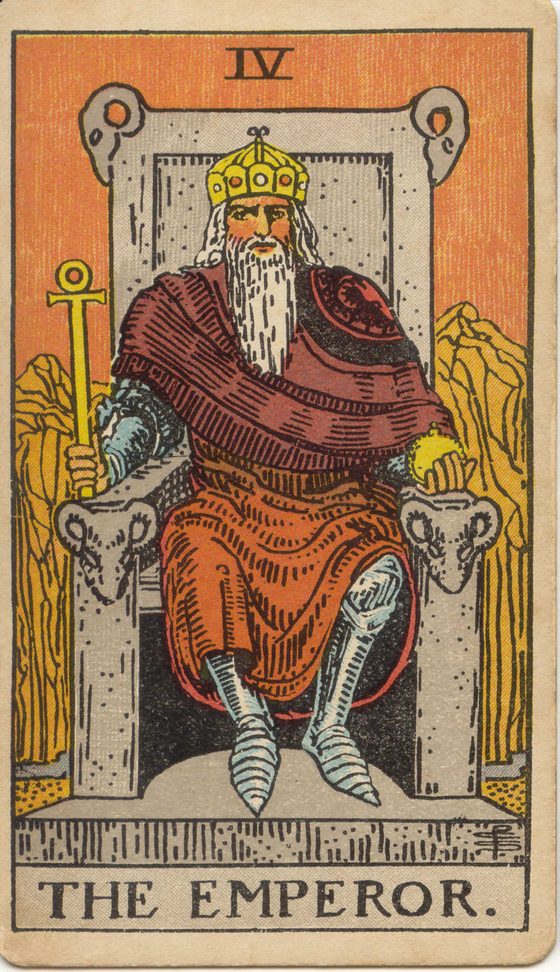
A bearded man sits upright on a large stone throne, facing forward. He wears a red robe over what is visibly armour, with mail showing at the arms and legs. A gold crown sits on his head. In his right hand he holds an ankh-headed sceptre; in his left, a plain orb.
Four ram heads are carved into the throne, two on the arms and two at the top corners. Behind him rise bare orange mountains with no vegetation on them at all, and a thin river runs along their foot. His posture is rigid: the knees are together, the back is straight, and neither hand is resting. He does not appear comfortable.
Upright meaning
The Emperor describes structure: rules, boundaries, a chain of responsibility, someone who has decided how things will be done. Where The Empress is a field that grows, this is a stone seat on rock where nothing grows at all. The pairing is deliberate and the contrast is the point.
Upright, it usually reads as order that is working. A framework holding something together, a person taking responsibility, a decision that has been made and will not be reopened every week. In a spread about chaos it is a relief. In a spread about constraint it is the constraint.
The card says nothing about whether the authority is good, only that it exists and is holding. It is often read as a father figure, which is one form the pattern takes and not the whole of it; a policy, a contract, a landlord and a manager all fit the same description. Beside The Fool the pair mark the two ends of the same problem, structure without openness and openness without structure. Beside cards of pressure, it more often describes the source of the pressure than the answer to it.
Upright in love
In relationship readings The Emperor describes a connection with defined shape. Agreements that hold, roles that are understood, a person who is reliable in a way that can be planned around. That is a genuine kind of love and it is rarely the kind querents are hoping to hear about.
The failure mode sits close to the virtue. Structure that is not negotiated becomes rule, and someone who is dependable can also be someone who is not movable. Where the question is about another person, the card describes how they operate rather than what they feel. It will not tell you they are warm, and it will not tell you they are not.
Upright in work
At work this is the card of hierarchy and process, drawn from either side. It describes the person setting terms, or the framework you are working inside, and often both at once. Systems, budgets, sign-off, the parts of an organisation that do not move when you push them.
Upright it usually favours working with the structure rather than around it. Put the request in writing, use the process, establish the boundary explicitly. The card has a specific limitation worth naming: it describes position, not competence. Waite's figure holds an orb and a sceptre and is doing nothing with either. Authority and ability are separate, and the deck keeps them on separate cards, which is why The Hierophant that follows is a different problem.
Upright in money
In money questions The Emperor is about control rather than amount. Budgets, terms, structures, the decision to put boundaries around spending and keep them. It reads as stability held in place by effort, not as stability that arrived.
It can also describe money that somebody else controls: a contract, an employer, a parent, an institution with the final say. That is a description of a situation, not a judgement on it. The card gives no view on whether any specific arrangement is sound, and it is not a substitute for reading the terms or for advice from someone qualified to give it.
Upright as feelings
As someone's feelings, The Emperor is commitment expressed as reliability rather than as declaration. Turning up, doing what was agreed, holding a position. It can be deeply steady and it can be closed; the card shows a man in armour, and armour is worn for a reason. What it does not describe is anything the person has said out loud.
Upright as advice
Write the rule down and apply it to yourself first. The Emperor's advice is not to take charge in general; it is to make one specific thing explicit that has been running on assumption. A deadline, a limit, a boundary, a division of labour. Say it plainly and then hold it for a month.
Reversed meaning
Reversed, The Emperor splits into two readings that sit at opposite ends of the same axis. The first is rigidity: structure that has outlived its purpose and is being defended anyway. Rules kept because they are rules, control exercised because letting go would mean admitting the situation has changed.
The second is the absence of structure where structure is needed. Nobody deciding, nothing written down, responsibility that evaporates when anyone asks who holds it. This reading is less discussed and appears at least as often, particularly in questions about families and small organisations.
A third, harder version is authority being used badly rather than held badly: position without accountability, a person who cannot be corrected by the people they affect. The reversal does not choose between the three, and neither does the picture. The question chooses, and so does what else is in the spread. Domination is the reading readers reach for first, and it is only one of the three.
Reversed in love
Either one person is setting terms the other did not agree to, or nobody is setting any terms at all and the ambiguity has become the problem. Both produce the same complaint from different directions: that the relationship has no shape you can rely on. The reversal is worth reading carefully in questions about control, because it describes a dynamic and not a person, and the same card falls whichever side of it you are on.
Reversed in work
Micromanagement, or a vacuum where a decision should be. In the first, process has replaced judgement and nothing can move without permission. In the second, nobody will own the call and the work stalls politely. The reversal also covers authority that is nominal: a title with no power behind it, which is a miserable position and rarely diagnosed as one. Read the surrounding cards for whether the problem is too much grip or none.
Reversed in money
Control tightened past the point of usefulness, or no control at all. The first shows up as a budget so restrictive it is abandoned; the second as spending nobody is tracking. The reversal can also describe money held by someone whose decisions you have to live with and cannot influence. That is a situation to address with information and, where it matters, with someone qualified, rather than with a card. Compare the Four of Pentacles, which shows the grip on its own.
Reversed as feelings
Feeling held behind a position, or the withdrawal of warmth as a way of enforcing one. In the milder reading a person cares and has no vocabulary for saying so. In the harder one, approval has become conditional and both people know it. The card marks the armour, not what is underneath, and it cannot tell you which of the two you are looking at.
Reversed as advice
Name one rule you are enforcing and check whether anyone still agrees with it, including you. If the answer is no, drop it this week rather than at the next review. If you are on the other side of the reversal and there is no rule at all, write one and put your name on it.
Symbolism in the 1909 image
The ram heads. Four of them carved into the throne, two at the arms and two at the crest. Rams are the sign of Aries, and this is the Golden Dawn attribution made visible in the furniture. It is the most explicit astrological signal on any trump.
The armour under the robe. Mail is visible at the wrists and shins beneath the red robe. The figure is dressed for war while seated in peace. Usually read as readiness; equally readable as a man who does not take it off.
The barren mountains. Bare orange rock behind the throne, with nothing growing on it. Placed immediately after The Empress and her wheat field, the emptiness is doing work: this is what the deck shows when it wants order rather than growth.
The ankh sceptre. An Egyptian life sign on the top of a rod of office. It arrives from the eighteenth-century French claim that tarot was Egyptian, a claim with no evidence behind it, and it sits here as a decorative fossil of that idea rather than as a meaning.
The river. A narrow band of water at the foot of the mountains, barely visible. It is the only living thing in the frame. Books rarely mention it, and it is the single detail that keeps the card from reading as pure sterility.
Where this meaning came from
L'Imperatore is among the original fifteenth-century Italian trumps, and like the Empress he made it through five centuries without controversy. In the trick-taking game he outranked most of the deck and meant nothing at all.
The interpretive layer is French and eighteenth-century, through Court de Gebelin and Etteilla, who gave the deck an Egyptian pedigree that the historical record does not support. The link to Aries comes later, from the Hermetic Order of the Golden Dawn, which assigned the twelve signs and seven planets across the trumps in the late nineteenth century.
Waite and Pamela Colman Smith worked inside that scheme in 1909, which is why the rams are carved into the throne. Waite's note in The Pictorial Key to the Tarot (1910) is unusually blunt for him: he calls the card the virile power of the male, and adds that it is the highest form of that principle rather than an ordinary man.
The modern reading of the card as fatherhood, and the more recent one of it as toxic authority, are both twentieth and twenty-first century additions. Neither is in Waite, and both are reasonable things to do with a five-hundred-year-old picture of a king.
The common misreading
The most common misreading is deciding this card is a specific man in the querent's life. Sometimes it is. Often it is a rule, a job, a legal arrangement or a habit of self-discipline, and identifying it as a person means the reading goes looking in the wrong place for the whole session.
The second is treating the upright card as approval of whoever holds the power. The Emperor describes authority functioning. It has no opinion on whether it should be there. Read in a spread about a difficult boss or a controlling relative, it confirms that the structure is solid, which is information and not comfort.
The third runs the other way and has become common recently: reading every Emperor as a warning about control. That is one of three reversals and it is not the upright meaning at all. A reader who cannot draw this card without producing a lecture on patriarchy is bringing a position to the table rather than reading what fell on it.
Questions to sit with
- What in this situation has no one taken responsibility for?
- Which rule are you following that nobody has actually asked you to follow?
- If you are the one setting terms here, when did you last check that they still work?
- Where would more structure help you, and where would it only make you feel safer?
Pull this card in a real spread.