- Card number
- 0
- Arcana
- Major Arcana
- Suit
- Major Arcana
- Element
- Air
- Rank
- Trump
- Roman numeral
- 0
- Planetary attribution
- Uranus
- Yes or no reading
- Yes
The Fool
A step taken before the ground is known. The Fool is the card of acting without a map, which is sometimes courage and sometimes carelessness, and the spread around it decides which.
- beginnings
- innocence
- spontaneity
- free spirit
- faith
- recklessness
- naivety
- poor judgement
- hesitation
- wasted potential
What the card shows
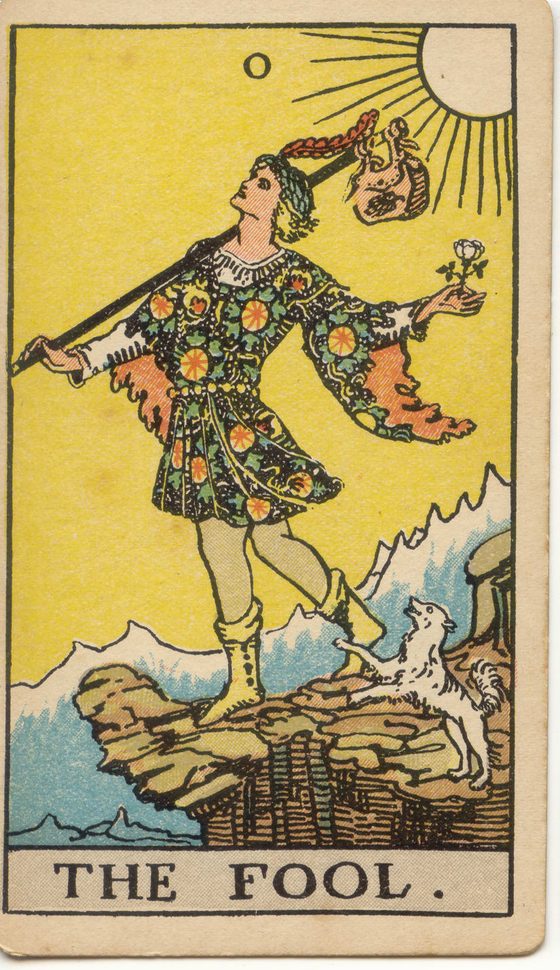
A young figure stands at the edge of a cliff in bright morning light, one foot already past the rock. The head is turned away from the drop, toward the sun. A small white dog leaps at the heels. Over one shoulder is a stick with a modest bundle tied to it; in the other hand, a white rose held loosely enough to drop.
The figure is dressed far too well for walking. The tunic is embroidered, the boots are decorative, and there is a feather in the cap. Behind, snow-capped mountains recede. Nothing in the picture is threatening. The only danger is the ground running out, and the figure is the one person in the frame not looking at it.
Upright meaning
The Fool describes the moment before commitment, when a situation is still open because nothing has been decided yet. It is the only card in the deck numbered zero, and that is the point: it stands outside the sequence, before experience has narrowed the options.
Drawn upright, it usually says the querent is at a genuine beginning and has less information than the decision seems to require. That is not automatically a warning. Some beginnings cannot be researched into safety, and waiting for certainty is its own way of never starting.
What the card does not say is whether the step works out. It describes a posture, not an outcome. Read the cards around it: The Fool beside a grounded card like the Four of Pentacles reads as a well-timed risk, and beside The Tower it reads as a risk taken for the wrong reason.
Position matters more than usual with this card. In a past position it often describes a decision the querent has stopped calling a decision, something now filed under what simply happened. In an outcome position it is close to useless as a prediction and much more useful as a question: what would it cost to be at a genuine beginning here?
Upright in love
In a relationship reading, The Fool often marks something genuinely new, or an old relationship being approached as if it were new. There is openness here and very little armour.
It is a difficult card to read as reassurance. It says you are not guarded, which is what makes closeness possible and also what makes it costly if the other person is not in the same position. Where the question is about someone else's intentions, this card describes yours instead. Compare The Lovers, which is about choosing, not about starting.
Upright in work
A change of direction taken before it is fully justifiable: leaving a stable role, starting something unproven, moving into work you are not yet qualified for. The card favours the move but says nothing about the outcome.
In a team context it can describe the person willing to say the obvious thing nobody senior will say. That is valuable, and it is also how people get a reputation.
It is worth separating two things the card gets used for. A career beginning that is genuinely unresearchable is one situation. A career beginning that could have been researched and was not is a different situation wearing the same picture.
Upright in money
Money spent or committed without the full picture. Sometimes this is a reasonable bet on yourself; sometimes it is optimism doing the arithmetic. The card cannot tell the two apart, and neither can a reading.
If a decision here is large and reversible, the card leans toward taking it. If it is large and irreversible, the card is describing your appetite, not endorsing it.
Nothing here is financial advice, and the card is not a signal about any market. What it describes is a relationship to the unknown part of a decision, which is a different subject entirely.
Upright as feelings
As feelings, The Fool is light, uncomplicated interest that has not yet decided how serious it is. It is not indifference. It is attention that has not yet been tested by anything difficult.
Read as someone else's feelings, it is honest but untested. Nothing about it is false; very little about it is yet load-bearing.
Upright as advice
Begin, but name the risk out loud first. The Fool's failure mode is not the leap; it is leaping while telling yourself there is no edge. Decide what you are prepared to lose, then go.
If you cannot name what you would lose, you are not ready to start. You are ready to hope.
Reversed meaning
Reversed, The Fool is usually read one of two ways, and they are close to opposites. The first is recklessness: the same step, taken with none of the openness that made it worth taking, driven by impatience or by wanting to escape something.
The second is the leap refused. The situation still calls for a beginning, and the querent keeps gathering information they will not act on. Hesitation dressed as diligence.
Which one applies is not decided by the card. It is decided by the question and by what else is on the table. A reader who always picks the same one of these two is not reading, they are reciting.
There is a third possibility worth holding, though it is less common than either. Some reversals describe a beginning that already happened and was not recognised as one at the time. The querent is further into something than they think, and the question of whether to leap has quietly been answered by their own behaviour over several months.
Reversed in love
Either a connection entered without any thought for the cost to someone else, or a connection avoided long past the point where avoidance was prudence. The reversal marks a mismatch between the openness the situation needs and the openness on offer.
In an established relationship the reversal more often describes the second reading than the first: a conversation both people know is due and neither will start, held off by the idea that more time will make it easier.
Reversed in work
A move made to get away from something rather than toward something. Or the opposite: a needed move deferred so long the option is closing. Look at whether the surrounding cards describe pressure or stagnation.
Watch for the version where the leap has already been taken privately. Someone who has mentally left a job months before resigning is not at a beginning, and the reversal often describes the gap between an internal decision and an unmade external one.
Reversed in money
Spending that is not a bet on anything, or an investment postponed until the reason for it has passed. The reversal is about the quality of the reasoning, not the size of the number.
The commonest form is small and repeated rather than large and dramatic: a series of decisions each too minor to think about, which together amount to a position nobody chose. The card asks whether anyone is actually deciding.
Reversed as feelings
Interest that has not been examined, or interest being deliberately kept unexamined because looking at it would require doing something.
It can also describe feeling that arrived faster than the person will admit, so it gets held at the level of a whim to avoid the conversation that taking it seriously would require. The card does not say which. It says the feeling has not been looked at.
Reversed as advice
Stop and find out which of the two reversals you are in. If you are moving to escape, the answer is not to move faster. If you are stalling, more information will not help; you already have enough.
Either way, the next move is smaller than you think.
Symbolism in the 1909 image
The white rose. Held in the left hand, loosely. In the 1909 image it is a single bloom, not a bouquet, and it is the one thing the figure could drop without noticing. Read as innocence in most books; read as what innocence costs by everyone who has walked off a cliff.
The dog. Not a threat and not a rescuer. It is the only figure reacting to the situation. Whether it is warning or celebrating is deliberately unresolved in the drawing.
The bundle. Small. Everything the figure owns fits on a stick. This is either freedom or the absence of anything worth carrying, and the card refuses to choose.
The sun behind the head. Bright and directly behind, so it lights everything except the direction of travel. The one thing the figure cannot see is the ground.
The cliff. Drawn plainly, with no drama. Pamela Colman Smith did not shade it as a danger. The picture is not frightened; only the reader is.
The mountains. Snow-capped and far off, and easy to miss. They are the only part of the drawing that supplies scale: whatever the figure is walking toward is a long way away and cold. Most readings ignore them entirely.
Where this meaning came from
The Fool is older than any of its modern meanings. In the tarot decks of fifteenth-century Italy it was il Matto, an unnumbered card in a trick-taking game, closer to a joker than to a symbol. It carried no divinatory meaning at all, because the deck had none.
The interpretive layer arrives in eighteenth-century France, largely through Antoine Court de Gebelin and later Etteilla, who attached Egyptian and occult readings to a deck that had never had them. Almost every claim from that period about tarot's ancient origins is now known to be invented.
The version most English readers actually mean is younger still: the 1909 deck drawn by Pamela Colman Smith to Arthur Edward Waite's direction, and Waite's own commentary in The Pictorial Key to the Tarot (1910). When a modern book says The Fool means new beginnings, it is nearly always paraphrasing Waite, or paraphrasing someone paraphrasing Waite.
Smith was paid a flat fee and credited only by her initials on the cards. She died in 1951 without royalties, and the deck she drew is the one the whole English-speaking tradition now reads from.
The common misreading
The Fool is routinely read as a promise that the leap will land. It is not. Nothing in the card describes the outcome, and Waite's own text on it is notably non-committal.
The second misreading is treating the reversal as simply bad. Two contradictory readings share that position, and choosing between them is the actual work. A reader who reaches for recklessness every time is reading the same card twice, not reading the spread.
The third is subtler and more common. Because the card is visually charming, it gets used to soften a spread that is otherwise saying something hard. If The Fool turns up alongside the Three of Swords or the Five of Pentacles, the honest reading is that someone is about to take a risk they have not costed, not that everything will be fine because the picture is sunny.
None of this makes The Fool a bad card to draw. It makes it a card that has to be read with its neighbours, which is true of every card in the deck and forgotten most often about this one.
Questions to sit with
- What exactly are you prepared to lose if this does not work?
- Are you moving toward something, or away from something?
- What would you need to know before starting, and is it knowable?
- Who else carries part of the cost of this decision?
Pull this card in a real spread.