- Card number
- 16
- Arcana
- Major Arcana
- Suit
- Major Arcana
- Element
- Fire
- Rank
- Trump
- Roman numeral
- XVI
- Planetary attribution
- Mars
- Yes or no reading
- No
The Tower
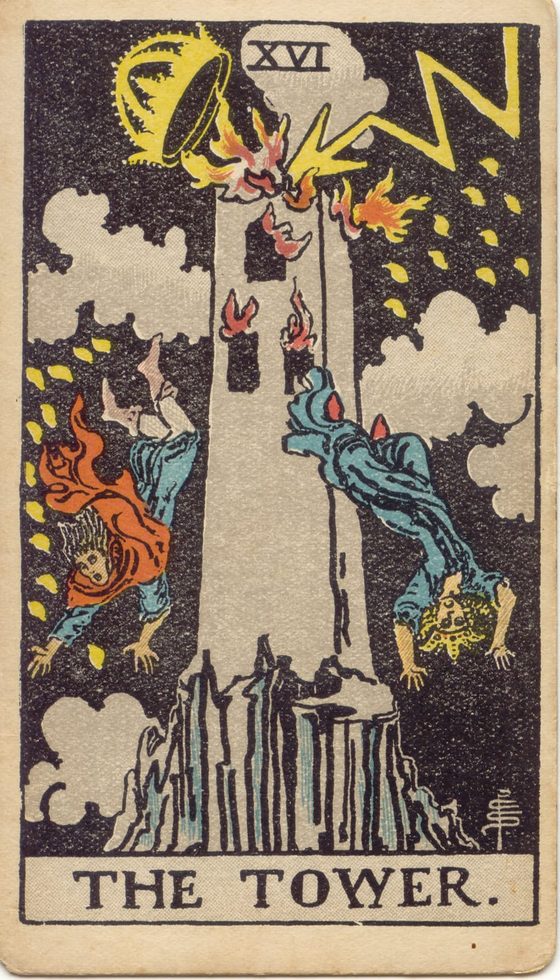
A lightning bolt striking a tower and knocking the crown off its top, with two figures falling. The Tower is the card of a structure coming apart faster than anyone can manage it, and of what was already wrong with it.
- sudden change
- collapse
- disruption
- revelation
- upheaval
- aftermath
- delayed collapse
- propping up
- recovery
- averted
What the card shows
A tall grey stone tower stands on a narrow rocky peak against a black sky. A bolt of lightning strikes its top from the upper right, and a golden crown has been knocked loose and hangs in the air above the roof. Flame pours out of three windows.
Two figures fall head-first from the tower, one to each side, arms out and legs apart. One of them wears a crown and the other does not. Both are dressed in bright colours against the dark ground. Twenty-two small flames shaped like commas fall through the air around them, arranged in two uneven groups. There is no vegetation, no path and no other building anywhere in the frame.
Upright meaning
The Tower describes a structure failing suddenly. Not a setback and not a difficult stretch: a specific thing that held weight has stopped holding it, and the failure is visible to everybody at once. The card is uncomfortable to draw and there is no honest way of softening it. The two figures are falling in the same direction and neither of them chose to.
What the picture also shows, and what most readings leave out, is that the tower stands on bare rock with no foundation drawn, and the crown was sitting loose on the top. Something was already wrong. The lightning is the moment, not the cause. In practice this card turns up for situations where the querent could say, if asked directly, roughly when they first knew.
It says nothing about what follows. No ground is drawn beneath the falling figures and there is no indication of how far they have to go, so a reader who promises a better structure afterwards has invented it. Beside Death it reads as an ending arriving all at once rather than gradually. Beside The Star, the card that follows it, it reads as a collapse already in the past.
Upright in love
In a relationship reading this is a sudden break, or a disclosure that changes everything at once: something said, something found out, a decision taken without warning by one person. The card describes the moment rather than the aftermath.
It is worth being careful here, because a querent asking about a relationship and drawing this card will hear a prediction whether or not one is offered. The honest reading is that the situation cannot continue in its present form, not that a particular event is scheduled. Where a couple has been holding something unspoken for a long time, the card is usually about the unspoken thing rather than about the couple.
Upright in work
A job lost, a company failing, a project cancelled outright, a reputation damaged in an afternoon. The Tower at work is the sudden version of all of those, and it is usually visible to the querent's colleagues some time before it is visible to them.
The useful part is what the picture says about foundations. Structures that fall this way are generally ones where the load-bearing element was a single person, a single client, an undocumented arrangement or an unexamined assumption. That is worth examining while the structure is still standing. Once the lightning is in the picture the card describes what to do next, and mostly what to do next is get clear of the falling masonry.
Upright in money
A sudden financial event: a cost that arrives all at once, an arrangement that collapses, income that stops rather than declines. The card describes discontinuity, which is a different thing from decline and calls for a different response.
It forecasts nothing and it is not advice about any decision. What it usefully raises is the question of concentration: what would break if one client, one job, one account or one person's goodwill went away tomorrow. Most people can answer that question in about a minute, and most people have never asked it.
Upright as feelings
A sudden change in how somebody feels, or a feeling that has just come out from under a long-held cover. It is shock rather than warmth or coldness. This position does not describe a settled state, and reading it as somebody's ongoing attitude is reading a moment as though it were a temperature.
Upright as advice
Get clear of the immediate damage before you think about anything else. Then, once you can, write down the thing you already knew was wrong and never acted on. The advice on this card is triage first and honesty second, and doing those two in the other order helps nobody.
Reversed meaning
Reversed, The Tower reads two ways, and the second is much harder to see.
The first is a collapse survived, or one that has already happened. The worst is past, the falling is finished, and what remains is clearing up. This is the reading most books give, and where the surrounding cards describe aftermath it is usually the right one.
The second is a collapse deferred. The structure is failing and is being propped up, sometimes at considerable expense, by somebody who cannot afford for it to come down. Nothing has fallen yet. Everything is worse than it was. This reading is unpopular because it offers nothing comforting, and it is common.
The spread decides, and so does the tense the querent uses. People describing a survived collapse talk about it in the past. People holding one up talk about the future, at length, and in conditionals. Waite gives the reversal as much the same as the upright, only in a lesser degree, which is not a great deal of help either way.
Reversed in love
A break that has already happened and is being recovered from, or a relationship where something is very obviously wrong and is being managed rather than addressed. The second is the more common and the harder to raise. Reversed, this card often describes a couple who both know what the conversation is and have an unspoken agreement not to have it, which is the same arrangement The Devil describes, without the chains drawn in.
Reversed in work
A crisis passed, a redundancy already survived, a failed project being cleared away. Or the reverse: an organisation everybody can see is failing, held together by a few people working unsustainably. The second version is one of the most accurate readings this card has, and it usually names a specific person who is carrying the structure and has not said so to anyone.
Reversed in money
A financial shock already absorbed, or one being postponed by borrowing against later. The card is not advice and forecasts nothing. Where it earns its place is in the distinction between a problem solved and a problem moved, which people are remarkably good at blurring in their own accounts of their own finances. Ask which of the two this is, plainly, and expect the answer to take a while.
Reversed as feelings
Somebody recovering from a shock and slowly returning to how they were, or somebody holding down a feeling that is going to come out eventually. Reversed, this position is about pressure rather than about the feeling itself, and pressure is exactly what makes it unreliable to read.
Reversed as advice
Stop propping it up. Whatever you are holding in place with your own effort, work out what happens when you let go, and choose the timing while the timing is still yours to choose. Reversed, the advice on this card is about controlling the manner of the fall, because the fall itself is not really the variable.
Symbolism in the 1909 image
The crown. Gold, knocked clear of the roof, hanging in the air. It was never part of the building. Waite reads it as a false structure being displaced; the plainer reading is that whatever sat on top was resting there rather than attached to anything.
The lightning. A single bolt from the upper right, drawn as a hard zigzag. It arrives from outside the frame and nothing in the picture accounts for it. That absence of cause is the honest part of the card and also the part that makes it so easy to misuse.
The two falling figures. One crowned, one not. They fall in the same posture at the same speed, which is the point: rank made no difference to the outcome. Neither is drawn as frightened, which is stranger than it first appears and is rarely commented on.
The twenty-two flames. Small comma-shaped marks, often read as the Hebrew letter yod, falling through the air in two uneven groups. Commentators count them and match the total to the twenty-two Major Arcana or to the Hebrew alphabet. The counts differ between printings, which ought to give the confident interpretations some pause.
The rock. The tower stands on a bare peak with no foundation drawn and no approach to it. It is a building nobody could reach and nothing supports, and the drawing says so before the lightning ever arrives.
Where this meaning came from
Like The Devil, this card is missing from the oldest surviving hand-painted Italian decks, so its earliest form cannot be recovered. In the printed decks that follow it goes by several names: La Maison Dieu, the House of God, in the Marseille pattern, and elsewhere the Tower, the Fire, the Thunderbolt, or the House of the Damned.
The imagery has more than one plausible ancestor: the Tower of Babel, the harrowing of hell, and the ordinary medieval fear of lightning striking a bell tower, which happened frequently and killed people. Whichever it began as, it was a picture in a card game rather than a prophecy. The divinatory layer arrives in eighteenth-century France with Antoine Court de Gebelin and Etteilla, and the Mars attribution comes from the Golden Dawn.
Waite in The Pictorial Key to the Tarot (1910) lists a run of meanings for it that do not agree with one another: ruin, misery, adversity, and also the destruction of a false intellectual structure. He declines to settle between them. That refusal is a large part of why the card carries such an unusually wide range of readings today.
The common misreading
The Tower gets read as catastrophe about to happen, often delivered with a certain amount of relish. That is the misuse that does the most damage, because a querent who believes a disaster is scheduled starts making decisions around it. Nothing in the card fixes a date, and it quite often describes a collapse that has already taken place. Compare Ten of Swords, which shows the aftermath and is a good deal easier to read honestly.
The second misreading is the correction applied too heavily: the card as necessary destruction, a clearing-out that had to happen to make room for something better. Sometimes that turns out to be true afterwards. It is not information, it is consolation, and offering it while somebody is still falling is a way of declining to sit with them. There is no rebuilding in the picture and no ground.
The third is treating the lightning as the whole story. The interesting material is the crown resting loose on the roof and the rock with nothing under it. Where this card is genuinely useful is in the question of what was structural and what was only assumed to be, and that question can be asked long before anything is on fire.
Questions to sit with
- What did you already know was wrong here, and when did you first know it?
- What in your situation is load-bearing, and does anybody else know that?
- What are you currently holding up with your own effort alone?
- If this came down tomorrow, what would you actually need in the first week?
Pull this card in a real spread.