- Card number
- 13
- Arcana
- Major Arcana
- Suit
- Major Arcana
- Element
- Water
- Rank
- Trump
- Roman numeral
- XIII
- Zodiac attribution
- Scorpio
- Yes or no reading
- No
Death
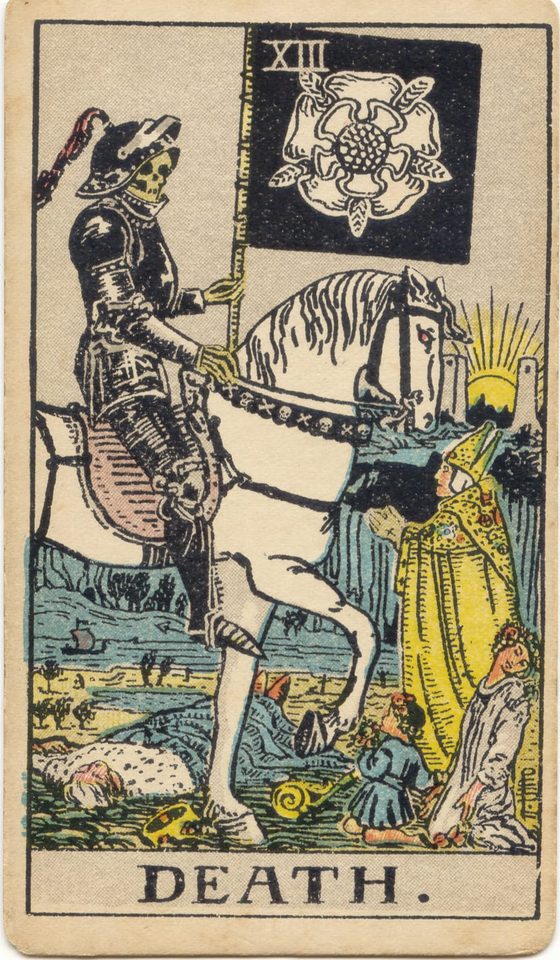
A skeleton in black armour on a pale horse, carrying a black banner with a white rose on it. Death is the card of an ending that has already happened, and of what it asks of the people still standing.
- endings
- transition
- letting go
- finality
- change
- resistance
- denial
- slow ending
- stagnation
- incompletion
What the card shows
A skeleton in black plate armour rides a pale horse across the foreground, visor raised and the skull plainly visible, a red plume on the helm. In one hand it carries a long staff flying a black banner, and on the banner is a white rose of five petals. The horse walks calmly, and its bridle is decorated with a row of small skulls and crossed bones.
Beneath the hooves lies a king, fallen, his crown on the ground beside him. Three living figures wait ahead of the horse: a bishop in a mitre standing with his hands pressed together, a woman kneeling with her head turned aside, and a child kneeling and looking up, holding flowers. Behind them a river runs back to the horizon with a small boat on it, and the sun stands between two towers on the far bank.
Upright meaning
Death is not a prediction of anybody's death, and no careful reader treats it as one. What it describes is an ending that has already taken place, or is taking place now, whether or not the people in the situation have agreed to it. The card is unusual in the deck for being in the past tense. The king is already down when the picture opens.
Upright, it generally marks something the querent has stopped being able to keep: a role, a relationship, a version of themselves, an arrangement that worked once and does not now. The three living figures are the useful part. The child looks up, the woman looks away, and the bishop stands and meets it. Those are the available responses, and most people recognise their own.
The card is direct without being cruel. It does not say the ending is deserved, and it does not promise that what follows is better. It says the shape of the situation has changed and will not change back. Beside The Tower it reads as a collapse still in progress. Beside Temperance, the card immediately after it, it reads as an ending being worked through rather than resisted.
Upright in love
In a relationship reading Death is the honest card and the unwelcome one. Something in the relationship has ended, which is not necessarily the relationship. Couples end phases all the time: a way of talking, an assumption about what was coming, a role one person had quietly stopped wanting.
Where the querent is asking whether a partner will come back, the card is not answering that question. It is saying that the version of things they are hoping to return to is no longer available, and that anything future would be a different arrangement with the same person. That is a harder answer than yes or no, and it is the one the picture actually supports.
Upright in work
A role ending, an industry changing underneath somebody, a project killed, a skill that no longer buys what it used to. The card describes the situation rather than warning about it, and by the time it turns up the change is usually visible to everybody except the person inside it.
The practical reading is about what carries over. Some of what the querent does still transfers and some of it does not, and separating the two is the actual work. A reading that treats this as pure loss misses what the picture shows, which is a procession still moving with living people in it. Compare Eight of Cups, where the leaving is chosen. Here it is not.
Upright in money
An income stream ending, a financial arrangement closing, a cost that cannot be carried any longer. Death describes the closing of the account rather than the size of it, and says nothing at all about what replaces it.
This is not financial advice and cannot be turned into any. The useful question it raises is whether the querent is still paying for something that has already finished: a subscription to a life they no longer live, in the broad sense as much as the literal one. That question is answerable, and it is worth more than a forecast.
Upright as feelings
Someone who has finished feeling what they used to feel about you. That is not the same as feeling nothing. It can be grief, or relief, or a settled affection with the old charge gone out of it. What the card is clear about is that the previous state is not coming back.
Upright as advice
Name the thing that has ended and say it out loud to one other person. Then stop maintaining it. The advice on this card is not to grieve harder or faster but to stop paying upkeep on a situation that is finished, and to find out what is actually left.
Reversed meaning
Reversed, Death reads two ways that the picture will not choose between.
The first is an ending resisted. The change has happened and the querent is holding the shape of the old thing in place at considerable cost. Rooms kept as they were, arrangements maintained for people who have gone, a job description nobody has performed in a year. This is the reading most books lead with, and it is often right.
The second is an ending that will not complete. Something is dragging: a separation three years in, a business winding down in slow motion, a departure announced and then not made. Here the querent is not resisting anything. They are stuck inside a process that has stalled on its own.
Which one applies is decided by where the delay is coming from, the querent or the situation. Ask that plainly, because the two need opposite responses. Waite treats the reversal as inertia and lethargy, which covers both without distinguishing them, and the distinction is the part that helps.
Reversed in love
A relationship in a long ending that neither person will finish, or somebody maintaining a connection that stopped some time ago because ending it formally feels like a larger act than living inside it. Reversed, this card often describes two people being kind to each other in a situation neither of them wants. That is a real thing rather than a failure of character. It is also expensive, and the cost is usually not shared evenly.
Reversed in work
A restructure that never finishes, a role wound down over months, a company that has effectively ended and is still holding meetings. Or the querent refusing a change everyone else has already accepted. The reversal is frequently about institutional slowness rather than personal denial, and it is worth checking which before advising anybody to let go of anything. The two call for very different responses, and only one of them is about the querent at all.
Reversed in money
Costs continuing past the thing they paid for. A lease on a closed office, obligations left over from an arrangement that ended, money still going out on a plan nobody is following. The reversal is unusually literal here and unusually useful: the honest question is what the querent is still paying for that has already finished. It is not advice about what to do instead.
Reversed as feelings
Feelings that have ended and are still being performed, or feelings that are ending very slowly and have not yet been admitted to. Reversed, this position often describes somebody waiting to feel differently before they act, when in practice the acting comes first and the feeling follows it.
Reversed as advice
Finish it. Whatever has been half-ended for months, complete the ending this week: the conversation, the cancellation, the formal notice. Reversed, the advice on this card is administrative rather than emotional, and the emotional part tends to follow the administrative one rather than lead it.
Symbolism in the 1909 image
The white rose on the black banner. Five petals, drawn plainly. Waite calls it the Mystic Rose and ties it to life. Pairing a white flower with a black flag is the whole argument of the card compressed into a single object.
The armour. Black plate, complete, with the visor raised. Armour is worn against something, and a skeleton has nothing left to protect, which makes it either a joke or a statement that the ending is impersonal. It is dressed for a job, not for a grudge.
The fallen king. Crown off, body under the hooves, already dead when the card opens. He is the figure who did not get to respond, and his presence is what makes the other three matter. Rank did not help him.
The bishop, the woman and the child. Three living reactions: address it, look away, look up. The child is drawn nearest the horse and is not frightened. Books read that as innocence, though it reads at least as easily as inexperience, and the drawing does not settle which.
The sun between two towers. On the far bank, and the picture does not say whether it is rising or setting. Commentators state confidently that it rises. Smith left the sky ambiguous, and the ambiguity is more honest than the confidence.
Where this meaning came from
The thirteenth trump was often left unnamed in early Italian decks. The title space at the bottom of the card was simply blank, and players called it what they liked. That is where the superstition about not naming it comes from, rather than from any older tradition. The blank was a printing convention, not an omen.
The image is not a tarot invention either. Death mounted, riding down the ranks of society without regard to status, is standard late-medieval European iconography, closest to the danse macabre cycles that spread after the plague years. Pope, king, labourer and child appear in those for the same reason they appear here: to say that rank makes no difference to the outcome.
The divinatory layer arrives in eighteenth-century France with Antoine Court de Gebelin and Etteilla, and the Scorpio attribution comes from the Golden Dawn. Waite's 1910 commentary in The Pictorial Key to the Tarot is notably evasive on this card: he spends most of it insisting the card does not mean physical death, offers transformation instead, and supplies very little detail. Most modern readings of Death are a restatement of that one evasion. Smith's drawing keeps the medieval procession intact and lets it say what it always said.
The common misreading
The obvious misreading is that Death predicts a death. It does not, and a reader who lets a querent go on believing it might has done real harm for the sake of atmosphere. There is no version of this card that is a medical statement. If somebody is frightened about a person's health, the answer is not in a deck of cards.
The correction is then overdone in the other direction. Modern readings sand the card down to transformation and new beginnings until it means very little at all. That is not honest either. Something has ended, the ending is not optional, and telling a querent it is really about growth is a way of skipping the part of the reading that would have been useful. The king is dead in the picture. Waite did not draw a metaphor for redecorating.
The third misreading is timing. Death gets read as an ending about to happen, when it far more often describes one that already has. Ask what has already gone. The querent usually knows and has not said it out loud, and the moment they do say it, the rest of the spread stops being mysterious.
Questions to sit with
- What has already ended here that you have not said out loud?
- What are you still maintaining for a situation that is finished?
- Of the three living figures in the picture, which one is you right now?
- What part of this actually carries over into whatever comes next?
Pull this card in a real spread.