- Card number
- 8
- Arcana
- Minor Arcana
- Suit
- Cups
- Element
- Water
- Rank
- Eight
- Yes or no reading
- No
Eight of Cups
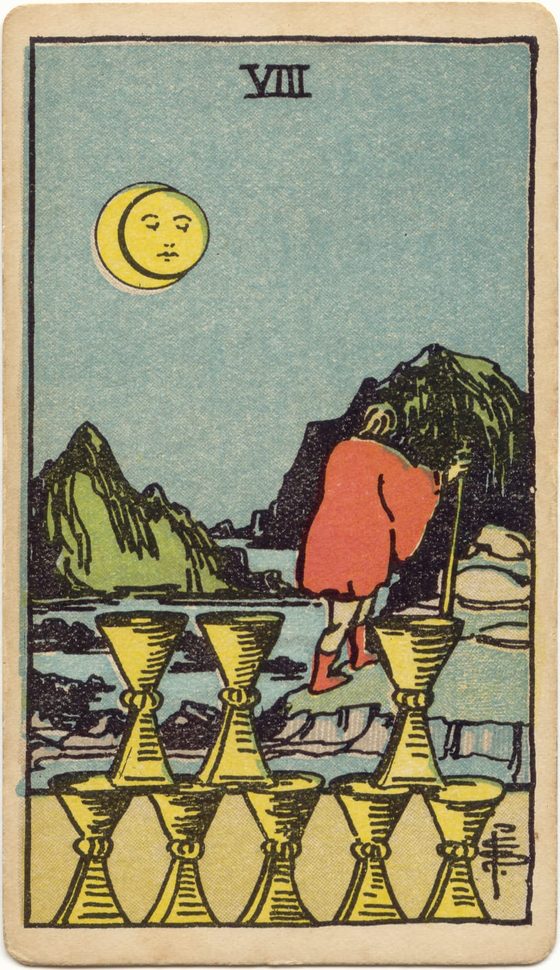
A figure walks away from eight stacked cups into rocky country under a strange moon. The Eight of Cups is the card of leaving something that still works, before anyone else agrees it should be left.
- walking away
- withdrawal
- disillusion
- searching
- moving on
- returning
- stalling
- avoidance
- drifting
- second chance
What the card shows
Eight golden cups stand in the foreground on a strip of pale ground beside water: five in a front row, three stacked behind, with an obvious gap in the upper row where another would sit. Nothing has been knocked over. The cups are upright and undamaged, and the ground between them and the path is empty.
A figure in a red cloak and red boots walks away from them, seen from behind, leaning on a long staff. The path leads up between grey rocks toward mountains. In the sky a crescent moon lies against a larger disc, and a face is drawn into it, looking down at the figure. The water in the foreground is still and shallow.
Upright meaning
The Eight of Cups describes a departure from something that is not broken. The cups are intact and stacked. Nobody has thrown anything. What has gone is the reason for staying, and the figure has noticed that before anyone else would have.
Waite is unusually candid about this card. He describes a man of dejected aspect deserting the cups of his felicity, and then admits that the older readings are entirely antithetical, giving joy, mildness, honour and modesty. His working compromise is that the card marks the decline of a matter, or a matter thought important turning out to be of slight consequence. That is stranger and more useful than the modern shorthand of walking away.
In practice it usually marks the period before an exit is announced, when nothing visible to other people has changed yet. Beside the Seven of Cups it reads as a decision finally made after long circling; beside The Hermit it reads as withdrawal chosen rather than forced. The card describes the leaving. It says nothing at all about what is at the top of the path.
Upright in love
In a relationship reading the Eight of Cups is the card of the person who has already left internally. The relationship may be working. That is the difficulty: there is often nothing to point at, no incident, no fault worth naming, only the fact that somebody has stopped investing.
It can also describe leaving a pattern rather than a person, such as a way of arguing, a role inside a family, a habit of settling. Where the question is about somebody else's intentions, this card describes a movement away, and it is honest to add that it cannot tell you whether that movement is toward anything in particular.
Upright in work
At work, the Eight of Cups is the resignation before the resignation letter. Someone has stopped caring about the outcome of things they used to argue about. The role may still be good on paper, which is exactly what makes it hard to explain to anyone, including yourself.
It can also mark abandoning a project that is succeeding modestly, because succeeding modestly is no longer worth the hours. That is a defensible decision and the card neither endorses nor warns against it. What the card does say is that the calculation was already made, quietly, some time before the reading.
Upright in money
In money questions the Eight of Cups marks walking away from something that still has value: a stake, a side business, an arrangement that pays but costs more than it pays. The eight cups are not empty. That is the point of the picture.
The card describes the decision to stop rather than whether stopping is correct, and it has nothing to say about numbers. If a sum is involved and the sum matters, a card is not where that gets settled. This is a description of how somebody has come to feel about a thing they own.
Upright as feelings
As someone's feelings, the Eight of Cups is disengagement rather than anger. Attention has moved elsewhere and has not been called back. There may still be fondness in it, since leaving is not the same as disliking. What has gone is the sense that staying is worth the effort, and that is usually the last thing to go.
Upright as advice
Say out loud, to one person who is not involved, the thing you have decided but have not admitted. Naming it is the whole action; the leaving follows or it does not. Do not build the case for it first. A decision that needs a case is usually not this card.
Reversed meaning
Reversed, the Eight of Cups pulls in two directions and both are common.
The first is the return: someone who left and is coming back, or someone stalled at the edge of leaving who does not go. Waite's own reversed reading is stranger and worth knowing, because he gives it as great joy, happiness, feasting. Read that way the reversal is not a failure to leave but the discovery that what looked like the end of something was not. It sits oddly close to the Nine of Cups, the card of getting what was asked for.
The second is the stall itself, and it is bleaker. The reasons for going are all still true and the person stays anyway, more often from tiredness than from doubt. In a spread this shows up as a situation described in the past tense by someone still living in it.
The picture cannot choose between them. The question and the surrounding cards can. If the spread describes relief and company, take Waite's version. If it describes weight, take the stall.
Reversed in love
Reversed in love, either a return, with a person coming back or a decision to stay that is genuinely made rather than defaulted into, or the reverse: staying in place long after the reasons for staying have run out. The first can be real. The second is usually described by the person inside it as giving things another chance, which sometimes it is. Look at whether anything in the spread has actually changed, or only the intention.
Reversed in work
At work, either an exit reversed, with a counter-offer taken or a project resumed and sometimes with real appetite, or a departure endlessly postponed. The second is more common in readings than the first, and from outside it looks like competence, because the work still gets done. Waite's reversed reading of joy and feasting fits the first case surprisingly well, and it is worth testing before assuming the gloomier one.
Reversed in money
Reversed, either a stake picked back up or a loss-making arrangement kept out of inertia. The reversal often marks the sunk cost showing its face: money already spent being used as the argument for spending more. Naming what has already gone, and treating it as gone, is the only part of this a card can usefully point at. What to do next is not something a tarot card can price.
Reversed as feelings
Either renewed engagement, with attention returning to something it had left, or the appearance of engagement without the substance: present, agreeable, and no longer really there. The two look identical for a while. The difference shows in what a person volunteers rather than in what they answer.
Reversed as advice
If you came back, say what would have to be different, in specific terms, and say it to the person who can change it. If you did not leave and still intend to, set a date. A departure with no date is a mood, and moods can run for years.
Symbolism in the 1909 image
The gap in the stack. Eight cups arranged five and three, with a clear space in the upper row. Read almost universally as the missing ninth, the thing that was never there. Nothing in the drawing confirms that. The space is simply left, and every meaning attached to it has been supplied by readers rather than by Smith.
The red cloak and boots. The only strong colour in a grey landscape. Red is the pigment Smith reserves for will and action across the deck. This figure is not drifting away. The clothes say the leaving is deliberate.
The moon. A crescent set against a full disc, with a face drawn into it. Books call it an eclipse, or the moon shown in two phases at once. It is the one element in the card that is watching, and the expression Smith gave it is genuinely hard to name.
The staff. A walking stick, not a weapon. It marks the journey as long and on foot. It also occupies the hands, which is one reason the figure carries nothing else away.
The water. Shallow and still, running along the foreground where the cups stand. The figure climbs away from water into dry rock, and in a suit governed by water that is worth a moment.
Where this meaning came from
The Eight of Cups has no ancestry as a picture. In the fifteenth-century Italian decks the minor cards were pips: eight cups, drawn as eight cups, with nothing happening between them. Whatever meaning the card had came from the game, and the game did not need one.
Meanings were attached later, in eighteenth-century France, when Etteilla and those who followed him gave every card a divinatory sentence. That tradition handed the eight of cups a set of readings, including joy, mildness, timidity, honour and modesty, which have almost nothing to do with how the card is read now.
Waite knew this and said so. In The Pictorial Key to the Tarot (1910) he describes Smith's new scene, a man of dejected aspect deserting the cups of his felicity, and immediately notes that the older readings are entirely antithetical to it. His compromise is that the card shows the decline of a matter, or a matter thought important turning out to be of slight consequence. The modern meaning is therefore about a century old, and it rests on Smith's drawing rather than on any tradition standing behind it.
The common misreading
The Eight of Cups is most often read as proof that leaving is the right choice. The picture does not carry that information. It shows a departure and a landscape. It does not show what is at the top of the path, because Smith drew nothing up there.
The second misreading is treating the eight cups as failures. They are upright, full and undamaged. The card is not about something that went wrong. It is about outgrowing something that went perfectly well, which is far harder to explain to other people, and it is why this card is drawn so often by people who cannot account for themselves.
The third is dismissing Waite's own note. He said the older meanings for this card were the opposite of Smith's picture, and that in practice it usually marks a matter turning out to be of slight consequence. That reading is less dramatic than walking away from your life and it fits many more spreads. Where the Six of Cups is a past that keeps its hold, the Eight is a present quietly losing its.
Questions to sit with
- What has actually changed here, and when did you first notice it?
- If nothing at the top of the path turned out to be better, would you still go?
- Who would you have to disappoint, and what have you already decided about that?
- Is there anything anyone could do that would make staying worth it?
Pull this card in a real spread.