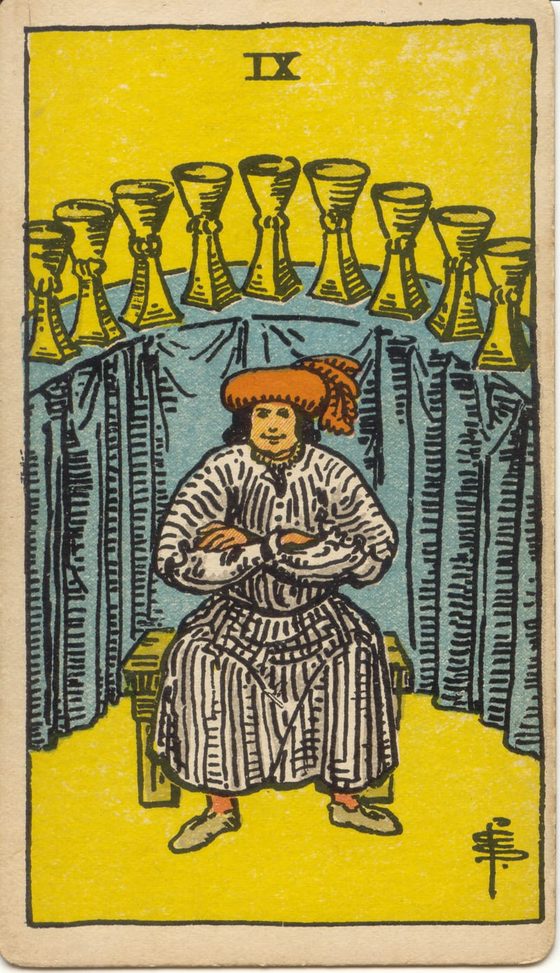
- Card number
- 9
- Arcana
- Minor Arcana
- Suit
- Cups
- Element
- Water
- Rank
- Nine
- Yes or no reading
- Yes
Nine of Cups
A well-fed man sits with his arms folded in front of nine cups arranged on a draped counter. The Nine of Cups is satisfaction of a specific and material kind, and it is not the wish card.
- contentment
- satisfaction
- comfort
- sufficiency
- enjoyment
- complacency
- overindulgence
- hollow win
- smugness
- loyalty
What the card shows
A broad man sits on a low wooden bench in the centre of the card, facing out, arms folded across his chest. He wears a white tunic, red hose and a tall red cap. His feet are planted apart and his expression is pleased and closed.
Behind him a counter curves in an arch, covered to the floor in blue cloth. Nine golden cups stand along the top of it in a single row, evenly spaced and identical. He is not looking at them, and nothing on the counter appears to have been used. The background is flat yellow with no landscape, no window and no second figure. The bench sits far enough forward that his back does not reach the cups.
Upright meaning
The Nine of Cups describes satisfaction that has already arrived. Waite calls the figure a goodly personage who has feasted to his heart's content, and then adds a sentence most books drop: the picture offers the material side only. The card is about having enough, and specifically about the kind of enough you can point at.
Upright it usually marks a situation that is genuinely good and that the querent is entitled to enjoy. There is nothing false in it. The cups are real, the room is warm, the man is comfortable and knows it. In a spread full of striving this is the pause where the striving paid, without the openness The Sun brings to the same brightness. Contentment is a legitimate reading, and a reader who cannot deliver one is not being rigorous, only gloomy.
What the card does not describe is anybody else. There is one person in the picture and no relationship in it at all. That is its honest limit, and it is why the card reads differently beside the crowded Ten of Cups than beside the Four of Cups, where the same seated posture has curdled into boredom.
Upright in love
In a relationship reading the Nine of Cups usually describes contentment rather than romance. Things are comfortable, needs are being met, and nobody is asking for more this week. That is a real state and an underrated one.
The card's limitation shows here more than anywhere. The figure sits alone and the satisfaction drawn is his own. Where the question is about two people, this card describes how one of them is doing. It is entirely possible for one person in a relationship to draw the Nine of Cups honestly while the other would draw something else, and a reading that ignores that is reading half the table.
Upright in work
At work the Nine of Cups is the card of the thing having worked. A role that fits, a project delivered, a stretch where effort and reward are roughly in proportion. It often turns up after a long run of a harder suit.
The caution is mild and worth stating anyway. The man in the picture has his back to the cups and his arms folded. Comfort at work can quietly become the reason nothing changes for several years, and the card cannot tell you whether you are resting or settling. Look at whether the surrounding cards describe movement or a closed room.
Upright in money
In money questions the Nine of Cups reads as sufficiency. Bills covered, some margin, no immediate pressure. It is one of the plainer cards in the deck on this subject and it does not promise more than it says.
Waite's note that the picture offers the material side only matters here. This card is comfortable with money in a way the rest of the suit is not, and it is the one place in Cups where a straightforwardly material reading is the correct one. It still describes a position rather than a forecast, and none of it is guidance about what to do with anything.
Upright as feelings
As someone's feelings, the Nine of Cups is contentment with how things currently stand. Warm, settled, not seeking. It is a comfortable card and not a hungry one, so it rarely describes longing. Somebody feeling this way is unlikely to be the person who initiates change, which is information, though it is not the information most people want from the question.
Upright as advice
Let something be finished. Take the thing you have been treating as provisional and say, out loud or in writing, that it is done and that it worked. Then spend one evening on it with nothing else attached, and notice whether that turns out to be easy for you.
Reversed meaning
Reversed, the Nine of Cups splits, and the two versions sit unusually far apart.
The common modern reading is satisfaction that does not satisfy. The thing was got and turned out to be smaller than the wanting. Contentment overshoots into complacency, or into consumption: the figure keeps eating past the point of pleasure.
The other is Waite's, and it is barely related to the first. He gives the reversed Nine as truth, loyalty and liberty, then admits the readings vary and include mistakes and imperfections. That first list has no obvious connection to Smith's picture, and it is honest to say this reversal has never been stable in the tradition.
Which applies depends on the question. If the spread is about getting something, the modern reading fits. If it is about how a person has behaved, Waite's loyalty reading is not a stretch. A reader who insists there is only one reversed meaning here has not read the source.
Reversed in love
Reversed in love, either comfort that has quietly become complacency, with two people no longer doing anything for each other because nothing appears to be wrong, or the older reading of loyalty and plain truth, which is a different card entirely. The first is common in long relationships and difficult to raise without sounding ungrateful. The second is worth considering where the question is about somebody's constancy rather than their happiness.
Reversed in work
At work, either satisfaction flattened into coasting, where the role stopped being demanding some time ago and nobody has mentioned it, or an achievement that did not feel like one when it arrived. The reversal often marks the gap between how something looks on a record and how it feels on a Tuesday. Look at whether the spread is describing the work or the person doing it.
Reversed in money
Reversed, either comfort spent down, with an easy position being consumed rather than held, or the discovery that a target reached changes less than expected. Both are common and neither is a warning about any particular sum. The card is describing the relationship between having and wanting, which is a psychological matter rather than a financial one, and none of it is advice about money.
Reversed as feelings
Either contentment gone slack, so that a person is comfortable enough not to notice you, or, on the older reading, straightforward loyalty without much display. Those are very different and the card does not distinguish them. What they share is an absence of urgency; the rest of the spread has to do the separating.
Reversed as advice
Ask what you would want if you already had the thing you are working toward, and answer in one sentence. If the answer is nothing, that is worth knowing now rather than afterwards. If it is something specific, consider starting on that instead.
Symbolism in the 1909 image
The folded arms. The figure's arms are crossed over his chest. Read universally as satisfaction. It is also the standard drawing convention for a closed posture, and Smith used crossed arms elsewhere in the deck for figures who are not open to anything.
The blue cloth. The counter is draped to the floor in blue, so nothing beneath it can be seen. The cups stand on a surface with a hidden interior. No standard reading makes anything of that, which is itself worth noticing.
The nine cups. Identical, evenly spaced, in one unbroken row behind the figure's head. They are arranged for display rather than for drinking. He is not looking at them and cannot reach them from where he sits.
The empty background. Flat yellow, no horizon, no window, no second person. Almost every other card in the suit has a landscape. This one has a room containing a man and his supply and nothing else.
The red cap. Tall and bright, the strongest colour on the figure. Red carries will and appetite across Smith's deck, which sits slightly against reading this card as restful.
Where this meaning came from
As a pip card the nine of cups meant nothing for three hundred years. Fifteenth-century Italian decks drew nine cups and no scene; the card's job was to win a trick.
Divinatory readings arrived with the eighteenth-century French occult writers, Etteilla foremost among them, who supplied a meaning for every card in the pack. For this one the lists tended toward concord and material success, which is close to where the card sits today.
Smith's 1909 drawing gave that meaning a body: a man, a bench, and nine cups arranged behind him. Waite's commentary in The Pictorial Key to the Tarot (1910) reads it as concord, contentment and physical wellbeing, with the significant caveat that the picture offers the material side only. His reversed list is truth, loyalty and liberty, and he notes immediately that the readings vary.
The best-known modern label for this card, the wish card, appears in none of that. It is a twentieth-century addition spread by popular manuals, and it has no support in Waite, in Smith's drawing, or in the older French lists.
The common misreading
The Nine of Cups is widely taught as the wish card: draw it and what you asked for is granted. That claim is not in Waite, not in Smith's picture and not in the eighteenth-century lists. It is a twentieth-century invention repeated long enough to sound traditional. The card describes a person who is satisfied. It does not describe a wish being granted and it certainly does not predict one. Where the Seven of Cups is wanting several things at a distance, the Nine is having one of them already.
The second misreading is inflating what kind of satisfaction is on offer. Waite wrote that the picture offers the material side only, and he meant it as a limit. Read as emotional fulfilment, or as a relationship, or as peace, the card is being asked to carry something it was not drawn to hold.
The third is the mirror of the first: readers suspicious of a pleasant card who insist the contentment must be hollow. Sometimes it is. Often the situation is simply good, and declining to say so is not rigour.
Questions to sit with
- What have you got that you have not yet let yourself count?
- Is this comfort you are resting in, or comfort you are hiding in?
- Who else is in this situation, and would they describe it the way you just did?
- If nothing improved from here, what would you want to change first?
Pull this card in a real spread.