- Card number
- 4
- Arcana
- Minor Arcana
- Suit
- Cups
- Element
- Water
- Rank
- Four
- Yes or no reading
- No
Four of Cups
A hand holding out a cup to someone who is not looking. The Four of Cups is the card of an offer arriving during a period of disinterest, and it takes no position on whether the offer is any good.
- apathy
- withdrawal
- boredom
- contemplation
- disinterest
- renewal
- awareness
- acceptance
- stagnation
- retreat
What the card shows
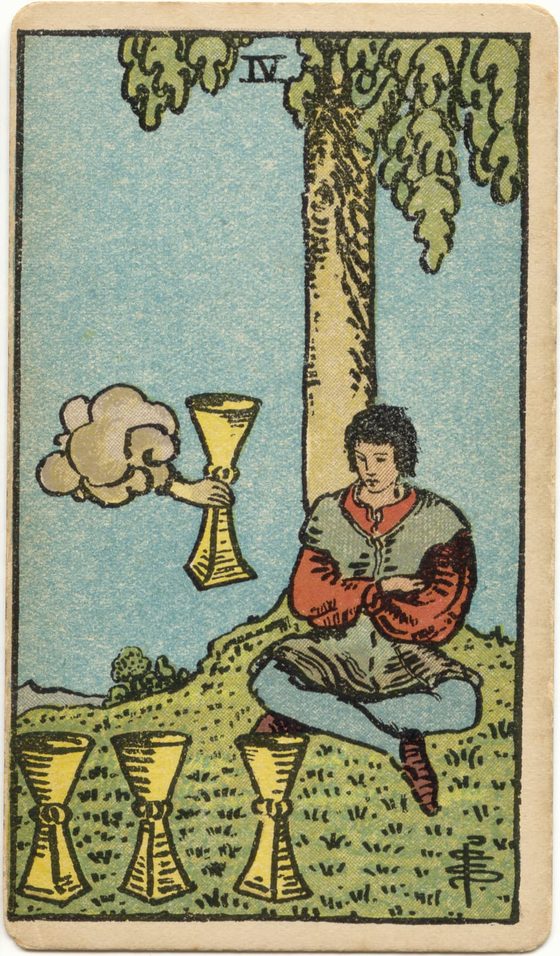
A young man sits on the grass at the foot of a tree with his back against the trunk. His arms are folded across his chest and his legs are crossed at the ankle. His head is tilted down and to the left. He wears a green tunic with red showing at the sleeves, dark hose and reddish shoes.
Three golden cups stand in a row on the grass below him, upright and evenly spaced. On the left, a hand comes out of a small grey cloud holding a fourth cup, level with his face and about an arm's length away. He is not looking at it. The tree above has a slender trunk and drooping foliage; a small shrub grows on the slope. The sky is plain blue and the numeral IV sits at the top.
Upright meaning
The Four of Cups is the card of the offer that arrives at the wrong moment. A hand is extended, a fourth cup is on it, and the person it is meant for has his arms folded. Nothing in the picture is hostile. He is simply not interested, and the card is about that state rather than about the cup.
The usual reading is apathy, and it is worth being more precise. This is not depression and it is not sulking. It is the specific dullness that follows having enough: three cups already, none of them wrong, and no appetite for a fourth. Contentment and boredom look identical from outside and the card does not separate them. Where Eight of Cups is the decision to walk away, this is the stage before anybody has decided anything.
What the card refuses to say is whether he should take it. Waite's own gloss is weariness and disgust, and later readers softened it into missed opportunity, which is a heavier accusation than the picture makes. Neighbours decide: beside Ace of Cups, which shows the same offering hand, it reads as something genuinely being turned down; beside The Hermit it reads as a withdrawal that is doing its job.
Upright in love
In a relationship reading this is the card of the partner who has gone quiet inside something that is basically fine. Nothing is wrong and nothing is happening. The affection is intact and the attention has drifted somewhere else.
It also covers being offered something and not wanting it: an approach you did not ask for, an ex who has reappeared, a relationship that would work on paper and does not move you. That is a legitimate answer, and the card does not treat it as a failure. What it does flag is that a decision is being made by not deciding, and the person holding the cup can see you.
Upright in work
At work this is the card of competence without appetite. The job is fine, the work gets done, and something has gone out of it. It is one of the most common cards to draw in the third or fourth year of a role.
It also marks the offer already on the table: the internal move, the project nobody has said yes to, the conversation someone started with you and you have not replied to. The card does not say the offer is good. It says you have not looked at it, and that not looking has been going on longer than you would say if asked.
Upright in money
Money that is adequate and has stopped being interesting. Three cups is not poverty. The Four of Cups rarely describes a shortage; it describes the flatness of a position that is stable and going nowhere in particular.
Where it points at anything actionable, it is at the thing you have not opened: the letter, the account statement, the offer left unread. That avoidance is usually mild and it is usually about not wanting to think rather than about bad news. Open it. The card cannot tell you what is in it, and nor can this page.
Upright as feelings
As feelings, this is interest that has flattened out. Not dislike, not anger: the person still holds you in regard and has stopped being moved by it. It is one of the more painful positions to read honestly, because the temptation is to upgrade it into something with more feeling in it than the card contains.
Upright as advice
Look at the fourth cup before you decide anything about it. You are allowed to refuse it; you are not currently refusing it, you are ignoring it, and those are different. Name the offer out loud this week, then give it a yes or a no.
Reversed meaning
Reversed, the Four of Cups is read two ways that point in opposite directions, and most books only give one. The first is the head coming up: the withdrawal ending, appetite returning, the person finally noticing what has been held out to them. Waite reads the reversal as novelty and new instruction, and this is the line he takes.
The second is the withdrawal deepening. What was a mood has become a habit, the arms have been folded long enough that folding them is now the position, and nothing is being offered any more because people stopped offering. This is the harder reading and it is common.
The two are told apart by what surrounds the card. Cards of movement, arrival or new information argue for the first; cards of stasis, isolation or exhaustion argue for the second. There is a plainer possibility worth keeping in view: sometimes the reversal simply marks that the offer has been withdrawn, and the question of whether to take it is no longer live.
Reversed in love
Either interest coming back after a flat stretch, or a flat stretch that has quietly become the shape of the relationship. Both are the same card and the difference is measured in months rather than in feeling.
The reversal is also where the offer expires. If the reading concerns somebody who was waiting for an answer, the honest possibility is that they have stopped waiting. That is not a punishment and it is not a message from anywhere; it is what happens when a hand is held out for long enough.
Reversed in work
Engagement returning, or disengagement becoming permanent. In the first, something in the work has become interesting again and it is worth noticing what did it. In the second, the person has already left and the paperwork has not caught up.
The reversal also covers the offer that has gone. If there was an internal move, a role, a conversation left open, this card raises the possibility that it has been given to somebody else. Check rather than assume; that is a factual question with a findable answer.
Reversed in money
Either attention returning to something you had let drift, or drift that has now cost something measurable. The reversed Four of Cups is the card of the unopened envelope in both directions.
There is a specific version worth naming: an arrangement left on autopilot past the point where it suited you. Subscriptions, a rate that reset, an account doing nothing. None of it is dramatic, all of it is boring, and boredom is exactly what the card is about. The fix is administrative and it is not going to be interesting.
Reversed as feelings
Either feeling starting to move again, or feeling that has settled into flatness and stopped being examined. From outside both look like distance. The card describes attention rather than affection, and someone can hold you in genuine regard while giving you almost none of it in practice.
Reversed as advice
Find out which way this is running by doing one small thing you used to enjoy and watching whether it registers. If it does, the head is coming up and you can trust it. If it does not, stop trying to feel differently and change something structural instead: the room, the routine, the hours.
Symbolism in the 1909 image
The folded arms and crossed legs. Both closed, both deliberate. This is the only figure in the suit drawn entirely shut, and everything the card is usually read to mean comes from that posture rather than from anything else in the frame.
The fourth cup and the hand. The same device as the Ace of Cups: a hand from a cloud, offering. Smith reused it exactly, which invites the comparison. In the Ace nobody has refused the cup yet. Here somebody is not looking at it, which is not the same as refusing it.
The three cups on the ground. Upright, evenly spaced, none of them spilled or empty. Whatever he already has is intact. The card is not about loss, which is Five of Cups, and readers who treat it as though it were have not looked at the row.
The tree. He is sitting under it with his back against the trunk, sheltered. Read as retreat and as contemplation. Waite's own text calls the figure's attitude one of discontent with his environment, which is a stranger reading than the picture suggests.
The direction of the gaze. He is looking down and to the left, at the three, not up at the fourth. Smith drew the offered cup at eye level. Whether he cannot see it or is choosing not to is left open, and the whole difficulty of the card sits in that gap.
Where this meaning came from
As a playing card the Four of Cups was four cups on a plain field, and it stayed that way for four centuries. The Italian decks it came from were for games; the number told you what beat what and nothing else.
Divinatory meanings arrive with the eighteenth-century French writers, Court de Gebelin first with his invented Egyptian genealogy and then Etteilla with the first published list of card meanings. The Golden Dawn, a century later, gave this card the title Lord of Blended Pleasure, which is a better description of it than most modern keywords manage.
The scene is Smith's, drawn in 1909. No previous deck put a figure under a tree here or added a hand from a cloud. Waite's entry in The Pictorial Key to the Tarot the following year describes weariness, disgust and a mingled sense of satiety, and notes that the figure is being offered something and does not see it. The modern reading of missed opportunity is a hardening of that, and it carries a judgement Waite did not make.
Smith drew all seventy-eight cards for a flat fee and signed them with a monogram in the corner.
The common misreading
The most common misreading of the Four of Cups is as a scolding. Missed opportunity is the phrase, and it turns a picture of somebody sitting under a tree into a failure of character. The card does not say the fourth cup is worth having. It says a cup is being offered and is not being looked at, and those are different claims.
The second misreading runs the other way: treating the folded arms as depression. That reading gets applied quickly in readings about someone's state of mind, and it is a diagnosis being made from a drawing. What the picture supports is disinterest. Whether there is something underneath it is not something a card can establish, and it is not something a reader should assert.
The third is the assumption that the three cups are the problem. They are drawn upright and intact. A great deal of modern commentary treats the card as being about ingratitude, which requires reading a moral into a posture. The more honest version is that the querent has enough and has stopped being moved by it, and that is a description, not a fault.
Questions to sit with
- What is currently being offered to you that you have not looked at properly?
- Is this boredom about the situation, or has it come with you from the last one?
- What did you want when you asked for the three things you already have?
- If you said no clearly today, what would change?
Pull this card in a real spread.