- Card number
- 9
- Arcana
- Major Arcana
- Suit
- Major Arcana
- Element
- Earth
- Rank
- Trump
- Roman numeral
- IX
- Zodiac attribution
- Virgo
- Yes or no reading
- It depends
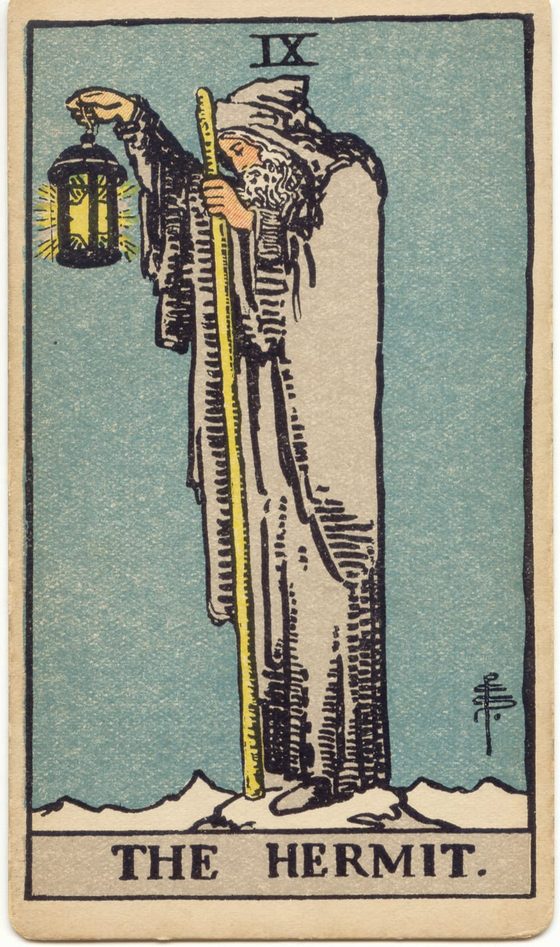
The Hermit
An old man on a bare summit, holding up a lamp with a star inside it. The Hermit is the card of deliberate withdrawal, not loneliness but the decision to stop taking counsel from the crowd.
- solitude
- introspection
- searching
- inner guidance
- deliberate pace
- isolation
- loneliness
- refusing help
- avoidance
- aimless retreat
What the card shows
A bearded man in a long grey hooded robe stands on a bare snow-covered summit, facing left, head bowed. His right arm is raised and held out from the body, carrying a lantern at about the height of his own head; inside the glass is a six-pointed star. His left hand grips a tall yellow staff at chest height, which runs from the ground to about the level of his brow.
The ground under him is snow and bare rock, drawn with no vegetation and no path. Behind him the sky is a flat pale blue wash, with no sun and no horizon detail. He is the only figure in the frame. His eyes are lowered and he is not looking at the lamp he carries. Its light is drawn as a few short rays around the glass and reaches nothing else in the picture.
Upright meaning
The Hermit describes a withdrawal that was chosen. The figure has not been abandoned on the mountain; he climbed it, and he brought a light. Upright, the card usually marks a stretch where the querent has stopped consulting other people and started working something out alone, and where that is the right thing to be doing.
It is a slow card. Nothing in the picture moves quickly and the staff sets the pace. The lamp lights very little, which is the card being honest: this kind of thinking does not produce a view of the whole route. It produces the next step, and then you take it and light the one after that.
Neighbouring cards decide a great deal here. Beside The High Priestess it reads as knowledge genuinely being gathered rather than avoided. Beside Eight of Cups it reads as a departure already under way. Beside a card of open conflict it can mean somebody has left the room rather than finished the argument. The card describes a posture rather than a result, and the same posture serves very different situations.
Upright in love
In a relationship reading The Hermit rarely describes the relationship. It describes one person's need for distance from it, which is not the same as wanting out. Someone has gone quiet in order to think, and the quiet is being read by the other party as an answer.
For a single querent it often marks a period of deliberate time alone, taken on purpose and not regretted. That reading is common and usually accurate. What the card will not do is tell you whether someone else is thinking about you. There is one figure in it. Where the question is about another person's feelings, this card is answering about yours instead.
Upright in work
At work The Hermit is expertise being built rather than displayed: research, a long unglamorous project, a period of learning with nothing yet to show for it. It is a poor card for visibility and a good one for depth.
It also turns up when someone has stopped asking and started working the problem themselves. That is sometimes exactly right and sometimes how a person ends up isolated on a team, and the surrounding cards decide which. Compare Three of Pentacles, which is the same competence built in company. The Hermit is what happens before there is anything worth showing anyone.
Upright in money
On money this is restraint and slow accounting. Spending less because attention has moved elsewhere, or a stretch of going through the numbers properly instead of guessing at them. It reads as sufficiency rather than wealth: what he carries is small, and the card is not troubled by that.
It is not a card about returns and cannot be made into one. What it describes is the querent's relationship to having enough, which is a different question from whether they do. Nothing here is investment guidance, and a reading that turns it into guidance is inventing content the picture does not contain.
Upright as feelings
As someone's feelings, The Hermit is inwardness rather than coldness. The person is occupied with something they have not put into words yet, and the not-putting-it-into-words is part of the process rather than evasion. Warmth is present but it is not currently pointed outward. The distance is not a verdict on you.
Upright as advice
Take the question away from everyone who has an opinion about it and sit with it alone for a fixed period. A week, not indefinitely. Write down what you actually think before you ask anyone else what they think. The Hermit's advice fails at the point where the withdrawal stops having an end date.
Reversed meaning
Reversed, The Hermit reads two ways that point in opposite directions, and the reader has to choose.
The first is withdrawal that has curdled. The retreat was useful once and has now become the whole arrangement. The lamp is still lit but nobody is walking anywhere. This covers isolation, refused help, and the particular pride of a person who has decided other people have nothing to offer them.
The second is the opposite: solitude refused. The situation plainly calls for the querent to go away and think, and they will not. Too much noise, too many advisors, a diary with no gap in it. Every decision is being made in company and none of them is theirs.
Nothing on the card settles which applies. The question does, and so does what is sitting next to it. A reader who reaches for loneliness every time has stopped reading and started reciting. Ask which of the two the querent recognises, because they usually know.
Reversed in love
Either a partner who went into themselves and stayed there, so that distance is now the arrangement rather than a phase in it, or someone who cannot be alone long enough to work out what they want and keeps making the decision in company. Both look like avoidance from outside. Only one of them is helped by more contact. Reversed, this card often marks a conversation deferred so long that the deferral has become the relationship.
Reversed in work
The specialist who has stopped talking to anyone and is now the single point of failure, with knowledge hoarded rather than shared, sometimes deliberately. Or the reverse: someone who never gets an uninterrupted hour, whose work has gone shallow because of it. In a spread about a stalled project the reversal often marks the moment where going away to think would have been cheaper than another meeting.
Reversed in money
Frugality that has hardened into something else, not saving toward anything but simply not spending. Or the opposite: accounts nobody has looked at properly in a year, because sitting down alone with them is unpleasant. The reversal is about avoidance in one direction or the other, and the card cannot say which without the rest of the spread. Neither reading is a forecast about the money itself.
Reversed as feelings
Someone shut down rather than reflective. The difference is that reflection has a subject and this does not. It can also read the other way: a person who needs company to know what they feel, and who goes blank when left alone with it. Neither is contempt for you, though both can feel like it.
Reversed as advice
Put an end on it. If you have been alone with this for months, tell one person the whole thing this week. If you have not been alone with it at all, cancel something and go be alone with it. The reversal is a failure of duration, in one direction or the other.
Symbolism in the 1909 image
The lantern. Raised and held out from the body at about head height, not tucked inside the robe as some older decks drew it. Smith gives it only a few short rays: it lights the glass and very little beyond. Books read it as inner guidance, and the drawing is stricter than the books, because a lamp that size on a mountain at night shows you one step.
The six-pointed star inside it. A hexagram of two interlocked triangles, usually read as the seal of Solomon and as a claim that the light is wisdom rather than merely fire. Waite makes that connection explicitly. It is also the only ornament on an otherwise plain card.
The staff. Tall, unworked, gripped in the hand not carrying the light, running from the ground to about the height of his brow. It is drawn as the same living wood as the wands of the Minor Arcana, which some readers make a great deal of and others ignore entirely. Practically, it is what you use to test ground you cannot see.
The grey robe and hood. Undyed, shapeless, hood up. Grey is the colour of neither side of anything. The hood shades most of the face in Smith's drawing, so the figure is deliberately hard to read: we are given his posture and denied his expression.
The summit. Bare rock and snow, with no path drawn in and none drawn out. The card supplies no information about how he arrived or where he goes next, and reading either into it is invention.
Where this meaning came from
The Hermit's earliest ancestor is not a hermit. In the fifteenth-century Italian trumps the card is il Vecchio, the old man, or Time: an aged figure carrying an hourglass, one allegory among others in a trick-taking game that had no divinatory use whatsoever. The lamp is a later substitution for the hourglass, and it quietly changes the card's subject from mortality to search.
The occult layer arrives in eighteenth-century France with Antoine Court de Gebelin and Etteilla, who read Egyptian mystery-religion content into a deck that had never carried any. The attribution most modern readers inherit, The Hermit to Virgo, comes from the Hermetic Order of the Golden Dawn in the late nineteenth century rather than from anything older.
The version English readers actually mean is the 1909 Waite-Smith illustration and Waite's commentary in The Pictorial Key to the Tarot (1910), where he ties the figure to the search for hidden truth and warns against the flat reading that makes him merely old. Pamela Colman Smith drew him for a flat fee and signed the card with her initials. Nearly every Hermit printed since is a redrawing of hers.
The common misreading
The Hermit is most often read as loneliness, and that is the reading the picture least supports. Nothing in it describes someone who has been left. He climbed, he is dressed for the weather, and he is carrying a light he lit himself. Sadness may well be in the spread, but it is not in this card by default, and reading it in tells the querent more about the reader's assumptions than about their situation.
The second misreading is the opposite kind of flattery: treating any withdrawal as wisdom. Some retreats are cowardice with good lighting. The card cannot distinguish the person who is thinking from the person who is hiding, and a reader who assumes the first is doing the querent no favours.
The third is quieter. Because the card looks patient, it gets used to counsel waiting when the honest reading is that a decision is overdue. The Hermit describes a way of working, not a permission to keep not deciding. Compare The Hanged Man, which really is about suspension. This one is about walking, slowly, by a small light.
Questions to sit with
- What exactly are you trying to work out, and would you know when you had worked it out?
- Who have you stopped talking to about this, and was that a decision or a drift?
- How long has the stepping back been going on, and what end did you have in mind for it?
- What could someone else tell you that you have not already told yourself?
Pull this card in a real spread.