- Card number
- 12
- Arcana
- Major Arcana
- Suit
- Major Arcana
- Element
- Water
- Rank
- Trump
- Roman numeral
- XII
- Yes or no reading
- No
The Hanged Man
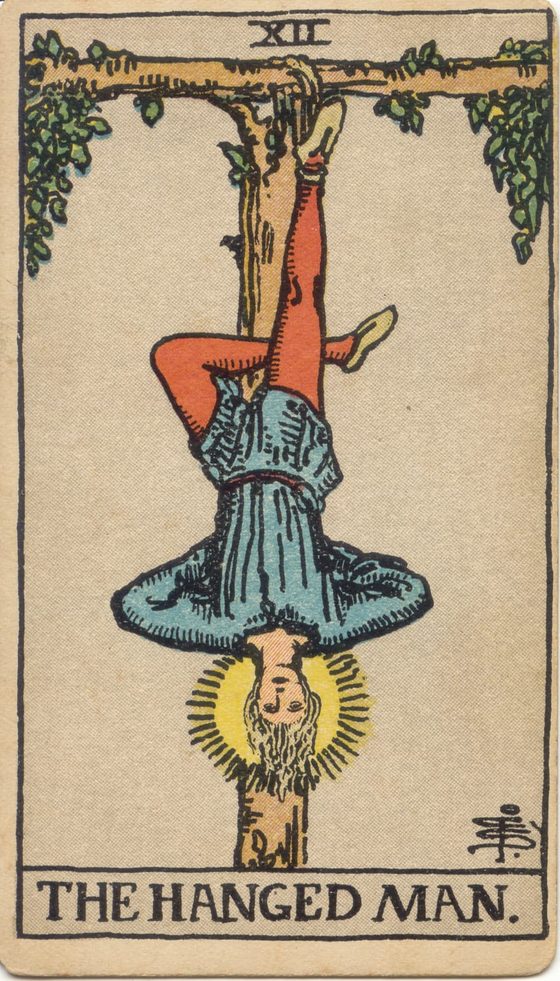
A man hanging upside down from a wooden beam by one ankle, his face calm and a halo of light around his head. The Hanged Man is the card of suspension: a pause that costs something and is not being ended.
- suspension
- pause
- new perspective
- waiting
- letting go
- stagnation
- delay
- indecision
- release
- stalling
What the card shows
A man hangs head-down from a T-shaped frame: one upright trunk running the height of the card with a single beam across the top. Both pieces are living wood, drawn with cut stubs and with green leaves sprouting at each end of the crossbeam. His right ankle is bound to the beam. His left leg is bent and crossed behind the right knee, making the shape of a figure four.
His arms are behind his back and hidden from the elbow, so that his shoulders and arms form a triangle. He wears a blue tunic with a row of buttons down the front, red hose and yellow shoes. A bright yellow nimbus of rays surrounds his head. His face is composed and his eyes are open. No ground is drawn, and the background is a plain flat wash. There is no crowd, no executioner and no sign of struggle.
Upright meaning
The Hanged Man is the card of a pause that has a price. Nothing in the picture suggests violence: one ankle is tied, the hands are behind the back, and there is nobody else in the frame. Whatever keeps him there, he is not fighting it, and the halo is the drawing's claim that the position is producing something.
Upright, it usually describes a situation the querent cannot move on their own terms and has stopped trying to. A decision that waits on someone else. A stretch between two things where nothing can be built yet. It is not passivity, because passivity has no cost, and this posture is uncomfortable, visible and expensive in time.
What the card will not tell you is how long. There is no clock in the image, and a reader who puts a number on it has invented the number. The neighbours are more useful here than the card is. Beside The Hermit the suspension is being used for something. Beside Eight of Swords it reads as somebody who believes they are stuck when they are not. Beside Death it reads as a waiting period that ends by ending.
Upright in love
In a relationship reading this is usually the card of waiting on somebody else. A decision that is not yours to make. Someone separating, someone deciding, someone not saying. The querent's part is the hanging rather than the choosing, and the card is honest that this is uncomfortable rather than serene.
It also describes voluntary suspension: a relationship deliberately put on hold, or a person choosing not to act on a feeling for reasons that are good ones. Both readings are common and the picture does not choose between them. Neither says how the situation resolves. Where the question is whether to keep waiting, the card asks a better one, which is whether the waiting is doing anything.
Upright in work
Work in a holding pattern: a hiring freeze, a decision above your grade, a project paused pending someone else's signature. The card describes the state accurately and offers nothing at all about when it lifts.
The productive version is real. Time in suspension is when people learn things they could not learn while executing. The unproductive version is equally real, and from outside the two look identical. The difference is whether the querent is using the pause or only enduring it, and usually only they know which. If nothing has been learned in three months of waiting, that itself is information worth acting on.
Upright in money
Money tied up rather than lost. Funds committed and not accessible, a payment held pending something, income paused between two arrangements. The card describes illiquidity rather than poverty, and the distinction changes how the querent should think about it.
It gives no guidance about any specific decision and should not be read as though it did. What it does raise usefully is the cost of waiting, which people routinely leave out of their arithmetic. A pause is not free. Knowing what it costs per month is worth considerably more than guessing when it ends.
Upright as feelings
Someone suspended in how they feel about you: not indifferent, not decided, and aware of the position they are in. This is more often honest than evasive. A person can genuinely not know. The card describes that state fairly without excusing how long it has been allowed to run, and it does not describe somebody stringing you along on purpose.
Upright as advice
Stop trying to force the part you do not control and put the effort into the part you do. Write down, specifically, what you are waiting for and what would tell you it had arrived. If you cannot name either, you are not waiting. You are avoiding.
Reversed meaning
Reversed, The Hanged Man goes two ways, and they are close to opposite.
The first is the end of the suspension. The thing being waited for arrives, the decision gets made elsewhere, movement returns. This reading is common and often right, and it is worth saying that the card offers no opinion on whether the resolution is welcome.
The second is suspension that has stopped being useful. The pause has become the arrangement. The querent is still hanging, still calling it patience, and nothing has come of it for a long time. This is the harsher reading and, in practice, the more frequent one.
The spread decides which, and so does an honest answer to one question: what has actually changed since this started? If the answer is nothing, the second reading applies, whatever the querent would prefer. Waite's own note on the reversal is unhelpfully brief, which has left readers to argue it out ever since, and the argument is better had case by case than settled in advance.
Reversed in love
Either a stalled relationship starting to move again, or a person who has waited so long that the waiting is now what the relationship consists of. The second is the one worth naming out loud. Reversed, this card often marks somebody who has confused endurance with commitment, and who would struggle to say what they are still waiting for if asked directly.
Reversed in work
A freeze lifting, a decision finally made, a project unblocked. Or the reverse: a role that has been temporary for two years, a promotion that is always next quarter, a person waiting for permission that was never going to be given. The reversal often marks a situation where the waiting was somebody else's convenience rather than a real process, and it is worth asking who benefits from the delay.
Reversed in money
Funds released, or the opposite: money tied up so long that the reason for tying it up has expired. The card is not advice about any particular holding. Its useful question is whether the arrangement still has a purpose or is simply what was set up once and never revisited, which is a question about attention rather than about markets.
Reversed as feelings
Someone who has come to a decision about you after a long suspension, in either direction. Or someone still suspended and now presenting that as depth of feeling rather than as indecision. The reversal is about how long it has gone on more than about what it is.
Reversed as advice
Set a date. If nothing has moved by then, treat the waiting as finished and act on what you know rather than on what you hoped to find out. Reversed, the advice here is nearly always to convert an open pause into a closed one.
Symbolism in the 1909 image
The living wood. The upright and the crossbeam are drawn as raw timber with cut stubs, and in this printing green leaves are sprouting from both ends of the beam. A gallows made from a growing tree is a contradiction, and Smith drew it that way deliberately.
The binding on the right ankle. One ankle tied to the beam. Nothing else restrains him and his hands are free behind his back. Readers who say he cannot get down are reading past the drawing, which shows a man who could and is not.
The crossed leg. The left leg bent behind the right knee, making a figure four. The same leg position appears on other cards in the deck, including court cards. It is a formal posture in Smith's visual vocabulary rather than a sign of discomfort.
The halo. A nimbus of yellow rays around the head, the standard mark of a saint in Italian religious painting. It is the card's strongest claim: that the position is producing something. It is also the element most likely to make a reader oversell the card as enlightenment.
The hidden hands. Behind the back, invisible, the arms forming a triangle. What he is doing with them is the one thing the picture refuses to show, and that refusal is the honest centre of the card.
Where this meaning came from
The Hanged Man has a specific and unglamorous ancestor. In fifteenth-century Italy a pittura infamante was a shaming picture: a debtor, traitor or fraudster painted hanging by one foot on a public wall, a punishment carried out in effigy rather than on the body. The earliest tarot versions of this card are that image, and the figure in them is a criminal.
It carried no divinatory meaning at the time, because the deck was equipment for a trick-taking game. The reinterpretation arrives in eighteenth-century France, where Antoine Court de Gebelin and Etteilla attached occult and Egyptian readings the cards had never carried.
Waite and Smith turned the traitor into a mystic. In The Pictorial Key to the Tarot (1910) Waite insists the card is about life in suspension rather than about death, adds the halo, and warns readers off the older meaning, while declining to say much about what the suspension is actually for. The distance between a shaming punishment and a saint's nimbus is the whole journey this card made in four hundred years, and the modern reading sits at the far end of it.
The common misreading
The Hanged Man is the card most often used to make a stuck situation sound spiritual. Because the figure has a halo and looks calm, readers translate nothing is happening into something profound is happening, and the querent goes away comforted rather than informed. Some suspensions are only suspensions. The halo is Waite's editorial addition, not a fact about anyone's life.
The second misreading is treating it as a card of sacrifice. That word appears in almost every modern summary and the picture does not support it. He is not giving anything up for anybody, and no beneficiary is drawn anywhere in the frame. Sacrifice implies a recipient. Suspension does not.
The third is timing, again. The card gets read as a promise that this will resolve soon, usually because both the reader and the querent would like that. Nothing in the image speaks to duration. What can honestly be said is that the position is neither permanent nor free, and that a person who cannot name what they are waiting for is probably not waiting.
Questions to sit with
- What specifically are you waiting for, and what will tell you it has arrived?
- What has actually changed since this pause began?
- What is the waiting costing you each month, and have you ever added it up?
- Which part of this is genuinely not yours to decide, and which part are you only calling that?
Pull this card in a real spread.